How to Organize Keys and Documents for a Stored Car
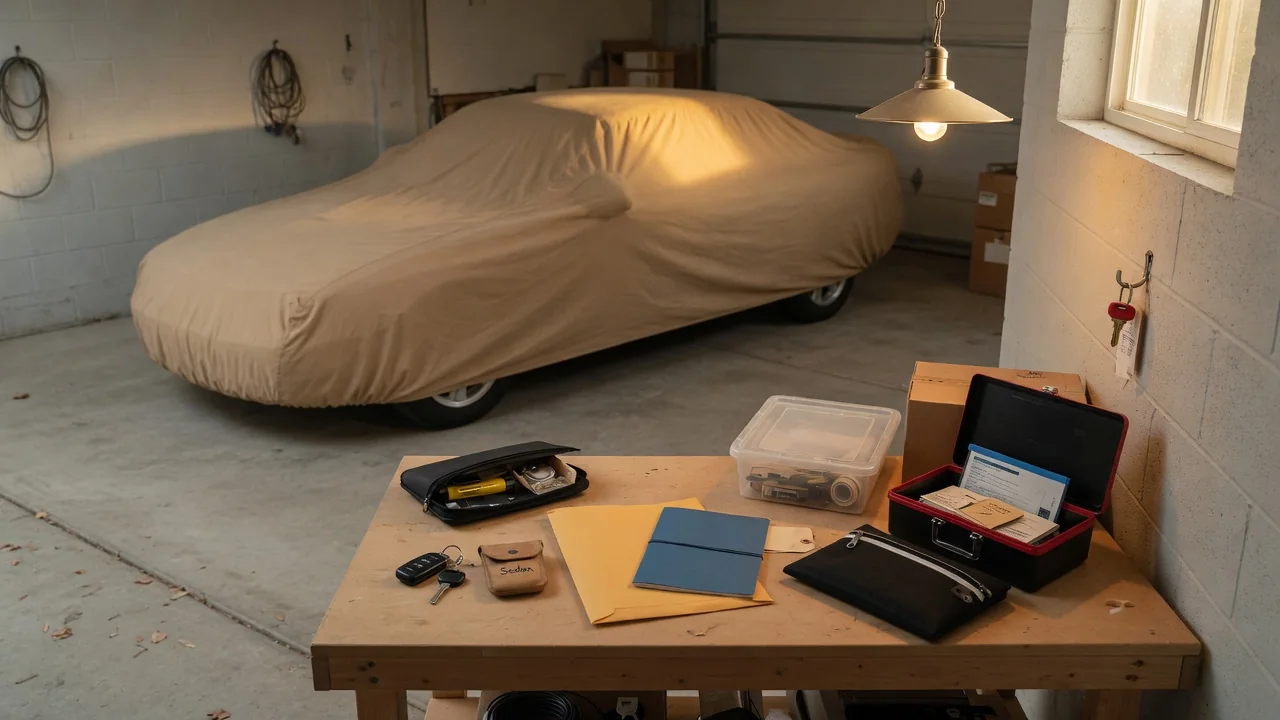
A car that sits for a season or longer still depends on items kept somewhere else: keys, fobs, the title, registration and insurance papers, and the service history. When these are scattered, getting the car back on the road takes longer, and a theft or insurance claim is harder to handle. Organizing the keys and documents for a stored car comes down to three things: a secure location, complete service records, and reliable access for you and anyone you trust.
Secure location
The first rule is to keep keys and ownership papers out of the stored car. A vehicle left with its keys in the ignition, a spare fob in the console, or the title in the glove box is easier to steal and easier to sell once stolen. Store the keys indoors at home in a locked drawer, key cabinet or small safe, not on a hook in the garage next to the car. If the car is kept in a rented unit or someone else's building, the keys should stay with you unless the facility has a specific need for them.
Keep the primary key and the spare in different places, so a single loss or burglary does not take both. With proximity fobs, distance from the car matters. Keeping them well inside the house, or in a signal-blocking pouch, reduces the chance that someone outside can relay the fob's signal to open the car. Label key tags with the vehicle description only, never with your address or plate number, so a lost key ring does not lead anyone to the car.
The title is the most important document to protect because it proves ownership. Store it in a fire- and water-resistant container at home or in a safe deposit box, together with the bill of sale and any lien release. Keep paper documents out of the garage if the space is damp or unheated, since humidity and temperature swings are hard on paper. One labeled folder or envelope per vehicle keeps everything for that car in one place.
Service records
A storage period interrupts the normal maintenance routine, and months later it is easy to forget what was done. Before the car goes into storage, write down the date, the odometer reading and every preparation step. That includes the oil and filter change, fuel stabilizer, tire pressure adjustment, battery tender or disconnection, and any rodent or moisture measures. This record shows what needs to be reversed later and helps you judge how much time has passed since each service.
Organize receipts and invoices chronologically in a binder or accordion file, and keep the owner's manual, maintenance schedule and warranty booklet with them. Many manuals list service intervals by both time and mileage, so a car that barely moves can still come due for items such as an oil change or brake fluid replacement. Your manual is the authority on what applies to your vehicle. Scanning each receipt into a backed-up folder protects the history if the paper copies are lost or damaged. A complete, orderly record also helps with warranty questions and when the car is eventually sold.
Keep a short recommissioning checklist with the keys rather than buried in the binder. It should list anything installed only for storage, such as an exhaust plug, intake cover, steering-wheel reminder tag or disconnected battery cable, along with the checks to make before the first drive. When the keys and the checklist stay together, whoever takes the car out is reminded of every step.
Access
Organization only helps if the right person can find things when you are not available. Decide who might need access during storage, such as a family member, the storage facility, a mechanic, or your insurer after a claim. Write a brief note that says where the keys, the spare, the title and the service binder are kept, and share it with one trusted person. For off-site storage, include gate codes, unit lock keys or combinations. These are part of the access set even though they do not belong to the car.
Plan for a dead 12-volt battery, which is common after long storage. On many vehicles with remote fobs, a discharged battery means the buttons will not unlock the doors, and the fob often contains a mechanical key blade for a hidden lock cylinder. The owner's manual explains where that blade and cylinder are on your vehicle. That is a good reason not to keep the only copy of the manual locked inside the car. Store the manual or a digital copy with the keys, and note the type of battery the fob uses so a weak fob does not become another obstacle.
Digital copies make access possible from anywhere. Scan the registration, insurance card, title and key service records into an encrypted folder or password manager, and add the policy number and your insurer's contact details. Copies do not replace originals for legal purposes, but they let you answer questions, start a claim or request a replacement document without returning home.
Practical implications and limits
Rules for stored vehicles are not uniform. Whether registration must stay current, whether the car must remain insured, and whether a reduced storage policy is available all depend on your state and your insurer. Before you cancel coverage or let registration lapse to save money, confirm the consequences, because reinstatement can involve fees, inspections or coverage gaps that affect a later claim. Document whatever arrangement you choose and keep the written confirmation in the vehicle folder.
On cars with immobilizers, losing keys during storage is more than an inconvenience. Replacement keys usually have to be programmed to the vehicle by a dealer or qualified locksmith, who will typically ask for proof of ownership. Having the title or registration and the vehicle identification number readily available speeds up that process. Recording the VIN, and any key code supplied with the car, in your secure notes is a low-effort safeguard.
Any system is only as good as its last update. Review the folder and key set each time the car goes into storage and each time it comes out. Replace expired insurance cards and add new receipts promptly. Owners with several stored vehicles benefit from identical folders and a consistent labeling scheme, while a single car laid up for winter may need only one envelope and a note. Match the effort to how long the car will sit and how hard its documents would be to replace.