How to Measure Cargo Space for a Real Object
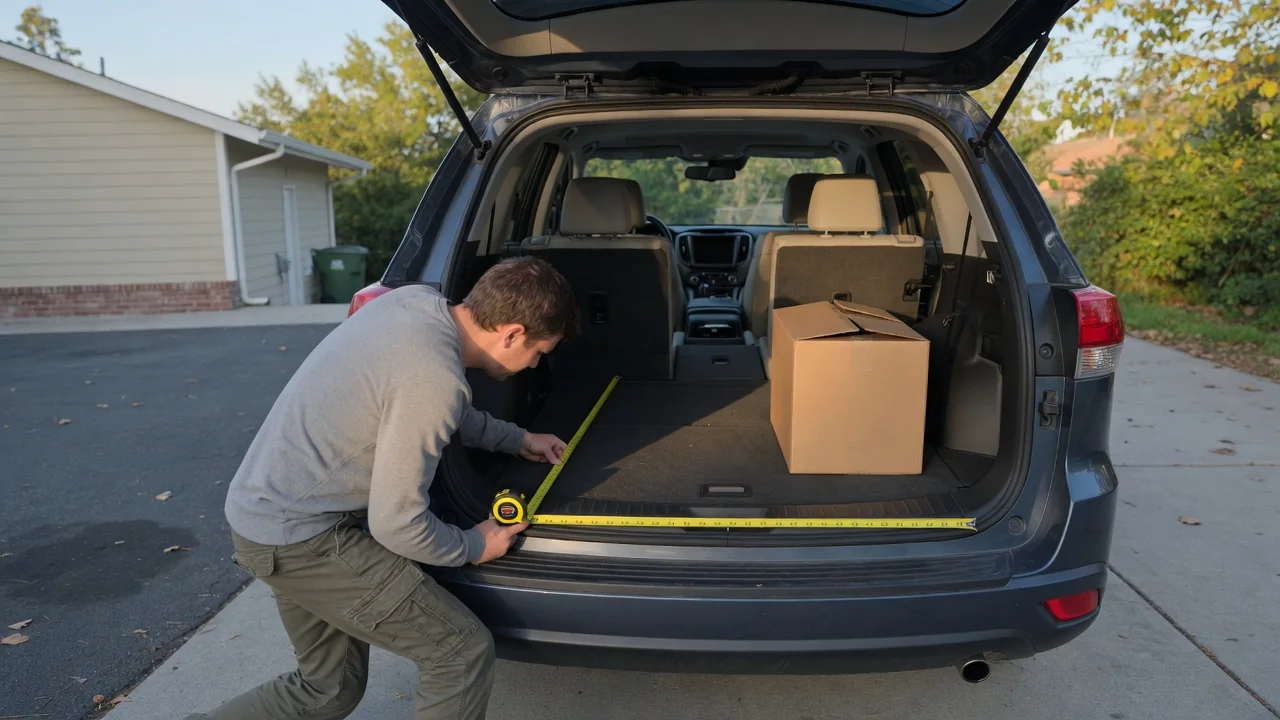
Published cargo volume tells you how much air fits behind the seats, not whether a boxed dresser or a bicycle will pass through the hatch. Learning how to measure cargo space for a real object means comparing the item's actual dimensions with the opening, the floor, and the tightest points in between. A tape measure and ten minutes usually answer the question before you load anything.
Measure object
Start with the item itself, because its true size is often larger than the label suggests. Measure length, width, and height at the widest points, including packaging, handles, legs, casters, or protruding knobs. A flat-pack bookcase may be listed by its assembled size, while the carton is longer and thinner. A boxed television is noticeably bigger than its screen diagonal implies. Write down all three figures rather than trusting memory, and note which dimension, if any, cannot be tilted or laid flat.
Shape matters as much as size. A rigid rectangular box needs its full dimensions cleared at every point along the load path, while a mattress or rolled rug can flex slightly around an obstruction. Irregular objects such as a bicycle, a wheelbarrow, or a lawn mower are best treated as the smallest imaginary box that would contain them, then refined by noting what can be removed or folded, like a front wheel or handle. Also record the weight, since a heavy item changes how you lift and position it.
Measure opening
The opening is usually the tightest part of the trip, and it is rarely a clean rectangle. On a hatchback or SUV, measure the width between the narrowest points of the liftgate aperture, which often sit at the taillight housings or latch area rather than at the floor. Then measure the height from the load lip to the lowest point of the upper frame or the raised gate itself. A sedan trunk is more restrictive still, because the lid opening is far smaller than the compartment beneath it.
Diagonal clearance deserves its own measurement. Many wide, flat objects pass through at an angle when they would not go in square, so measuring corner to corner across the opening shows whether tilting helps. Check the liftover height as well, since a tall bumper or a deep lip affects how you can pivot a long item inward. Details vary considerably between vehicles: gas struts, sloping rear glass, trim panels, and speaker enclosures all intrude differently, so measure the vehicle in front of you rather than assuming a similar model matches.
Allow room to secure
An item that fits with no margin is not truly loadable. Leave a little space on each side so you can get your hands around it, slide it without scraping trim, and close the hatch without pressing on the glass. Measure the floor length from the closed gate's inner surface to the seatbacks, not from the bumper edge, because a sloping tailgate or raked rear window takes away room near the top. Width between the wheel housings is commonly the narrowest floor dimension and should be compared with the object's base.
Securing takes space too. Locate the tie-down anchors, usually found near the floor corners in many vehicles, and confirm that a strap can reach them once the object is in place. A load pushed hard against the seatbacks with nothing restraining it can shift forward under braking, so room for straps, a cargo net, or padding matters as much as the fit itself. If the object must protrude from an open hatch or trunk, check local rules on overhang and flagging, and consider that exhaust fumes can enter the cabin.
Everyday Use and Observations
In practice, a few observations explain why the published figure and reality diverge. Volume ratings count the pockets beside the wheel wells, the space under a cargo cover, and sometimes the area up to the roof, none of which helps a single rigid box. Two vehicles with similar ratings can behave very differently: one may have a wide, square opening and a flat floor, while another has a higher number but a narrow aperture and a pronounced step where the folded seats meet the cargo floor.
Look at how the seats fold before you rely on the longer floor. Some seatbacks lie nearly level, others rest at an angle that lifts the front of a long item toward the headliner and reduces usable height. Split-folding seats let a long, narrow object such as lumber or skis run alongside a passenger. Removing the cargo cover, lowering an adjustable floor panel, or sliding the front passenger seat forward may add useful inches, though these features differ by trim and model year, so confirm them on your own vehicle.
Limits and Next Steps
Dimensions are only part of the answer. Every vehicle has a payload limit, typically shown on a placard in the driver's door area, that covers passengers and cargo together, and a compact but dense object such as bagged concrete or a stone tabletop can approach it long before the space is full. Heavy items belong low and as far forward in the cargo area as practical. A load that blocks the rear window or sits higher than the seatbacks also changes visibility and what happens in a sudden stop.
When the numbers are close, a cardboard template cut to the object's largest face is a quick way to test the opening before you buy or haul anything. If the measurements show it will not fit safely inside, the sensible next steps are a roof rack within the manufacturer's stated roof load, a trailer, a rented van or pickup, or delivery. The owner's manual is the right place to confirm load limits, anchor locations, and seat-folding instructions, because those details are specific to each vehicle.