How to Keep a Tire Pressure Log
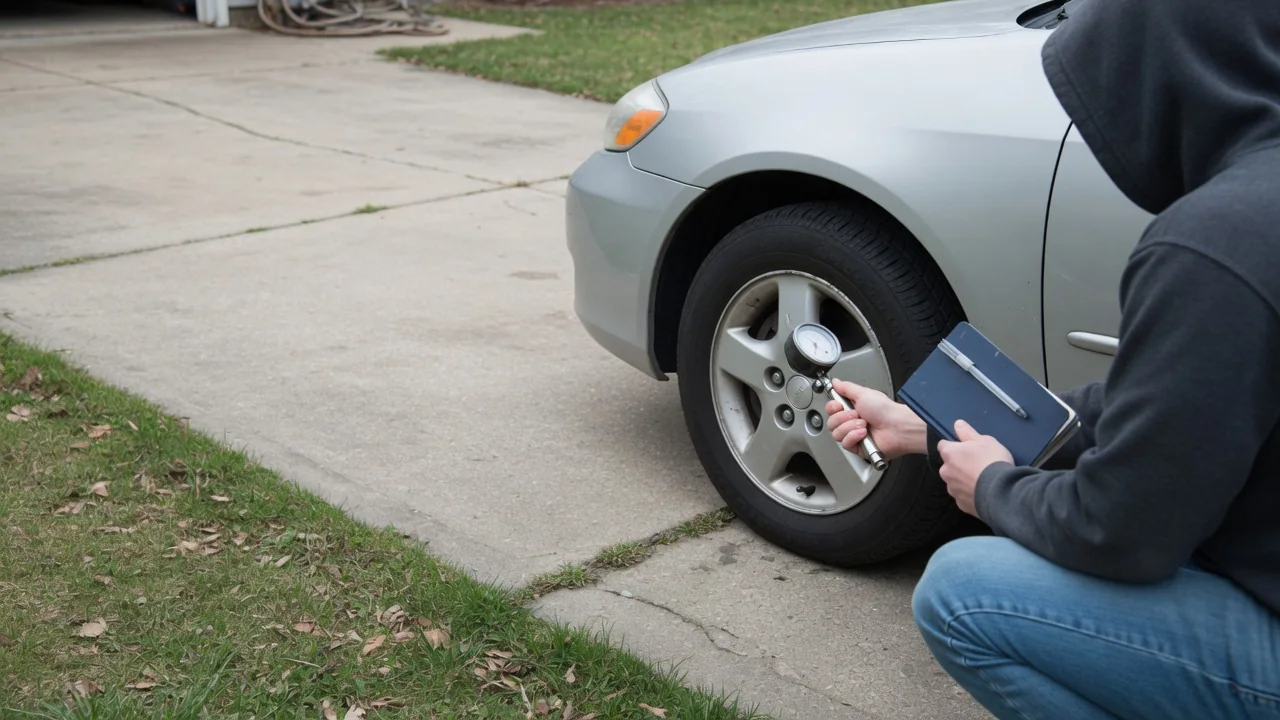
Learning how to keep a tire pressure log takes a few minutes a month and turns scattered gauge readings into evidence. A single low reading says little, but a written history shows whether one tire keeps losing air faster than the others. That pattern is the clearest early sign of a slow leak, long before a warning light appears or the tire looks soft.
Measure consistently
A log is only useful if each reading is taken the same way. Check the tires cold, meaning before driving or after the vehicle has sat for several hours, because heat from rolling raises the pressure and hides small losses. Use the same gauge every time, since two gauges can disagree slightly, and a consistent tool matters more than a perfect one. Press it squarely onto the valve stem so no air escapes during the reading.
Compare each reading against the recommended cold pressure printed on the vehicle's tire placard, usually found on the driver's door jamb or in the owner's manual, rather than the maximum figure molded into the sidewall. Some vehicles specify different pressures for front and rear axles, and a few list separate values for heavy loads, so note the correct target for each position. Check all four tires in the same order, and include the spare if your vehicle carries one that can be reached.
Record date and temperature
Every entry needs a date, because a slow leak is defined by how much pressure disappears over time. A tire that drops a few psi across three months is behaving very differently from one that loses the same amount in a week. Write down the reading for each wheel position, whether you added air, and the pressure after topping up. Without that last number, the next reading has no reliable starting point.
Outside temperature belongs beside the date. Air contracts as it cools, so pressure commonly falls by roughly one psi for every ten degrees Fahrenheit of temperature drop, and all four tires move together when weather is the cause. A cold snap in autumn can make the whole set read low without any leak at all. Noting the approximate temperature, and whether the car was in a garage or in direct sun, lets you separate seasonal change from genuine air loss.
Escalate trend
The pattern to watch for is one tire drifting away from the other three. If the left rear needs air at every check while its neighbors hold steady under the same conditions, weather is not the explanation. Repeated top-ups to the same wheel, or a gap that widens between entries, justify having that tire inspected. Common sources include a small puncture in the tread, a leaking valve core or stem, and corrosion where the bead seals against the wheel.
How quickly to act depends on the rate of loss. A tire that sheds a little air over several weeks can usually be scheduled for inspection at a convenient time while you keep it topped up. One that falls noticeably within days deserves prompt attention, and a tire losing pressure overnight should not be driven on beyond what is needed to reach help safely. Bring the log to the shop, since a documented history helps a technician decide where to look.
Everyday Use and Observations
Between measurements, ordinary driving supplies clues worth adding to the notes. A vehicle that begins pulling gently to one side, steering that feels heavier, or a tire whose sidewall bulges more than its mate on the same axle can all point to low pressure. Glance at the tread for nails or screws while you are crouched at the valve. Jotting down these observations alongside the numbers links what you feel on the road with what the gauge shows.
Many vehicles display individual tire pressures on the dashboard, while others only illuminate a warning lamp once pressure has fallen well below the recommended value. Either way, the monitoring system is a backstop rather than a substitute for a handheld gauge, because a slow leak can persist for weeks beneath the alert threshold. Displayed readings also climb as the tires warm during a drive. If you record them, mark them as such so they are not confused with cold gauge checks.
Limits and Next Steps
A log shows that air is escaping, not why. It cannot distinguish a puncture from a porous alloy wheel or a damaged bead, and it will not reveal internal damage caused by driving on an underinflated tire. Readings also carry small errors from gauge tolerance and the puff of air lost at each check. Treat differences of a fraction of a psi as noise, and look for a direction that repeats across several entries.
When the record points to one tire, the next step is a professional inspection, which typically involves examining the tread, valve, and bead area and, where needed, removing the tire from the wheel to view the inside. Whether a repair is appropriate depends on the location and size of the damage and on the tire maker's guidance, so that decision belongs with a qualified shop. Afterward, keep logging; steady readings on the repaired wheel confirm the fix has held.