How to Keep a Garage-Stored Car Accessible for Checks
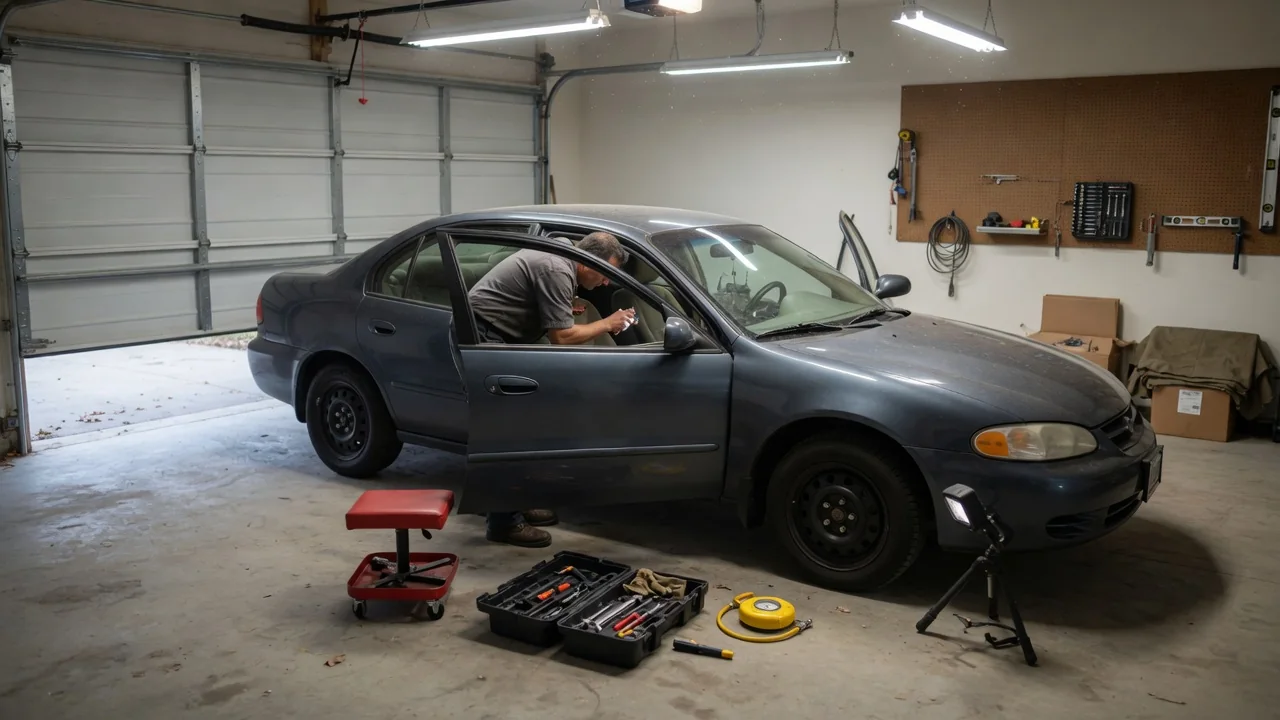
A car stored in a garage still needs regular attention. Tire pressure, fluid levels, the battery or its maintainer connection, and signs of leaks or pests all deserve a look during storage. Those checks are easy to skip when the car is boxed in by shelves, bikes, and seasonal clutter. Good car storage garage access comes down to three things: room to open the doors, room to raise the hood, and a layout that keeps every check safe.
Door clearance
Many storage checks start inside the cabin. You may need to turn the ignition on to read warning lights, start the engine if your storage plan includes it, look for condensation or musty odors, or check for signs of rodents under the seats and in the footwells. If the driver's door can only open a few inches, every visit becomes a squeeze, the door edge is likely to hit a wall or shelf, and it becomes tempting to skip the check altogether. Aim to park so the driver's door can open far enough for normal entry and exit, not just a gap to slide through.
The simplest way to find the right spot is to test it once. Park the car, open each door you expect to use to a comfortable position, and note where the edges land. Then mark the parking position with floor tape, a wheel stop, or a hanging guide so the car returns to the same place every time. Foam or rubber guards on nearby walls protect door edges if a door swings further than planned. Remember the passenger side as well if you keep documents in the glove box or need to inspect that side of the cabin.
Door clearance also depends on what happens around the car over a season. Storage bins, lawn equipment, and holiday decorations tend to drift into open floor space, and a zone that was clear in autumn can be blocked by midwinter. Treat the door swing area as a no-storage zone. If you use a car cover, leave enough room to fold it back from the door before opening it, and give the trunk or hatch the same consideration, since some vehicles place the battery or other service items in the cargo area.
Hood access
Most routine under-hood checks need the hood fully open: engine oil level, coolant in the reservoir, brake fluid, washer fluid, belts and hoses, battery terminals when the battery sits in the engine bay, and any nesting material left by mice. Overhead obstacles are the usual problem in garages. Garage door tracks, the opener rail, ceiling storage racks, light fixtures, and items hanging from hooks can all sit in the path of a rising hood. How high a hood travels varies between vehicles, so the reliable approach is to open it once in the actual parking spot and confirm nothing contacts it or forces it to stop short.
You also need room to stand at the front of the car and lean over the engine bay. Parking nose-tight against a workbench, freezer, or wall makes fluid checks awkward and forces you to reach at odd angles. Leave a clear standing space in front of the bumper, and keep in mind that the hood release is usually inside the cabin, so hood access depends on being able to open a door first. On many cars a secondary safety latch at the front of the hood must also be released by hand, which again requires standing directly in front of the vehicle.
Lighting matters more than people expect. Reservoir level marks are often molded into translucent plastic and can be hard to read in a dim garage, and dipstick markings are easier to judge under good light. Keeping a work light or flashlight within reach of the front of the car makes each check quicker and more accurate.
Safety
If your storage routine includes starting the engine, exhaust is the most serious hazard. Engines produce carbon monoxide, which can build up quickly in an enclosed space. Open the main garage door fully before starting the car, never run the engine with the door closed or only partly open, and do not leave a running car unattended in the garage. A working carbon monoxide detector in living spaces next to an attached garage adds another layer of protection. Whether to start the engine at all during storage depends on your storage plan and the vehicle's guidance; when no start is needed, this risk does not arise.
Physical hazards tend to build up around a stored car. Battery maintainer and extension cords should run along walls or overhead rather than across walking paths, and they should not be pinched by a closing door or hood. Keep fuel cans, solvents, and other flammable products stored properly and away from the car and from heat sources. When the hood is open, make sure it is fully secured by its prop rod or support struts before leaning in. Aging gas struts can lose strength and let a hood drift down, so use an additional prop if a hood no longer stays up firmly.
If the car is stored on jack stands to rest the tires, never work under it while it is supported by a jack alone, and make sure the stands sit at the support points described in the owner's manual. For cars resting on their wheels, wheel chocks are a common way to prevent rolling, and some owners prefer them to leaving the parking brake applied for long periods; follow the manufacturer's storage recommendations for your vehicle. Finally, keep a clear exit path from the car to both the garage door and the house door at all times.
Practical implications and limits
Garage space is finite, so accessibility competes directly with storage capacity. A useful way to decide is to start from the checks you actually plan to do and how often you will do them. If space is tight, prioritize the driver's door and a clear area in front of the hood, since those cover most routine inspections, and move stored items vertically onto wall shelving that sits outside the door swing and below the hood's path. In a garage shared with a daily driver, consider whether the stored car can sit in a spot that still allows door and hood access without moving the other vehicle first.
There is no universal clearance figure that fits every car or garage. Door length, hinge design, hood geometry, and the location of service points vary between vehicles. Rear-engine cars, vehicles with front trunks, and electric vehicles may put the items you need to check in different places, and some cars locate the battery under a seat or in the cargo area rather than under the hood. The owner's manual is the authoritative source for where fluids and the battery are and for any storage-specific instructions. Good access also does not replace proper storage preparation for fuel, battery, and tires; it simply makes it easier to confirm that preparation is holding up over time.