How to Judge Turning Clearance With a Trailer
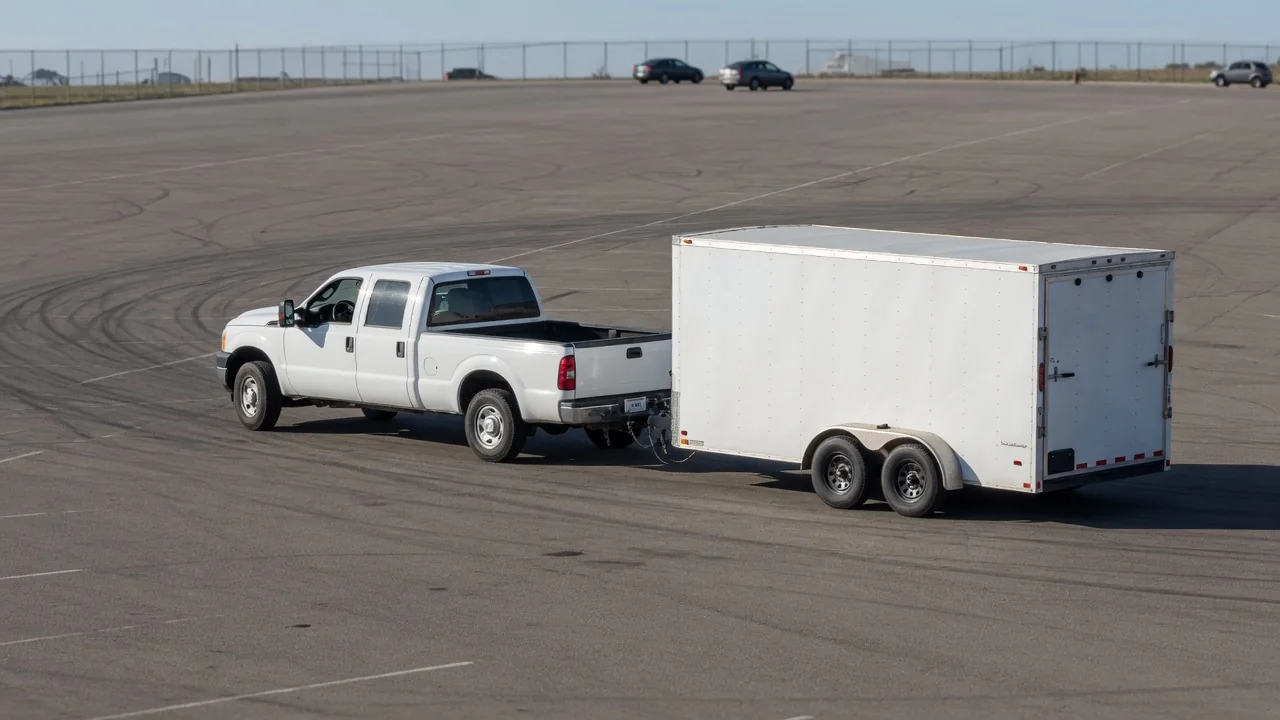
Learning how to judge turning clearance with a trailer starts with one idea: the trailer does not follow the tow vehicle's tracks. Its wheels cut inside the path of the truck, while the rear of a long trailer can swing outward. Understanding both movements, and knowing what to watch in the mirrors, makes corners, fuel stations and driveways far less stressful.
Inside path
When a tow vehicle turns, the trailer pivots at the hitch and its axles take a shortcut toward the inside of the corner. This effect is called off-tracking. The trailer wheels trace a tighter arc than the rear wheels of the truck, so a curb the truck clears comfortably can still be struck by the trailer tires. The sharper the turn and the longer the distance from the hitch to the trailer axles, the farther inside the trailer wheels will travel.
Drivers can see this in the inside mirror during a right turn at an intersection: the trailer fender drifts toward the curb as the truck straightens out. A short utility trailer follows fairly closely, while a long travel trailer or car hauler cuts in noticeably more. Fifth-wheel and gooseneck setups, with the pivot located over the truck's rear axle, track differently from bumper-pull trailers, so the amount of cut-in learned on one combination should not be assumed for another.
Wide turns
Compensating for the inside path means delaying the turn. Rather than steering as soon as the front of the truck reaches the corner, the driver pulls farther forward into the intersection so the tow vehicle begins its arc later and deeper. This gives the trailer wheels room to come around the curb, sign post or fuel pump island. The goal is a later turn-in, not a swing into the adjacent lane before the corner, which can invite another vehicle to slip alongside.
Wide turns also introduce tail swing. The portion of the trailer behind its axles moves in the opposite direction of the turn, so in a tight left turn the rear corner swings to the right. Trailers with long rear overhang, such as many travel trailers and boat trailers carrying an outboard motor, show this most clearly. Pulling away from a fuel pump or a parked car while turning sharply is a common situation in which the swinging rear corner makes contact.
Obstacle checks
Before committing to a tight turn, it helps to identify what sits on both sides of the trailer. On the inside, the concerns are curbs, bollards, drainage ditches, mailboxes and gate posts along the path of the trailer tires. On the outside, the concerns are anything within reach of the rear corner, including canopy supports, parked vehicles and walls. Height matters as well, since a trailer taller than the tow vehicle may reach tree limbs, awnings or roof overhangs the truck passes beneath.
Mirrors are the main tool during the turn itself. Glancing at the inside mirror shows the gap between the trailer tires and the obstacle, and the outside mirror shows where the rear corner is heading. If the gap is closing faster than expected, stopping is always better than hoping. In tight campgrounds or driveways, getting out to look or using a spotter standing where the driver can see them removes guesswork. Extended towing mirrors and trailer cameras vary by vehicle and may not show the whole trailer side.
Everyday Use and Observations
Daily towing provides steady feedback about clearance. Scuffed trailer tire sidewalls, marks on fenders or a trailer wheel riding up over a curb indicate that turns are starting too early. Tire tracks left on wet pavement or gravel are a simple visual: the trailer's tracks lying inside the truck's show exactly how far the combination off-tracks in that turn. Watching these patterns at a familiar corner builds a reliable sense of how far forward to pull before steering.
Practice in an empty parking lot speeds up the learning. Setting out cones or using painted lines lets a driver make slow turns at different steering angles and see in the mirrors where the trailer wheels and rear corner pass. Load and setup can change the picture, because a different trailer, a longer hitch extension, or cargo hanging beyond the rear, such as a bike rack or ladder, alters both the inside path and tail swing compared with what the driver is used to.
Limits and Next Steps
Judgment has limits. Some turns cannot be made in one sweep with a given combination, and forcing them risks jackknifing, where the trailer contacts the tow vehicle's bumper or body at an extreme angle. Short-bed trucks with fifth-wheel hitches may have limited cab clearance in tight turns, depending on hitch design and trailer shape. The owner's manual and hitch manufacturer's guidance are the proper sources for those vehicle-specific limits rather than general rules of thumb.
When a turn looks doubtful, the practical next steps are simple: slow down, stop if needed, and choose another approach, such as a larger entrance, a pull-through space or a route with gentler corners. Backing up a few feet to reset the angle is acceptable when the area behind is confirmed clear. Drivers new to a trailer can measure its overall length and rear overhang, note its height, and repeat low-speed practice until mirror checks on both sides become routine.