How to Identify Major Parts Under a Car Hood
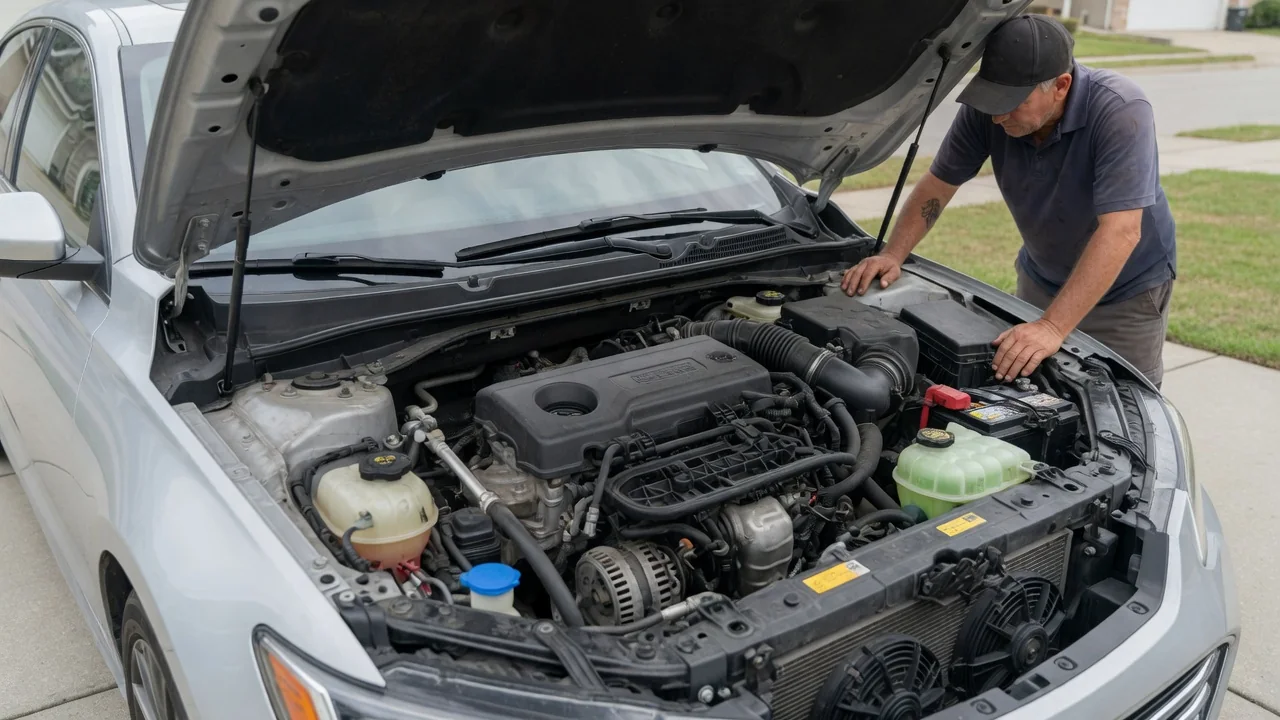
Opening the hood for the first time can feel like looking at a puzzle of hoses, covers and caps. Learning how to identify major parts under a car hood starts with a calm visual survey, done with the engine off and cool, your hands at your sides, and attention on shapes, colors and symbols rather than on anything that might be hot.
Find reservoirs and battery
Fluid reservoirs are usually the easiest landmarks because most are made of translucent white or pale plastic, letting you see the liquid level against molded minimum and maximum lines. The windshield washer reservoir often carries a cap with a windshield-and-spray symbol and typically holds blue fluid. The coolant overflow tank sits near the radiator or along a fender and connects to it by a small hose. The brake fluid reservoir is generally a smaller container mounted high on the driver's side, close to the firewall.
The battery is a rectangular box with two terminals, commonly marked with plus and minus signs, and the positive side often wears a red cover. Many vehicles place it in a front corner of the engine bay, but some manufacturers mount it in the trunk, under a rear seat or beneath a plastic shroud, leaving only remote jump-start posts under the hood. Hybrids and electric vehicles arrange things differently again, so the owner's manual diagram is the reliable guide to what sits where on your car.
Read labels
Manufacturers expect owners to check certain items, so they mark them. Caps and handles intended for routine attention are frequently colored yellow, blue or another bright shade, and they carry standardized pictograms: an oil can for the engine oil filler, a thermometer in waves for coolant, a circle with brackets for brake fluid. The engine oil dipstick usually has a looped handle in a bright color. Reading these symbols from a comfortable distance tells you a great deal before you ever reach for anything.
Look also for printed stickers on the underside of the hood, the radiator support or the strut towers. These commonly show belt routing, emissions information, refrigerant type for the air conditioning and warnings about the cooling fan or pressurized coolant. Fuse and relay boxes are black plastic housings, often labeled on the lid with a diagram inside. Wording, symbol placement and color choices differ between brands and model years, so treat the labels on your own vehicle, together with its manual, as the authority.
Know no-touch areas
Some components should be identified by sight only. The exhaust manifold, usually a metal casting or a part hidden beneath a thin heat shield on one side of the engine, stays hot long after a drive, as do the turbocharger on equipped engines and the radiator with its upper hose. The radiator or coolant pressure cap is the classic hazard: the system is pressurized when warm, and opening it can release scalding fluid. Warning text on the cap itself usually says exactly that.
Moving and electrical parts deserve the same respect. The accessory belt and its pulleys at the front or side of the engine can catch fingers, sleeves and jewelry, and electric cooling fans on many vehicles can start without warning, even after the engine is switched off. On hybrids and electric vehicles, bright orange cables indicate high-voltage circuits that should never be handled by an untrained person. Air conditioning lines, some of which are metal tubes with service caps, hold pressurized refrigerant and are likewise look-only items.
Everyday Use and Observations
Once you know the landmarks, a quick look every few weeks becomes informative. With the car parked on level ground and cooled down, you can compare washer, coolant and brake fluid levels against their marked lines without opening anything. The large black box with a wide duct leading to the engine is the air filter housing, and the big plastic cover in the middle usually sits over the engine itself. Recognizing these shapes makes it much easier to follow instructions in the manual or describe something to a shop.
Familiarity also helps you notice change. White or bluish crust on battery terminals, a damp film around a hose connection, a cracked or frayed belt edge, chewed insulation from rodents or a fluid level that keeps dropping are all things an owner can spot by eye. A phone photo taken when everything looks normal gives you a handy reference later. Layouts vary widely, with transverse engines, longitudinal engines and extensive plastic covers all changing what is visible, so expect your view to differ from generic diagrams.
Limits and Next Steps
Visual identification has clear boundaries. Knowing where a part sits does not reveal its condition, and much of what matters is hidden beneath covers, behind the engine or under the car. A low reservoir tells you fluid is going somewhere but not why, and a warning light or stored fault code points toward a system to investigate rather than proving that a particular component has failed. Brake fluid loss, repeated coolant top-ups and any fuel smell are observations to report promptly, not puzzles to solve by trial.
The sensible next step is to pair what you see with the owner's manual, which shows the engine bay layout, approved fluid types and the checks the manufacturer intends owners to perform. Adding washer fluid is typically within anyone's reach, while work involving the cooling system, brakes, air conditioning or high-voltage components belongs with a qualified technician. Bringing clear notes about what you observed, when it appeared and where under the hood it is located helps a shop diagnose the concern faster and more accurately.