How to Estimate Overnight EV Charging Needs
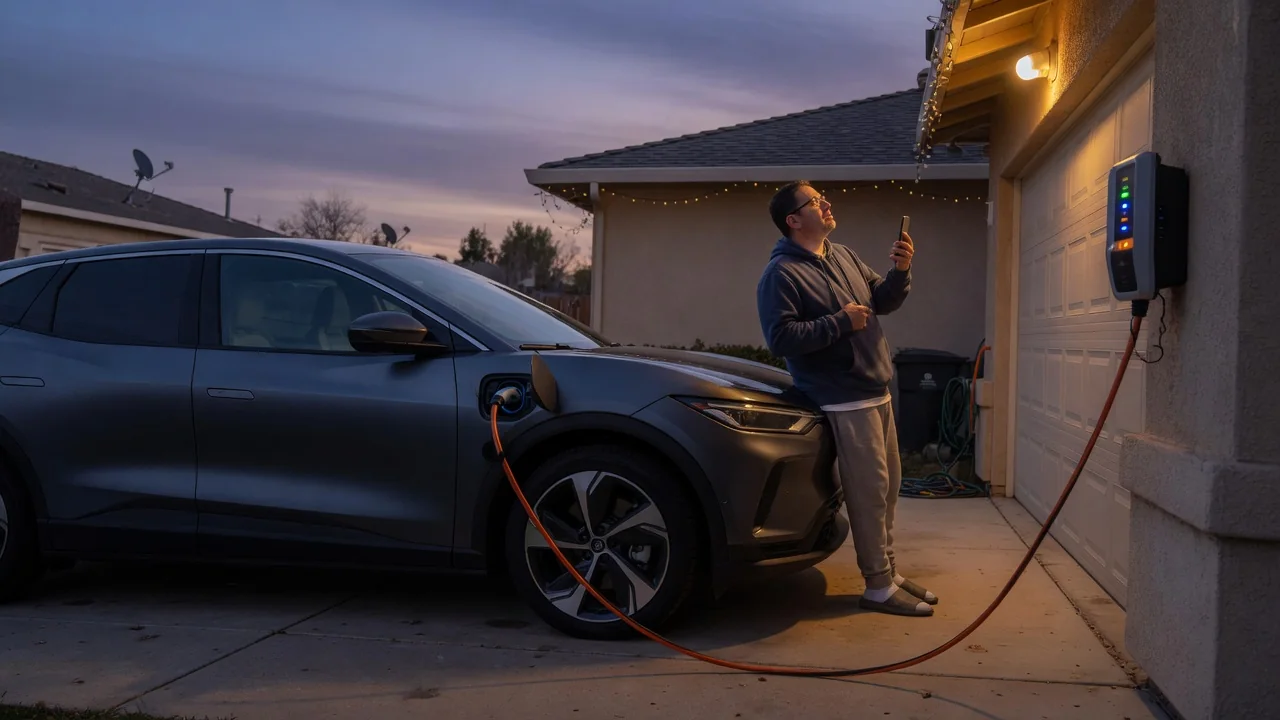
Learning how to estimate overnight EV charging needs starts with a simple shift in thinking: the question is not how big the battery is, but how much energy the day's driving removed from it. A large pack that lost only a small share of its charge needs little time on the plug, and that distinction shapes every home charging decision.
Daily energy use
Daily energy use is the product of distance driven and the vehicle's consumption, usually displayed as miles per kilowatt-hour or kilowatt-hours per hundred miles. As an illustration, a driver who covers forty miles in a car averaging roughly three miles per kilowatt-hour has used about thirteen kilowatt-hours. That figure, not the pack's total capacity, is what the charger must put back overnight. Two vehicles with very different battery sizes can need the same refill if they traveled the same route with similar efficiency.
Consumption is not fixed, so the trip computer deserves a regular look. Highway speeds, cold weather, cabin heating, roof racks, towing and heavy loads all raise energy use, while gentle suburban driving lowers it. Larger trucks and SUVs generally draw more per mile than compact cars. Most vehicles show a recent average on the instrument cluster or in a companion app, and tracking that number across a typical week gives a far more reliable basis than a rated range figure taken from a window sticker.
Charging rate
Charging rate, measured in kilowatts, determines how quickly that daily energy returns. Dividing the kilowatt-hours needed by the power delivered gives an approximate number of hours. Continuing the illustration, thirteen kilowatt-hours at a little over one kilowatt from a standard household outlet could take most of a night, whereas a 240-volt Level 2 circuit delivering several kilowatts might finish in a couple of hours. The same arithmetic applies whatever the pack size, which is why capacity alone says little about overnight adequacy.
The actual rate is set by the weakest link among the circuit, the charging equipment and the car's onboard charger, so a powerful wall unit cannot exceed what the vehicle accepts on AC. Some energy is also lost as heat in conversion and battery conditioning, meaning the wall supplies somewhat more than the battery stores. The dashboard or app normally reports live power and estimated time remaining; comparing those readings with expectations reveals what the installation truly delivers. Onboard charger capacity varies by model and trim, so the owner's documentation should confirm it.
Schedule margin
Schedule margin is the gap between the hours the car is actually plugged in and the hours the refill requires. A vehicle that arrives home at seven and leaves at seven has a twelve-hour window on paper, but a late return, an early departure or an off-peak electricity tariff that only opens late in the evening can shrink it considerably. Estimating against the shortest realistic window rather than the ideal one keeps the plan honest on the nights when it matters.
A sensible buffer also accounts for days that exceed the routine. If the charger can replace the usual energy in a third of the available window, an unexpected evening errand or a colder morning causes no trouble. If it barely finishes in time, any deviation leaves the battery short. Many vehicles allow a scheduled departure time and a charge limit, and some precondition the cabin from grid power before leaving. Those features differ between manufacturers, so the available settings should be checked in the car's menus.
Everyday Use and Observations
Over ordinary weeks, the most telling observation is whether the car reaches its set charge limit before departure. If the state of charge returns to the same target each morning, the setup is matching demand. If it creeps lower day after day and only recovers on weekends, the charging rate is lagging behind consumption. Charging history in the vehicle app, or a home energy monitor, shows the kilowatt-hours added each night and makes that pattern easy to see without guesswork.
Seasonal shifts are worth noting too. Winter often brings higher consumption and, in some vehicles, energy spent warming the battery before or during charging, so a setup that is comfortable in spring can feel tight in January. Households sharing one charger between two cars face a combined energy requirement inside the same window. Drivers with short commutes sometimes find that a basic outlet covers their needs, while those with long daily mileage see the limits quickly. Observing real nights beats any single calculation.
Limits and Next Steps
Any estimate of this kind is an approximation. Displayed efficiency figures are averages, charging power can taper as the battery nears full, and usable capacity differs from the headline number and changes gradually with age. Extreme temperatures can slow charging or increase losses in ways a simple division does not capture. For those reasons the result is best treated as a planning figure with headroom, then corrected using several weeks of the vehicle's own recorded data.
If the numbers show a consistent shortfall, the next step is to look at the rate rather than wish for a bigger battery. Options may include higher-power equipment, a dedicated circuit or a longer charging window, and public fast charging can cover occasional long days. Any change to household wiring calls for a qualified electrician, who can assess panel capacity and local code requirements. The vehicle's manual and the equipment maker's guidance remain the reference for what a particular car and charger can safely support.