How to Diagnose Parasitic Battery Drain in a Honda HR-V
What parasitic battery drain means
A parasitic battery drain is current that continues to flow after the ignition is off and the vehicle has entered its sleep state. Every modern Honda HR-V keeps a small amount of electrical load for memory functions, security monitoring, and control module standby. The problem is not that any current exists, but that the total stays high enough to discharge the battery while the vehicle is parked.
Start with the battery before blaming the drain
A weak or sulfated battery can look like a drain problem because it cannot hold a normal charge overnight. Verify that the battery is fully charged and passes a load or conductance test before spending time hunting for excessive current. Also check that the charging system is reaching the correct voltage while the engine is running, because an undercharged battery will repeatedly fail even with a normal parasitic load.
Prepare the vehicle so the modules can sleep
Modern HR-V control modules need time and the right conditions before they enter their low-power state. Close all doors and the tailgate, remove the key or keep the smart key away from the vehicle, switch off the lights, and make sure the hood latch is manually set or carefully secured so the vehicle does not think the hood is open. Allow the recommended settling time for the applicable model year and configuration before measuring.
Measure the quiescent current draw
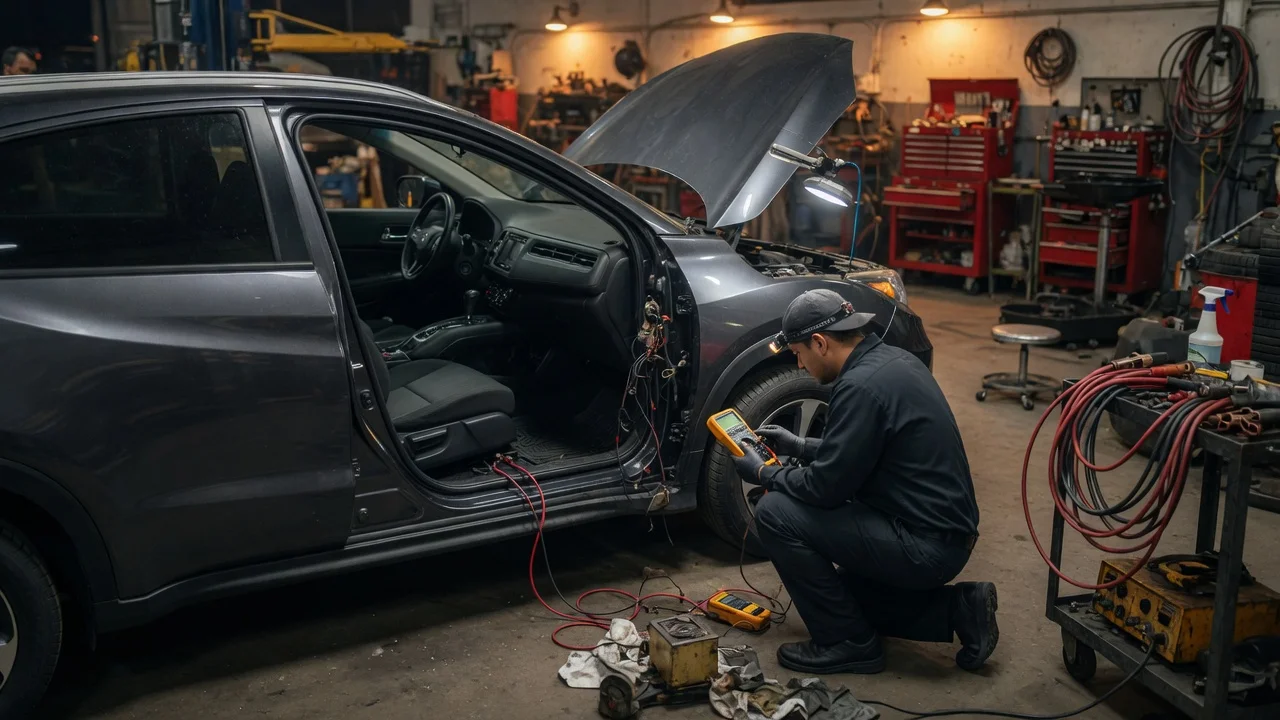
Set the multimeter to the 10 amp DC current range and connect it in series at the battery negative terminal. Remove the negative cable and connect one meter lead to the battery terminal and the other to the removed cable. If necessary, use an ampere clamp with adequate low-current resolution so that you do not disturb the vehicle repeatedly.
Vehicle asleep and settled before the test; Doors, tailgate and hood inputs closed; Interior and exterior lighting off; Multimeter fused and set to a range that can tolerate the initial wake-up current; No charger or jump pack connected during measurement
Interpret the reading
Exact acceptable limits vary by model year, market and equipment level, so confirm the specification for the vehicle being tested rather than assuming one universal number. As a practical guide, a reading below roughly 50 milliamps is likely acceptable on many vehicles, while a settled reading well above that indicates a real drain. The most useful evidence is the difference between the measured value and the applicable specification, not a single reading taken too early.
Identify the circuit that is staying awake
With the vehicle asleep and the meter still connected, measure the small voltage drop across each fuse in the interior and under-hood fuse boxes. A current flowing through a fuse creates a measurable drop across its test points. The fuse showing a meaningful drop narrows the drain to a circuit, after which you can inspect the components and wiring on that circuit for the cause.
Common causes and how to separate them
The reading identifies how much current is flowing, but it does not by itself name the defective component. Aftermarket accessories such as dash cameras, phone chargers, amplifiers or tracking devices are common causes because they may remain powered directly from the battery or from a circuit that stays active longer than expected.
Other possible causes include a glove box, cargo or interior lamp that remains on without being visible, a control module that fails to enter sleep, or a relay or switch that continues to operate. Pulling a fuse only confirms which circuit carries the drain; it does not prove that a particular module on the circuit is defective. Remove the suspected accessory and retest before replacing an expensive electronic component.
Checks that prevent false results
Avoid opening a door to reach a fuse panel during the test, because that can wake the vehicle and change the reading. Plan access to both fuse boxes before the vehicle sleeps. If a fuse supplies several modules, use the wiring information for the applicable model year and configuration to divide the circuit logically rather than guessing.
Some systems wake periodically or maintain communication for a limited time after the ignition is turned off. A single brief spike may be normal, so wait for the vehicle to settle again after each disturbance. If the drain returns only after the vehicle has been locked or after a set period, repeat the test under those exact conditions.
What the result does and does not prove
A high settled current draw supports a parasitic drain diagnosis. Isolation through fuse voltage-drop testing narrows the problem to a circuit. It remains necessary to inspect the wiring, connectors, switches and components on that circuit to find the actual cause before replacing parts.
Where the applicable specification, settling time or fuse assignment is unknown for a specific HR-V model year or market, treat the finding as useful evidence rather than a complete diagnosis. Confirm the vehicle-specific values from the relevant technical information before concluding that a reading is out of specification.