How to Clean Salt Stains From Car Floor Mats
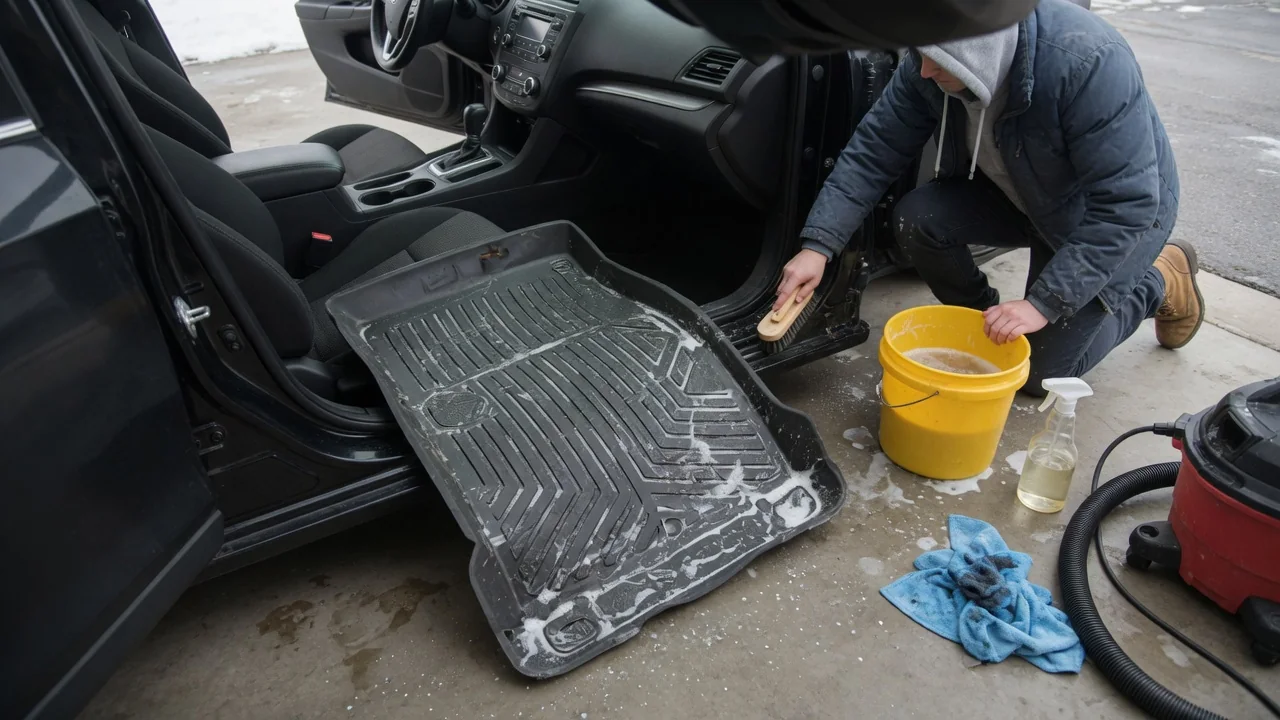
Winter road salt rides into the cabin on boots, melts into the mat fibers, and dries as a chalky white crust. Learning how to clean salt stains from car floor mats comes down to two ideas: dissolve the residue so it can be lifted out, then dry everything thoroughly so the minerals and moisture do not return. The approach differs slightly for carpet and rubber mats.
Remove mats
Taking the mats out of the vehicle is the first step because salt needs water to dissolve, and that water should not soak into the carpet and padding underneath. Working on a driveway or garage floor lets you flush and rinse freely without wetting seat tracks, wiring, or sound insulation hidden below the floor. Before lifting, note how each mat is secured. Many vehicles use hooks, twist locks, or snaps on the driver side, and their design varies by manufacturer and model year.
Lift each mat carefully and keep it level so loose grit and salt crystals do not spill onto the floor carpet. Shake or tap the mat outdoors, then vacuum it dry before adding any liquid, since loose crystals removed now are crystals that never have to be dissolved later. While the mats are out, look at the carpet beneath. A white ring or stiff, crunchy patch there means brine has wicked through or run past the mat edges, and that area will need its own attention.
Clean solution
Salt residue is water soluble, so the cleaning solution does not need to be harsh. Warm water does most of the work, and many owners mix it with white vinegar, often in roughly equal parts, because mild acidity helps loosen the mineral film that plain water sometimes leaves behind. A dedicated carpet or upholstery cleaner labeled for automotive interiors is another option. Whichever you choose, test a small hidden corner first, since dyes and backing materials differ between factory and aftermarket mats.
On carpet mats, mist the stained area until it is damp rather than flooded, let it sit for a few minutes so the crust softens, then work it with a soft brush. The key move is blotting with a clean towel or extracting with a wet vacuum, because scrubbing alone only spreads dissolved salt through the pile. You may see the towel pick up a gray or cloudy tint. Rubber and all-weather mats are simpler: scrub with soapy water, paying attention to the grooves, and rinse thoroughly.
Dry completely
Drying matters as much as washing, because salt stains reappear through evaporation. As a damp mat dries, moisture travels upward and carries any remaining dissolved salt to the tips of the fibers, where it is left as a fresh white haze. Pressing dry towels firmly into the carpet, or making several slow passes with a wet vacuum, removes that salty water before it can migrate. If a faint ring returns once the mat is dry, a second light treatment usually takes less effort than the first.
Hang mats or lay them flat in moving air, and give thick carpet mats more time than they seem to need, since the dense backing holds moisture long after the surface feels dry. Press a hand or a paper towel against the underside to check. Avoid high heat from heaters or dryers, which can warp rubber backing or curl molded edges. Putting a damp mat back traps moisture against the floor, which encourages musty odors, fogged windows, and eventually corrosion on the metal beneath the carpet.
Everyday Use and Observations
In daily winter driving, the pattern of staining tells you where to focus. The driver's mat usually shows the heaviest buildup near the heel pad by the pedals, where a boot rests and meltwater pools. Rear mats often stain along the edges closest to the doors. Darker carpet shows the white crust clearly, while light gray or beige interiors can hide it until the fibers feel stiff or gritty to the touch, so checking by feel is worthwhile.
Small habits reduce how often a full cleaning is needed. Knocking snow off boots before getting in, emptying pooled water from deep-channel rubber mats, and vacuuming dried crystals every week or two all keep brine from concentrating. Some drivers swap carpet mats for rubber or all-weather liners during the cold months and store the carpet set clean and dry. After refitting any mat, confirm it is locked on its retainers and sits clear of the pedals, because a mat that slides forward is a safety hazard.
Limits and Next Steps
Home cleaning has limits. Salt left in place for several seasons can bleach dye or leave fibers brittle and flattened, and no solution restores color that is gone. Repeated soaking can also separate the backing on older mats. If the white marks keep returning after two or three careful rounds of dissolving and extracting, the salt is probably deep in the backing, and a professional hot water extraction or simply replacing the mat becomes the more practical choice.
The next step is checking what lies under the mats. If the vehicle's fixed carpet is stained, the same dissolve, blot, and dry method applies, but use far less liquid, because the padding underneath is slow to dry and some vehicles route wiring or modules below the floor. Carpet that stays wet, smells musty, or gets damp without an obvious source of tracked-in snow suggests a water leak rather than a salt problem, and that deserves inspection by a qualified shop or detailer familiar with your model.