How to Choose a Subaru Outback Engine Air Filter
The short answer
A Subaru Outback engine air filter is the replaceable element inside the engine airbox. It traps dust, pollen, and grit so cleaner air reaches the engine. Choose a filter that matches your Outback’s model year, engine, and market first, then pick the media type that fits how you drive and how you want to service it. For most owners the factory-style disposable paper (or equivalent dry cellulose) filter is the straightforward choice: it is designed for the airbox, the mass airflow sensor, and the scheduled-maintenance approach Subaru documents for that vehicle. Other media types change the balance among particle capture, airflow, cleaning versus replacement, and the risk of contaminating the airflow sensor. Fitment is not universal across Outback generations.
What this part does, and what it is not
The engine air filter sits in a sealed airbox in the engine bay, upstream of the intake tract and the mass airflow (MAF) sensor. Incoming air must pass through the filter media before it is measured and mixed with fuel. A clogged or poorly sealing filter can restrict airflow, let unfiltered air bypass the media, or leave debris in the airbox. It is a different part from the cabin air filter, which treats air entering the passenger compartment through the HVAC system. Buying or servicing the cabin filter does not address engine intake filtration.
Confirm the vehicle before you compare brands
Outback engine air filters change with generation, engine, and sometimes market equipment. Treating “Outback” as a single part number is a common mismatch. Identify the vehicle by model year, engine, and trim, then confirm the catalog listing against the airbox you actually have. A VIN-based parts lookup or the filter specification in the owner’s maintenance material is the reliable path. Visual match of an old filter is useful only after you know that filter was the correct one for that airbox.
Model year and generation: body and airbox designs change across Outback generations, so a filter that seats in one year may not seal in another. Engine: naturally aspirated 2.5-liter boxers, earlier 3.6-liter six-cylinder engines, and later turbocharged 2.4-liter engines used on some XT and Wilderness models do not share one intake layout. Market and equipment: emission and equipment packages can alter the airbox or the listed service part; a listing for another region is not automatically correct. Physical check: the element should fill the airbox tray, sit flat on the sealing surface, and allow the lid to close without crushing the media or leaving a gap.
Exact Subaru part numbers, interchange lists, and replacement intervals are not supplied in this guide and vary by year and market. Use the owner’s manual maintenance schedule and a parts source keyed to your VIN. Do not copy a part number from a different engine, a Forester or Legacy listing, or an unlabeled online photo.
The options that actually differ
Once fitment is fixed, the remaining choice is media and service method. Compare only filters sold for the same year, engine, and airbox. Brand names, flow claims, and prices from mixed vehicle applications are not comparable. The practical split is disposable paper-style elements versus reusable oiled or dry aftermarket elements.
Option How it is serviced What it is built for Main trade-off; OEM or equivalent disposable paper Replace at the interval or inspection result in the maintenance schedule Stock airbox seal, particle capture, and MAF-friendly dry media Ongoing replacement cost; little owner upkeep; Aftermarket paper or dry synthetic, same shape Usually replace like the OEM element Same job as stock, sometimes with a different pleat count or media blend Quality varies by maker; confirm it is listed for your exact airbox; Reusable oiled cotton Clean, re-oil, and reinstall on the maker’s schedule Marketed for more airflow and long-term reuse Over-oiling can foul a MAF sensor; cleaning adds time and chemicals; Reusable dry performance media Clean without oil, following the maker’s kit Reusable service without oil in the airstream Still must seal in the Subaru airbox; filtration versus flow is a design compromise
Decision criteria that matter on an Outback
Fit and seal come first. An element that is slightly short, warped, or missing the correct sealing bead can let dirty air around the media even if the brand is well known. After fit, weigh filtration, driving dust load, MAF compatibility, and how you will actually maintain the part.
Filtration versus flow: paper and many dry synthetics are chosen to capture fine dust. Performance cotton is often sold on airflow. Higher advertised flow is not automatically better for a street Outback; unfiltered dust is harder on the engine than a clean stock-style element. Independent efficiency numbers are not supplied here, so treat marketing flow figures as incomparable unless they share a test standard, dust type, and restriction point. Driving conditions: dusty roads, construction, pollen-heavy seasons, and off-pavement use load a filter faster. In those conditions a high-capture disposable element, inspected more often, is the conservative match. Mostly highway commuting in clean air is less demanding, which is where a quality equivalent paper filter is usually enough. MAF sensor: Subaru Outback engines use a mass airflow sensor in the intake. Oil from an over-oiled reusable filter can coat that sensor and disturb the reading. If you choose an oiled filter, follow the cleaning kit amounts exactly and keep oil off the downstream side. A dry OEM-style or dry synthetic element avoids that oil path. Warranty and service records: some powertrain warranties and dealer service lanes expect the specified service part or an equivalent that does not modify the intake. A reusable filter does not by itself void a warranty in every jurisdiction, but damage tied to a non-specified filter can become a dispute. Keep receipts and follow the vehicle’s maintenance schedule. Cost over time: a cheap paper filter that is replaced on schedule is simple. A reusable filter costs more up front and only pays back if you complete the clean-and-reinstall cycle correctly. Skip reusable media if you will not service it. Noise and drivability: some open or high-flow setups change intake sound. That is not a measure of a healthier engine. Keep the airbox lid and ducts in place unless you are following a complete intake design that still meters air correctly.
Which choice fits common use
If you want the least guesswork, buy the Subaru-listed engine air filter or a major-brand equivalent sold specifically for your year and engine, and replace it when the maintenance schedule or a visual inspection says to. That pairing matches the airbox, stays dry at the MAF, and keeps service ordinary.
If you drive in heavy dust and still want a disposable element, stay with a high-capture paper or dry synthetic of the correct shape and shorten the inspection interval rather than switching media types on a claim of “more air.” If you prefer a lifetime element and will follow a cleaning kit, a dry reusable listed for that airbox reduces MAF oil risk compared with an oiled cotton filter. Choose oiled cotton only if you accept the extra care around oil quantity and sensor contamination.
Performance or “high-flow” filters are a fit only when they still seal in the stock airbox (or in a complete intake sold for that engine) and you have a reason to change restriction, such as a documented intake package. They are not required for normal Outback use, including typical highway and light unpaved driving. Do not mix a filter from a different Subaru model even if the outline looks similar.
How to choose in order
Read the engine and model year from the vehicle, not from memory of a previous Outback. Look up the engine air filter in the owner’s documentation or a VIN-matched parts catalog. Note whether your trim uses a turbo engine; those airboxes differ. Inspect the current element and the airbox sealing surface. A crushed, wet, oil-streaked, or rodent-damaged filter still tells you the correct outline, but replace it rather than cleaning a paper element. Select media: disposable paper or dry equivalent for standard ownership; dry reusable if you will service it; oiled reusable only with strict oil control. Buy one unit listed for that year and engine. Avoid “universal” panels that must be cut or wedged. After installation, confirm the lid latches evenly, no foam or paper is pinched, and there is no whistle or unmetered-air symptom on a short drive. Recheck the airbox if the engine light, rough idle, or sudden fuel-trim behavior appears after a filter change.
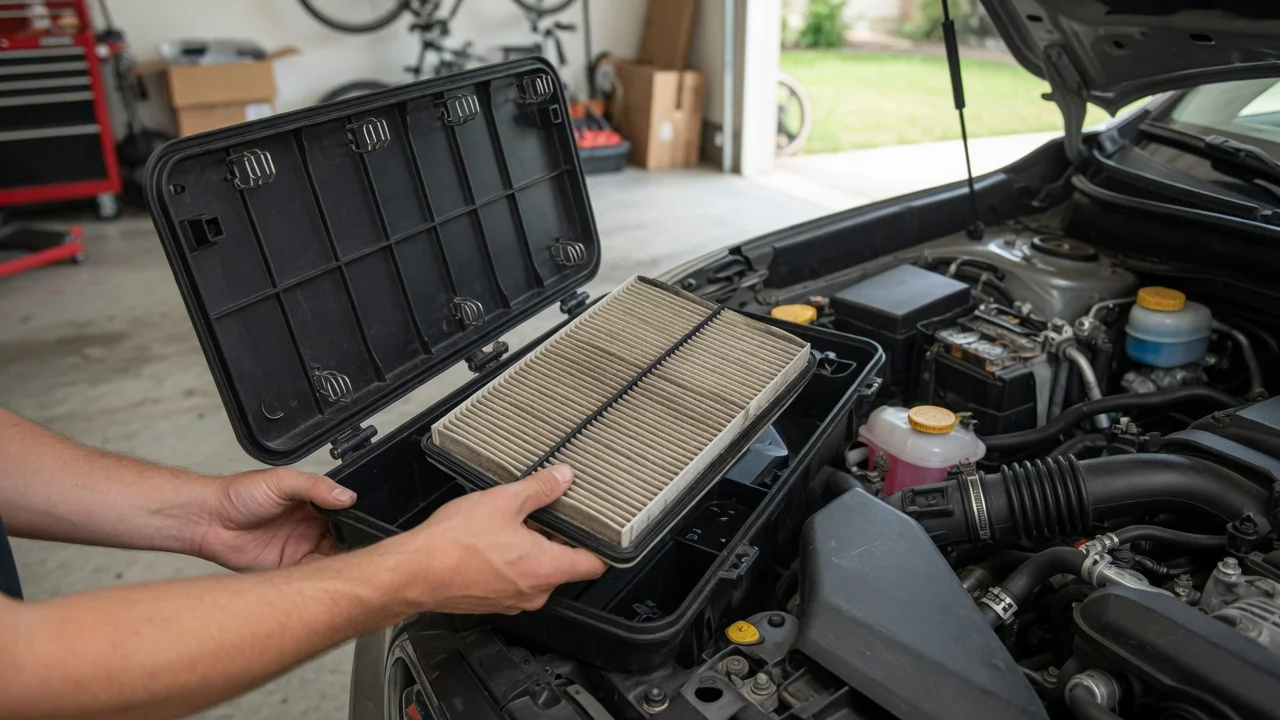
Replacement itself is usually an under-hood airbox job: open the clips or screws, lift the lid, swap the element, and reseal. Torque values, clip counts, and any intake-duct precautions are vehicle-specific and are not validated here. If the airbox is cracked, the lid will not latch, the intake hose is split, or you are not sure the new element is the listed part, stop and use qualified service rather than forcing a mismatch.
Limits of this guidance
This article does not list Subaru part numbers, prices, test efficiencies, or mile- or kilometer-based change intervals, because those figures depend on model year, market, engine, and the maintenance schedule that applies to that vehicle. Claims about horsepower, fuel economy, or filter life from mixed tests are omitted for the same reason. Legal warranty rules vary by jurisdiction; this is not a warranty determination. When the catalog, the airbox, and the old filter disagree, treat the VIN-matched listing and a physical seal check as the authority, not a generic “Outback air filter” search result.