How to Choose a Subaru Forester Engine Air Filter
The short answer
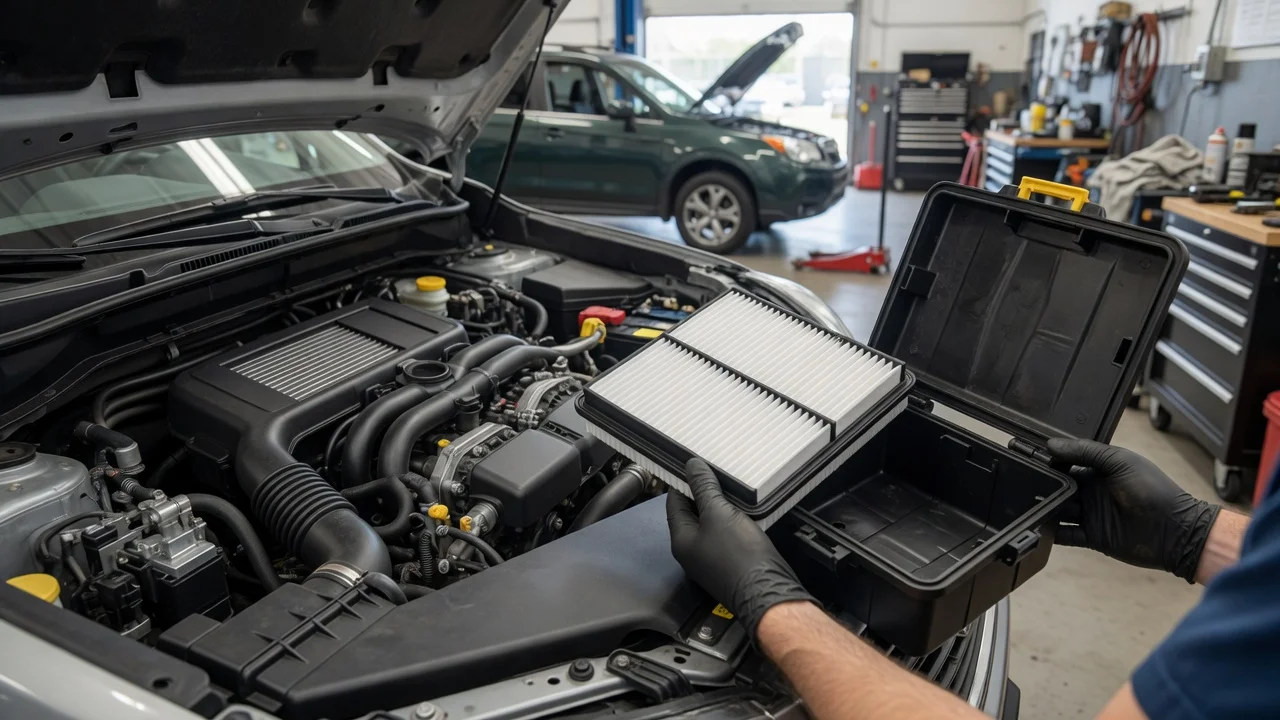
A Subaru Forester engine air filter is the replaceable panel inside the engine airbox that traps dust, pollen, leaves, and road grit before intake air reaches the throttle body, mass airflow sensor, and combustion chambers. The right choice is the filter that seals in your specific airbox and uses a media type that matches how you drive. Fitment comes first: year, engine, and airbox shape decide the part. Media type comes second: stock-style paper or synthetic for most street use, a higher-capacity disposable filter for dusty roads, or a high-flow design only if you accept more upkeep and a different filtration trade-off.
That answer changes with model year, engine, and market. Foresters have used several boxer engines across generations, including naturally aspirated 2.5-liter fours, turbocharged 2.0-liter fours on XT and some Wilderness models, and hybrid powertrains in some years and regions. Each combination can use a different panel size, sealing lip, and Subaru part number. The engine filter is also not the cabin filter: the cabin filter cleans air for the heater and air-conditioning system and lives in a different housing, usually in the cowl or behind the glove box.
Confirm fitment before you shop
An engine air filter only works if its frame and rubber or foam gasket fill the airbox opening. A near-fit panel that rattles, sits proud, or leaves a gap lets unfiltered air bypass the media. That dirt can wear cylinders and contaminate the mass airflow sensor. Shopping by “Forester air filter” alone is not enough; shop by the vehicle’s year, engine, and the number printed on the old filter or in a Subaru parts listing for that VIN.
Record the model year, trim, and engine from the driver’s door sticker and the owner’s manual. Note turbo, Wilderness, or hybrid equipment if fitted. Read the part number on the old filter’s plastic frame. Cross-check it against a Subaru dealer parts catalog for your VIN rather than assuming one number covers every Forester. Compare the replacement’s length, width, thickness, and sealing lip to the old panel before you install it. The new filter should sit flat and compress the gasket evenly when the airbox lid is latched. If you cannot open the airbox yet, use the VIN with a parts lookup. Do not treat a listing for a different year or engine as interchangeable.
There is no single OEM part number for every Forester. Published numbers change by generation and sometimes mid-cycle. This guide does not list those numbers because they are vehicle-specific and would be wrong for many readers. Treat the owner’s manual maintenance schedule and a VIN-matched parts catalog as the authoritative sources for the exact part and the inspect-or-replace interval.
Filter types compared
Once the shape is correct, the remaining decision is media. The types below share the same job and the same airbox, but they differ in how finely they filter, how freely they flow, and how you maintain them. Figures for efficiency, restriction, and price vary by brand and test method, so the comparison is qualitative. Use it to match a type to your constraints, then pick a specific product that states compatibility with your year and engine.
Type Filtration Airflow Upkeep Best fit; OEM Subaru paper panel Designed for the stock intake and engine management Stock calibration; adequate for a stock Forester Disposable; replace on the schedule or when dirty Daily driving and warranty-minded ownership; Quality aftermarket paper or dry synthetic equivalent Similar role to OEM when the panel is the correct shape Typically similar to stock Disposable; same replacement habit as OEM Same use as OEM at a lower parts cost, if fit and seal match; High-capacity disposable (severe-dust designs) More dust-holding volume in a stock-style panel Still a paper or synthetic panel, not a race filter Disposable; inspect more often in dust Dirt roads, gravel, pollen season, or dusty climates; Oiled cotton reusable (high-flow) Generally trades some fine-particle capture for less restriction Higher flow potential on a modified intake Wash, dry, and re-oil on the maker’s schedule Enthusiasts who will service it correctly; Dry reusable performance media Aims for extra flow without oil Higher flow potential than stock paper Clean per the maker; no oil on the element Drivers who want more flow but want to keep oil off the sensor
The practical trade-off is filtration versus flow versus maintenance. Stock-style paper and quality equivalents favor fine filtration and a simple replace-and-forget habit. That pairing suits a boxer engine that already runs a mass airflow sensor in the intake tract. Oiled reusable filters can flow more, which some owners want on a turbo Forester or a modified intake, but over-oiling can foul the sensor and cause rough running or a check-engine light. Dry reusable media avoids that oil risk while still asking you to clean the element instead of throwing it away. Cheap no-name panels are the weak option in every column: poor seals, uneven pleats, and media that sheds or collapses are more expensive than a known brand once you count engine wear.
Independent lab rankings, restriction graphs, and dollar prices are not included here. Those numbers are brand-, batch-, and test-standard-specific, and they do not transfer cleanly from one listing to another. If a seller quotes a capture percentage or a horsepower gain, treat it as a claim for that product under that test, not as a universal Forester result.
Which option fits how you use the Forester
For mixed street and highway use on a stock engine, an OEM Subaru panel or a well-reviewed equivalent from a filtration brand is the default. It preserves the intake seal Subaru designed, it matches the service habit in the maintenance booklet, and it does not ask you to wash or oil anything. Choose this path if you want the least guesswork and you are not chasing intake flow.
For dirt roads, construction dust, agricultural areas, or a Wilderness-style mix of gravel and trail, stay with a disposable panel and inspect it more often than the mild-service interval. A high-capacity stock-shape filter is a better match than a high-flow oiled filter in heavy dust, because the job is holding grit, not lowering restriction. Replace the panel when the pleats are caked, darkened through, or starting to collapse. Severe-service schedules in the owner’s manual, when present for your year, override a “replace only at the standard mileage” habit.
For a turbocharged or modified Forester where intake flow is a stated goal, a dry high-flow panel in the correct airbox shape is the more cautious performance choice. An oiled reusable filter can be used if you follow the cleaner and oil quantity exactly and keep oil off the mass airflow sensor. Neither type replaces a properly sealed airbox. A filter that does not clip into the stock housing, or an open cone that leaves the factory box, is a different intake design with its own water-ingestion and debris risks; it is not a drop-in “choice of filter” for a stock Forester.
In the United States, the Magnuson-Moss Warranty Act generally lets you use a quality aftermarket filter without voiding the new-vehicle warranty. A manufacturer may still deny a related claim if it can show that a poor-fitting or oil-contaminated filter caused the failure. Other countries follow different warranty rules. Keep the receipt and the old part if a dispute is possible, and use the correct panel for the airbox rather than a universal filter.
Stock daily driver, any recent Forester: OEM or equivalent disposable panel, VIN-matched. Dust, pollen, or unpaved roads: stock-shape disposable with more frequent inspection; skip oiled media. Turbo or modified intake, willing to service the filter: dry high-flow panel that still seals in the factory airbox. Lowest purchase price only: still buy a named filtration brand in the correct size; a gap around the frame costs more than the savings. Unknown year or engine: stop and identify the vehicle before ordering. Guessing the panel is the most common buying error.
Limits of this guide
Replacement mileage, exact Subaru part numbers, panel dimensions, and current prices depend on model year, market, and engine, and they are not verified here for every Forester. Read the maintenance schedule in your owner’s manual for inspect-and-replace timing, and confirm the part against a VIN-based Subaru listing or the number on the filter already in the airbox. If the airbox lid is cracked, the snorkel is missing, or the gasket will not seal, replacing the panel alone will not restore filtration; that is a housing repair, not a filter choice.