How to Choose a Subaru Engine Air Filter
The short answer
Choose a drop-in engine air filter that matches your Subaru’s model year, market, and engine, then pick the media that fits how you drive. For most street cars, a quality paper or dry synthetic panel that seals in the factory airbox is the sound choice. A high-flow oiled or dry reusable filter is a trade-off: more airflow potential and a washable element, against more owner maintenance and, with oiled media, a risk of contaminating the mass-airflow (MAF) sensor if the filter is over-oiled. An electric Subaru such as the Solterra has no engine air filter; this guide applies to gasoline models with an intake airbox.
What the engine air filter is
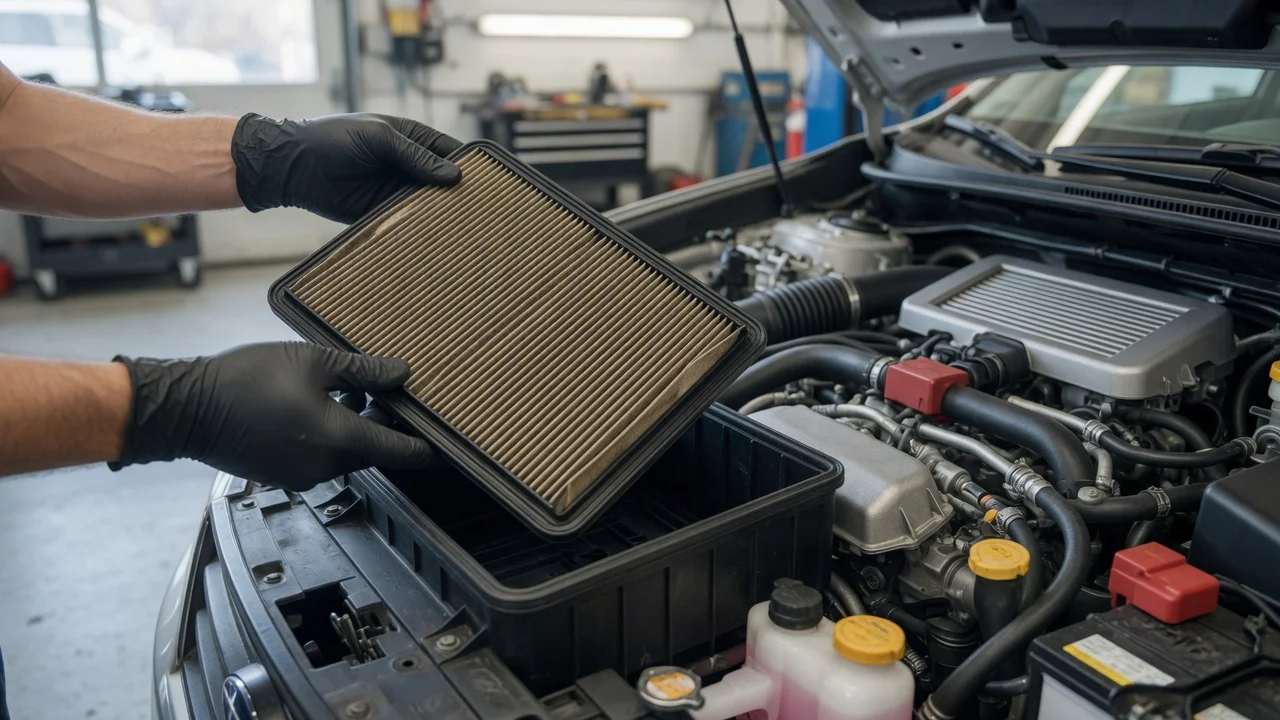
The engine air filter sits in the intake airbox and traps dust, leaves, and grit before they reach the throttle body, intake tract, and cylinders. It is a different part from the cabin air filter, which cleans air for the heating and air-conditioning system. Subaru boxer engines typically use a rectangular panel filter in a sealed plastic box with an inlet snorkel. A filter that is the wrong size, the wrong thickness, or poorly sealed lets dirty air bypass the media, which matters more than the brand printed on the frame.
Match the car before you compare products
Fitment is vehicle-specific. A Forester, Outback, Impreza, Crosstrek, Legacy, Ascent, WRX, or BRZ can use different airbox shapes and filter dimensions depending on year, engine code, and whether the engine is naturally aspirated or turbocharged. Markets also differ: a part that fits a U.S.-spec car may not fit the same nameplate sold elsewhere. Use the year, model, engine, and VIN or the existing filter’s Subaru part number when you look up a replacement. Do not assume one “Subaru filter” fits every model.
Year, model, and trim, plus engine (for example FB, FA, or EZ families) and turbo or non-turbo. Whether the car still has the factory airbox or a cold-air or short-ram intake that takes a different element. The part number printed on the current filter or listed in the owner’s manual or parts catalog for that VIN. Driving conditions: mostly highway, stop-and-go, dusty roads, winter sand or salt, or light off-road.
How the common options compare
Once the shape and seal match the airbox, the decision is media type and quality. Compare options only on the same job: a panel that drops into the stock box. Intake kits that replace the box change airflow, noise, and how the filter is exposed to engine-bay heat and water; those are a different choice from a stock-replacement element. Published “efficiency” or “airflow” figures are useful only when tests use the same particle sizes, dust loading, and airflow. Brand marketing numbers are often not measured on a common basis, so treat them as claims rather than a ranking.
Option Filtration character Airflow character Upkeep Fits which use; Subaru genuine paper panel Designed around the factory airbox, MAF calibration, and service interval in the maintenance schedule Matches stock intake design Replace at the interval or condition in the owner’s schedule; disposable Stock street cars and anyone who wants the factory specification; Quality aftermarket paper or dry synthetic panel Similar role to the genuine part when it is a correct-fit equivalent; quality varies by maker Typically similar to stock in a sealed box Disposable; replace on the same schedule unless the maker states otherwise Daily driving when the part is listed for that year, engine, and market; Oiled cotton or gauze reusable panel Can pass more fine dust when dirty or when oil is uneven; over-oiling can coat the MAF sensor Often marketed for higher flow; real gain in a stock Subaru airbox is limited by the box and snorkel Wash, dry, and re-oil on the maker’s schedule; skip oiling if the product is a dry version of the same style Enthusiasts who will service the filter and accept MAF-care risk; Dry high-flow reusable panel Avoids oil on the MAF; still a coarser or more open media than many paper filters unless the maker proves otherwise Similar intent to oiled high-flow panels without the oil film Clean per instructions; no oil step Performance-oriented street use when the owner will clean it and wants to avoid oil
A stock Subaru airbox already restricts and meters air. Swapping media inside that box rarely transforms power. The practical differences are how well the filter seals, how much dust it holds before it chokes flow, how often you must service it, and whether oil can reach the MAF. Turbo models such as WRX still need clean, correctly metered air; a leaking or oil-fouled intake can cause rough running, check-engine lights, or sensor faults. Those effects depend on the specific engine management and how the filter is installed, so they are not a universal result of every aftermarket part.
Which option fits the intended use
Daily commuting and mixed highway use: a genuine Subaru panel or a reputable dry paper or synthetic equivalent listed for that VIN is the straightforward fit. It is disposable, needs no oil, and is meant to work with the factory airbox and MAF. Choose this when you want predictable service and the least extra process.
Dust, gravel, winter sand, or unpaved roads: prioritize filtration and a tight seal over advertised flow. Replace the filter sooner when it is visibly loaded. A reusable high-flow filter in heavy dust needs more frequent cleaning, and a dirty reusable element can flow worse than a fresh paper filter. If the car sees water crossings or deep snow, keep the factory box and snorkel path; an exposed cone in the engine bay can ingest water.
Modified or track-oriented turbo Subarus: a high-flow panel can make sense only if the rest of the intake is the limiting factor and you will keep the filter clean. Pair it with a correct-fit panel that still seals the box unless you are installing a complete intake designed for that engine. After a reusable-filter service, watch for MAF-related drivability issues if the media is oiled. Independent dyno or filter-bench numbers for one WRX or BRZ setup do not transfer to another year, tune, or airbox.
Budget and warranty constraints: a correct-fit paper filter is usually the lower ongoing-cost path because there is no cleaning kit and no extra labor. Warranty treatment of aftermarket filters depends on jurisdiction and on whether a failure can be tied to the part. In the United States, a maker generally cannot void the whole vehicle warranty solely because an aftermarket filter was used, but it can deny a claim for damage the filter caused. Elsewhere, the contract and local law control. If preserving a remaining factory warranty with the least argument is the priority, the genuine Subaru filter is the conservative choice.
What to verify on the part you buy
The listing names your year, model, and engine, or matches the Subaru part number on the old filter. The panel thickness and end-seal foam or rubber will close the airbox lid without gaps or crushing. It is an engine intake filter, not a cabin filter. If it is oiled, the kit includes the specified cleaner and oil, and you will let it dry fully before install. If the car has a non-stock intake, you buy the element made for that kit, not the stock-box panel.
Limits and gaps
Replacement mileage and time intervals are in the maintenance schedule for that model year and market; they are not the same across all Subarus, and severe-service schedules can shorten them. Exact Subaru part numbers, prices, and laboratory efficiency or restriction figures are not stated here because they change by VIN and test method. When those numbers matter for a purchase, read them from the owner’s manual, a dealer parts lookup for the VIN, or a filter test that states particle size and airflow. If the airbox is cracked, the lid clips are broken, or the MAF is already contaminated, replacing the filter alone will not restore a proper seal or signal; that is inspection and repair work on the intake, not a filter-type decision.