How to Choose a Subaru Crosstrek Engine Air Filter
The essential answer
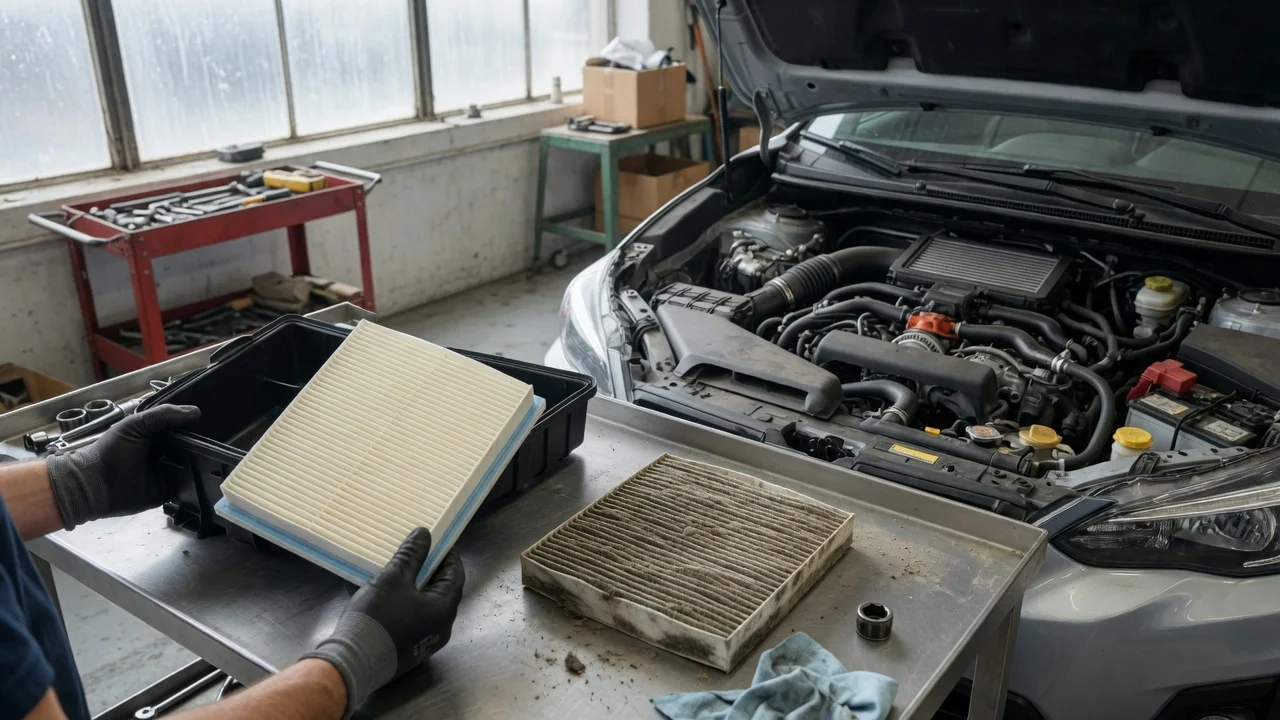
The engine air filter on a Subaru Crosstrek is the panel-shaped element inside the plastic airbox in the engine bay. Incoming air passes through it before reaching the throttle body and cylinders. Choose that element in two steps: match it to your exact model year, market, and engine, then pick a filter media that fits your dust exposure and how you want to service the part.
A listing that says only Crosstrek, without year and engine, is not a reliable match. Airbox size and the sealing edge have changed across generations and can differ among 2.0-liter petrol, 2.5-liter petrol, and hybrid powertrains. The cabin air filter is a separate part, usually behind the glove box, that cleans air for the heating and air-conditioning system. It does not protect the engine, and the two filters are not interchangeable.
Match the filter to the vehicle first
Fitment is vehicle-specific. In many markets, including the United States, Crosstrek generations fall roughly into 2013–2017 (sold as XV Crosstrek in some early years), 2018–2023, and 2024 onward. Common engines are naturally aspirated flat-four petrol units of 2.0 liters or 2.5 liters. Some years and markets also offer a hybrid. These combinations do not all share one airbox element.
Official Subaru parts listings and aftermarket catalogs that name the same year, engine, and body are the authoritative match. This guide does not assign OEM part numbers. Those numbers vary by model year, market, equipment, and later supersessions, so a number copied from another Crosstrek can be wrong for yours.
Read the model year from the registration documents or the certification label on the driver’s door jamb. Identify the engine from the owner’s manual, an under-hood label, or a parts lookup that uses the vehicle identification number (VIN). Treat hybrid as its own lookup even when the body looks the same as a petrol model. Compare the candidate filter with the old element’s length, width, thickness, and sealing edge. Open the airbox only with the engine off and cool, and keep loose debris from falling into the housing. Reject a filter whose height is different or whose foam or rubber seal does not sit fully in the airbox groove. A poor seal lets unfiltered air bypass the media.
Compare filter types
Once fitment is confirmed, choose among media types on the same criteria: how well the filter traps fine dust, how much air it flows for a stock intake, how you will service it, cost over the life of the vehicle, and risk to the mass airflow sensor. The mass airflow sensor (MAF) is the intake sensor that measures incoming air so the engine computer can meter fuel. Typical Crosstrek petrol engines use a hot-wire MAF in the intake tract.
Filter type What it is Advantages Trade-offs Typical fit; OEM paper (Subaru) Disposable cellulose or mixed-fiber panel sold as the factory air-cleaner element Known dimensions and sealing; filtration intended for the stock airbox and engine calibration Usually costs more per change than a generic paper filter; discarded when dirty Stock daily driving when you want a catalog-correct factory match; Aftermarket paper Disposable panel listed as equivalent for the same year and engine Same service pattern as OEM; often easier to find and lower purchase price Construction quality varies by brand; the listing must still name your year and engine Routine replacement on an unmodified engine, if the catalog line is an exact fit; Oiled cotton or gauze, reusable Washable panel that uses filter oil to hold particles Reusable after cleaning and re-oiling; often sold for higher airflow Typically traps fine dust less effectively than a good paper filter; extra oil can coat the MAF and cause running problems Drivers who accept more service work and a filtration trade-off for a reusable panel; Dry reusable or high-flow synthetic Washable or long-life media that does not use oil Avoids oil near the MAF; some designs flow more air than paper while still using the stock airbox Filtration, lifespan, and sealing quality vary by product; still must match the airbox Reusable media without oil, when the product is listed for your housing
Independent lab ratings, micron sizes, airflow figures, and street prices are not compared here because published numbers are only useful when they use the same test method, the same filter size, and the same model year. Brand marketing claims that skip those conditions are not a basis for a Crosstrek-specific ranking.
If you choose an oiled reusable filter, apply oil only as that filter’s maker specifies and keep oil off the MAF, the intake tube, and the sealing edge. Excess oil on a hot-wire sensor is a known cause of mis-readings, rough running, or a check-engine light on modern Subaru intakes.
Which option fits how you use the Crosstrek
Paved commuting and highway use with a stock engine: an OEM Subaru paper element, or a reputable aftermarket paper element listed for your year and engine, is the default. Paper remains the practical choice because it filters fine road dust well enough for the factory airbox and does not introduce oil into the intake.
Dust, gravel, winter sand, or frequent unpaved roads: stay with a quality paper element and inspect it more often than a highway-only schedule would suggest. A Crosstrek used on dirt will load a filter faster. Severe dust is a reason to check the element, not a reason to run without one or to assume a high-flow design filters better. A dirty disposable paper filter is simpler to replace than a reusable filter that is overdue for cleaning.
A goal of extra airflow on an otherwise stock engine: a dry or oiled performance panel that still seals in the original airbox. At Crosstrek power levels the drivability difference is usually modest. Sealing and dust control matter more than the brand on the label. Do not cut the airbox or use an element that only fits after modifying the housing unless you accept a non-stock intake and the tuning, noise, and warranty questions that follow.
Hybrid models: order only a filter listed for that hybrid powertrain. Do not assume the petrol 2.0-liter or 2.5-liter element of the same generation will seal or flow correctly.
There is no single best filter apart from year, engine, and conditions. The suitable choice is the catalog-correct element whose media matches your dust exposure and whether you will service a reusable design.
Limits of this choice and a sensible next step
This guide does not replace the inspect-or-replace interval in your owner’s manual. Subaru’s published schedule for the air-cleaner element depends on model year and market, and it shortens in dusty service. Those mileages and time limits are not restated here because they are vehicle-specific and must be read from the manual that matches your VIN.
Warranty treatment of a non-OEM filter depends on the consumer law where the vehicle is registered. A maker may still deny a related claim if it can show that an incorrect or poorly sealed filter caused the failure. Confirm the rule with the selling dealer or a local consumer agency; this article does not state a legal outcome for any jurisdiction.
If the airbox is cracked, the lid clips are broken, the old filter is soaked with engine oil, or dirt is packed downstream of the element, replacing the filter alone may not restore a proper seal. Those conditions need inspection by a qualified technician.
After you have the year and engine, the practical next step is to order the Subaru element or a listed equivalent for that configuration. Install it with the engine off, seat the seal fully, close every airbox fastener, and keep debris out of the housing. If the new filter does not match the old element’s size and sealing edge, stop and re-check the catalog line before the airbox is closed.