How to Choose a Safe Place for a Car Jack
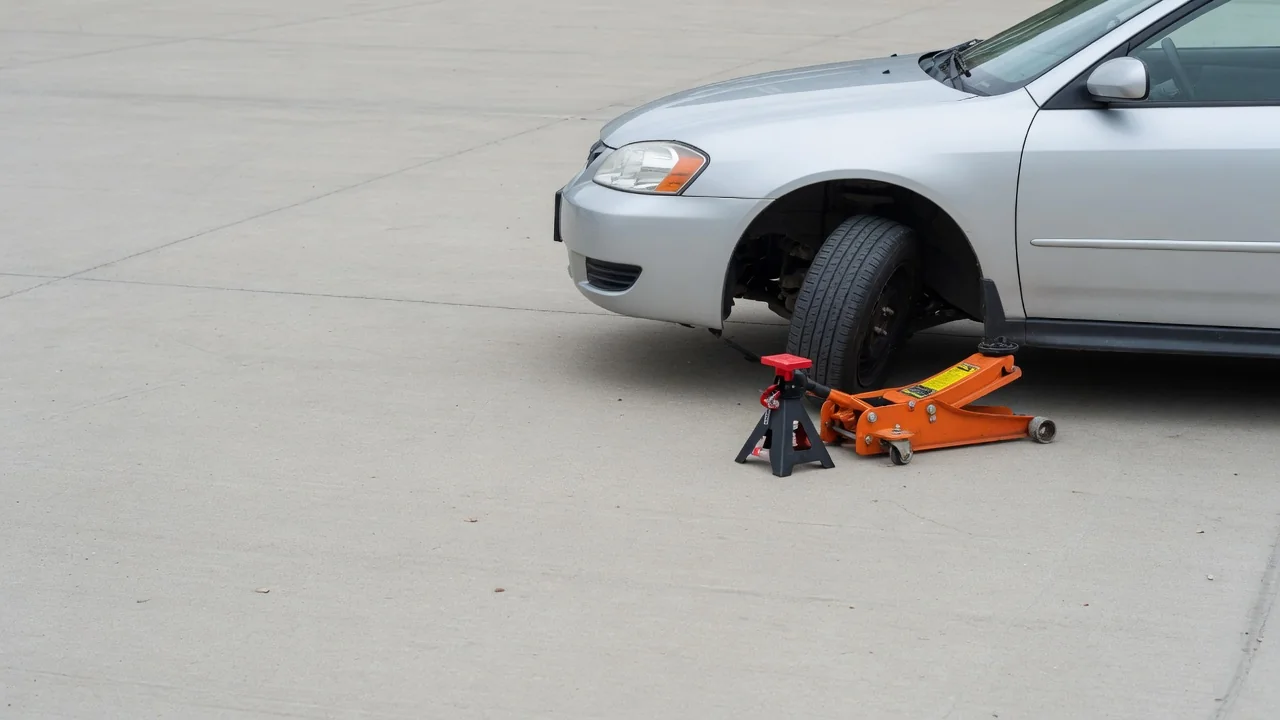
Choosing a safe place for a car jack comes down to three questions. Will the ground hold the load without shifting? Will the vehicle accept the jack without bending or slipping? And what will hold the car up if the jack fails? A jack is designed to lift a vehicle, not to keep it in the air while someone works nearby. This guide explains how to judge the car jack placement surface, find suitable lifting points, and set up proper support before any work begins.
Ground stability
The first requirement is a surface that stays put under load. A flat, solid concrete floor, such as a typical garage slab, is the best starting point because it is level and does not deform. Any slope works against you. The vehicle can try to roll as one end rises, and the jack can lean as weight shifts toward the low side. Floor jacks add another factor. Their lifting arm travels in an arc, so the jack body needs to roll slightly on its wheels as the car goes up. On a smooth, hard floor that movement happens freely. On a rough or uneven surface the wheels can catch, and the jack may drag the saddle sideways under the lifting point instead of moving itself.
Soft or loose ground is the most common hidden hazard when judging a car jack placement surface. Gravel, dirt, grass and sand let the small base of a jack sink or tilt. Asphalt can soften on hot days enough for a jack or stand to press into it. If you must lift on such ground, a wide, solid, flat board or a purpose-made jack base can spread the load, but it does not turn a poor surface into a good one. Also check for cracks, expansion joints, drain covers and oil or coolant spills where the jack and stands will sit, since each can let a base slip or settle.
Before the jack touches the car, secure the vehicle itself. Set the parking brake, put an automatic transmission in Park or a manual transmission in gear, and place wheel chocks against the wheels that will stay on the ground, ideally on the end opposite the one being lifted. A parking brake usually acts on only one axle, so if that axle is the one going up, the chocks become the main thing keeping the car from rolling.
Vehicle points
Every vehicle has places designed to take the concentrated load of a jack, and they differ from one design to the next. The owner's manual or the manufacturer's service information is the authoritative source for where they are. As a general pattern, many unibody cars and crossovers use reinforced sections of the pinch weld seam beneath the doors, often marked with small notches, arrows or indentations. Many body-on-frame trucks and SUVs are lifted at the frame rails or other points listed in their documentation. Treat these patterns as a guide to what to look for, not as a substitute for the information for your specific vehicle.
The right point also depends on the jack. The scissor jack supplied with many cars is usually intended for the side points shown in the manual, one corner at a time. A floor jack may be able to use a central lifting point, such as a front crossmember or a rear axle area, but only where the vehicle's documentation identifies that location as suitable. In general, avoid the oil pan, transmission pan, floor panels, plastic underbody covers and side skirts, exhaust components, and any brake or fuel lines. A thin sheet-metal panel can fold under a jack long before the car leaves the ground.
Contact between jack and vehicle matters as much as location. Center the saddle squarely under the lifting point. If the point is a pinch weld, a rubber pad or slotted adapter helps keep the seam from bending and the saddle from sliding off. Inspect the area first, because heavy corrosion, previous crash repairs or damaged seams can make a normally suitable point unreliable. Raise the jack slowly until it just contacts the car, check alignment again, then continue lifting while watching for any shift, tilt or creaking. If something moves, lower the car and reposition rather than trying to correct it under load.
Support
A jack is a lifting tool, not a holding device. Hydraulic jacks can lose pressure gradually or suddenly through worn seals or valves, and mechanical jacks can slip or collapse if loaded unevenly. That is why the safe place for a jack is only half of the setup; the other half is where the jack stands go. Never put any part of your body under a vehicle that is held up only by a jack, even for a quick look.
Jack stands should be rated for the load and placed at support points the manufacturer identifies, which may differ from the jacking point you used. Set them on the same firm, level surface, fully engage their locking pins or ratchets, and adjust paired stands to matching heights so the car sits evenly. Lower the vehicle slowly onto the stands and confirm that each one is seated squarely before releasing the jack completely. Many technicians then leave the jack raised to light contact as a secondary backup. From a position outside the vehicle's footprint, give the car a firm push to confirm it does not rock before working near it.
Improvised supports are a poor substitute. Bricks, cinder blocks, stacked wood and similar materials can crack, split or shift without warning, especially under the uneven forces created when someone pulls hard on a wrench. If a wheel has been removed, sliding it flat under a solid part of the chassis near the lifted corner is a commonly recommended extra precaution, giving the car something to land on if other supports fail.
Practical implications and limits
At home, these principles usually point to one consistent work area: a level section of garage floor or driveway kept clear of clutter, with chocks, stands and pads stored nearby. At the roadside, conditions are rarely ideal. For a flat tire, the goal is to move the vehicle, if it can be done safely, to the firmest and flattest spot available away from traffic, turn on the hazard lights, and limit the job to changing the wheel with the supplied jack. Roadside lifting on a shoulder or slope is meant only for that short task, never for working underneath the vehicle.
General guidance also has limits that only the vehicle's own documentation can resolve. Some vehicles with air suspension or automatic leveling require specific steps before lifting, and some electric vehicles designate lift points that keep the jack away from the battery pack. Lowered or modified cars may need a low-profile jack or different points altogether, and aftermarket running boards, skid plates or suspension changes can block or alter the original points. When the manual does not cover your situation, or a point looks damaged, a professional shop with a vehicle lift is a reasonable alternative.