How to Choose a Honda Engine Air Filter
Start with fit, then choose the media
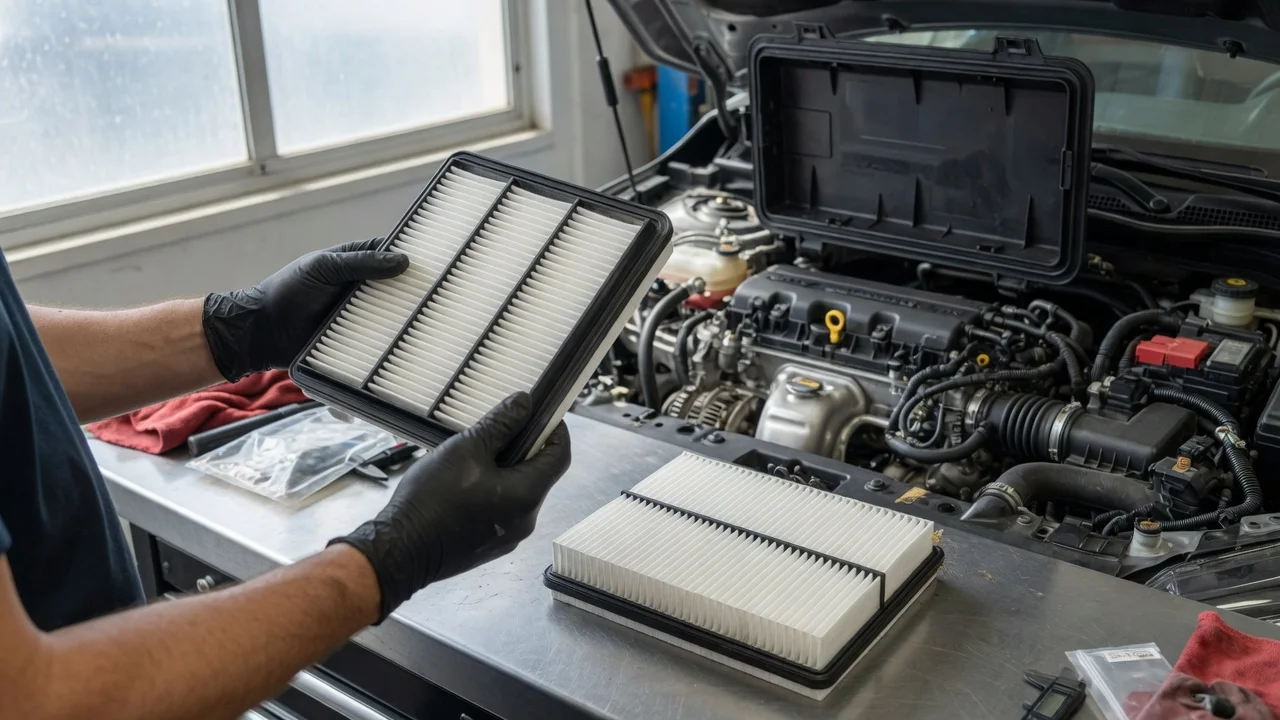
A Honda engine air filter is the replaceable element inside the engine airbox. It traps dust, pollen, sand, and other debris so intake air is cleaner before it reaches the throttle body and cylinders. The essential choice is not a single “best” filter for every Honda. Identify the filter that matches your exact model year, market, body style, and engine, then pick a construction type that fits how you drive and how you want to maintain the car. A filter that does not seal in that airbox, or that is built for a different engine family, is the wrong part even if the brand is familiar.
Confirm the filter your airbox actually uses
Honda assigns engine air filters by vehicle configuration, not by the Honda name alone. A Civic, Accord, CR-V, Pilot, or Odyssey can use different panel sizes, thicknesses, and sealing frames across years and engines, including differences between naturally aspirated and turbocharged powertrains and between trims sold in different markets. Applicability is unknown until year, model, engine, and market are specified. Use those details, or the vehicle identification number (VIN), in a Honda dealer parts catalog or an equivalent catalog that maps Honda part numbers. If the current filter is still readable, its Honda part number or a listed cross-reference is the most direct check. Shape, overall length, width, height, and the foam or rubber seal must match the airbox lid and base so unfiltered air cannot bypass the media.
Record model year, model name, engine code or displacement, and drivetrain before you shop. Use the VIN when trim or market splits the parts catalog into more than one filter. Compare the new filter to the old one for panel size, thickness, and a continuous seal. Do not assume a “Honda universal” or a nearby model’s filter will interchange.
Compare the main options on the same criteria
Once fit is confirmed, the usual choice is among Honda Genuine (original-equipment) disposable filters, quality aftermarket disposable filters in paper or synthetic media, and reusable performance filters, typically oiled cotton gauze or dry washable synthetic. Compare them on sealing and dimensions, dirt-holding behavior in normal and dusty use, service method, and whether you want a part that follows Honda’s service documentation. Published airflow, efficiency, or price figures are only useful when they come from the same test method, the same filter size, and the same restriction point. Brand marketing numbers that omit those conditions are not a like-for-like comparison, and this guide does not assign specific cubic-feet-per-minute, efficiency percentages, or street prices.
Option Fit and sealing Service pattern Best fit when; Honda Genuine disposable Built to the airbox Honda designed for that engine and year Replace on the interval or inspection cue in the owner’s manual or Maintenance Minder You want the simplest match to Honda’s specified part; Aftermarket disposable (paper or synthetic) Acceptable only if dimensions, thickness, and seal match the Honda part Replace on a similar inspection or time/mileage schedule; quality varies by maker You want a correctly fitting equivalent and are willing to verify the listing; Reusable oiled or dry media Must still match the stock airbox unless the intake itself was changed Clean and re-oil or wash on the maker’s schedule; skipping that service loads the media You accept extra upkeep and have confirmed compatibility with a mass airflow (MAF) sensor if fitted
Honda Genuine is the baseline for stock engines: the part number is unambiguous, the seal is designed for that box, and the filtration-versus-flow balance is the one Honda documented for that vehicle. A well-listed aftermarket disposable can serve the same role when the catalog maps it to that Honda number and the physical filter matches. Bargain filters that are slightly small, too thin, or poorly sealed leak dirty air around the media. Reusable filters are a maintenance product as much as a hardware product. Oiled media can leave residue on a MAF sensor if over-oiled; dry reusable media avoids that oil step but still needs washing before the element loads up. Neither reusable type is automatically “better” for a stock daily driver unless you will actually service it.
Tie the choice to how and where you drive
Driving conditions change which option is practical. They do not change the fitment rule. Honda’s own severe-service notes, where published for a given model year, typically treat dusty roads, short trips, and heavy stop-and-go as reasons to inspect the filter more often. The exact mileage or time interval is vehicle- and market-specific and belongs in that Honda’s owner’s manual or Maintenance Minder. It should not be copied from another model.
Stock commuting in ordinary paved conditions: Honda Genuine or a correctly cross-referenced disposable filter is the straightforward choice. Dirt roads, construction zones, agricultural dust, or desert sand: prioritize a well-sealed disposable element and inspect it early; a neglected reusable filter in heavy dust can restrict the engine as badly as a cheap clogged paper filter. You prefer to replace a part and forget it: disposable media matches that habit. You are willing to clean, dry, and re-oil or wash on a calendar: a reusable filter can make sense if it still fits the stock airbox. A cold-air intake or a non-Honda airbox is already installed: buy the filter that intake manufacturer specifies for that housing, not the stock Honda panel, and treat that as a different system.
Limits that change the answer
Filter choice does not fix other intake problems. A cracked airbox, a loose lid clip, a torn inlet snorkel, or a missing gasket lets dust in regardless of media quality. Turbocharged Hondas still need the filter Honda (or the intake maker) sized for that airbox; a looser “high-flow” element is not a substitute for a boost leak diagnosis. New-vehicle warranty language is in Honda’s warranty booklet for that market. Using a correctly fitting equivalent filter is common practice; a failure shown to be caused by an ill-fitting, collapsing, or badly oiled filter can still be treated as outside coverage. Legal and warranty outcomes are jurisdiction- and case-specific and are not settled by a parts-counter label alone.
Do not mix specifications across incompatible configurations. A filter listed for one Civic generation, an Accord four-cylinder, or a hybrid powertrain is not interchangeable with another unless the parts catalog says it is the same Honda number. Cabin (pollen) filters are a different part in a different housing; they do not substitute for the engine air filter.
A practical next step
Look up the Honda engine air filter part number for your VIN or for year, model, and engine, then decide among Genuine, a matching disposable aftermarket unit, or a reusable element you will actually service. If the current filter is already in the airbox, compare the candidate to that element for size and seal before you buy. For the replacement interval and any severe-service inspection cue, use the owner’s manual or Maintenance Minder for that Honda rather than a generic mileage rule. If the airbox, lid, or inlet duct is damaged, have that housing repaired or replaced so the new filter can seal.