How to Check Wheel Alignment at Home and What a Free Alignment Check Includes
Most alignment problems show up slowly: uneven tread, a crooked steering wheel, or a car that wanders toward the shoulder. You can gather useful evidence at home before paying for service, and many shops will measure the angles at no charge. It helps to know what you can learn at home and what only an alignment rack can confirm. Then you can decide whether an adjustment is actually needed.
Reading Tire Wear Patterns for Early Alignment Clues
Park on level ground, turn the engine off, and set the parking brake. Turning the steering wheel to full lock exposes most of the front tread without crawling underneath. Look across the full width of each tire. Healthy wear leaves the tread depth roughly equal from the inner shoulder to the outer shoulder. Wear concentrated on the inner edge, or a smooth band along the outer edge, suggests the tire is not meeting the road squarely. Check for exposed cords or sharp debris before running a palm lightly across the tread.
Brushing the tread in both directions can reveal feathering. Each tread block feels smooth one way and sharp-edged the other. Feathering usually points to a toe problem because the tire is being scrubbed sideways as it rolls. One-sided edge wear can point to camber, but underinflation, heavy loads, and worn suspension parts leave similar marks. Compare left against right and front against rear. A pattern on both tires of an axle hints at a shared setting, while one odd tire suggests damage or a local fault. Wear shows past conditions, and only measurement shows today's geometry.
Steering Wheel Position and the Straight-Road Drift Test
An off-center steering wheel is one of the clearest everyday signs. On a flat, level road, notice whether the spokes sit level while the car travels straight. If the wheel suddenly sits cocked after a hard pothole or curb strike, something in the steering linkage or the toe setting may have shifted, even if the car still feels normal. A wheel that has been slightly off since the last service is less alarming than one that changed overnight. The timing of the change is often as telling as the angle itself.
For a drift test, pick a straight, empty, level road with little crown and no traffic behind you. At low speed, relax your grip briefly with your hands close to the wheel and ready to correct, and notice whether the car tracks straight or eases to one side. Road crown, crosswinds, uneven tire pressure, and a dragging brake can all cause a pull, so repeat the run in both directions. Vibration, wandering, or tire squeal on gentle turns are worth noting too, although tires and worn suspension can cause them as well.
Basic Home Measurements and Where Do-It-Yourself Checks Fall Short
With the car on truly level ground and the wheels pointed straight, you can get a rough toe reading by holding a straightedge or a taut string against the sidewalls. Compare the gap between the string and the tire at the front and rear edges of each front wheel. A narrower gap at the front suggests toe-in, and a wider one suggests toe-out. For camber, stand in front of the car and see whether the top of each tire leans in or out. A bubble level against the rim gives only a coarse hint.
These methods have firm limits. They cannot measure caster or thrust angle, they cannot resolve the fractions of a degree that specifications involve, and sloped floors, bent rims, and sidewall bulge all throw them off. Use the results to decide whether a shop measurement is worth arranging, not as a guide for turning tie rods or loosening suspension parts. If you find play, hear clunks, or spot loose components while looking around, stop. Have the suspension inspected before any alignment work is done.
What a Professional Alignment Check Actually Measures
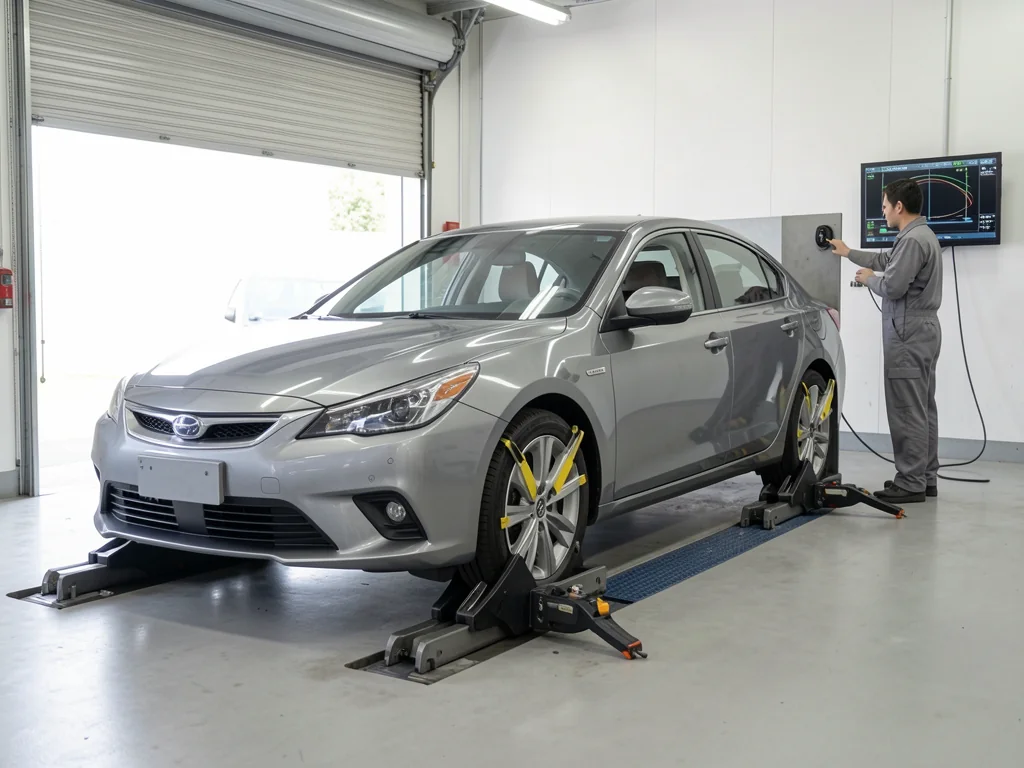
On an alignment rack, the technician mounts sensors or reflective targets on all four wheels. A camera or laser system then reads camber, caster, toe, and thrust angle and compares them with the manufacturer's specification for that vehicle. A proper check starts before the sensors go on. The technician sets tire pressure, looks over the tires, notes ride height, and checks the steering and suspension for play. A loose tie rod end or a tired bushing makes any adjustment short-lived.
The printout or screen report usually lists each measured value next to its acceptable range. Readings are often color-coded so that values outside tolerance stand out. Read the report wheel by wheel and angle by angle, and note how far a value sits from its range rather than relying on color alone. A two-wheel check covers only the front, while a four-wheel check also reads the rear. Rear readings matter even where rear adjustment is limited, because thrust angle sets the direction the car travels and affects how the front must be set.
What a Free Wheel Alignment Check Includes and What It Leaves Out
Many tire and service shops offer a free alignment check as a measurement-only service. The car goes on the rack, the angles are read, and you get a report without any adjustment being made. Expect a short wait and a visual look at the tires and suspension parts. Someone will also talk you through any readings outside the specified range. The free part usually ends there. Adjustment, replacement parts, and extra labor are separate paid services that you decide on afterward.
Before you agree to any work, ask which angles are out of range and by how much. Also ask whether any worn components were found and whether you will get printouts of the readings before and after adjustment. The answers help you tell a genuine need from a routine upsell. Keep the report even if you turn down service. It gives you a baseline for comparing future measurements and for judging whether new tire wear matches a known alignment condition or points to something else.
When an Alignment Check Makes Sense and When Adjustment Is Warranted
Common reasons to have the angles measured include a hard pothole or curb impact and a new set of tires. Replaced steering or suspension parts are another reason, as is a change in ride height from new springs or a lift kit. So is a pull or an off-center wheel that appeared recently. In each case, the geometry may have shifted without obvious symptoms. New tires in particular are worth protecting from early, uneven wear that a quick measurement could have prevented.
A reading slightly outside the range on a single angle does not always call for immediate adjustment. Weigh it against tire wear, how the car handles, and whether worn parts are the real cause. Adjusting the alignment on top of loose ball joints, tie rod ends, or bushings wastes the work, so repair those parts first when play is found. Check your owner information for any manufacturer guidance on alignment instead of relying on a universal rule. Let a shop's measurement, not symptoms alone, confirm the decision.