How to Check Control Arm Bushings
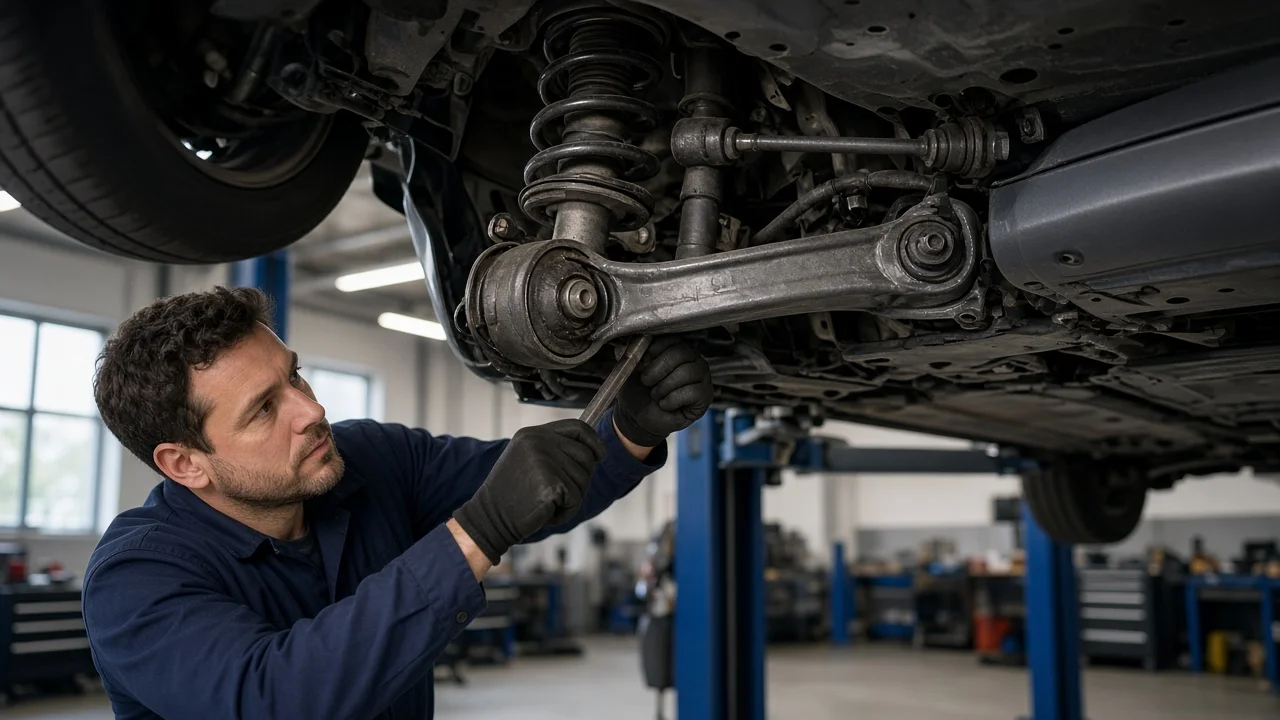
Control arm bushings let the suspension pivot while isolating the body from road shock. When they wear, the car can feel like it has one of several other front-end faults. A proper check links what you notice on the road with what you can see and test at the arm itself, so you don't condemn parts too early. This guide covers how to inspect control arm bushings, which tests need tools or a technician, and how to tell good bushings from bad ones before anything is replaced.
Establish the symptoms
Start by writing down exactly when the problem appears. Worn bushings commonly cause a clunk or knock over speed bumps, potholes or driveway transitions. They can also cause a thud when shifting between drive and reverse or when braking firmly. Note whether the steering wanders on the highway, whether the car pulls or shimmies only under braking, and whether the sensation seems to come from the front or the rear. Many vehicles use control arm bushings at both axles, so the location matters.
Associated signs help narrow the search. Look for uneven tire wear, especially on the inner or outer shoulder. Check whether the steering wheel is still centered and whether the car settles differently after a bump. Also record recent changes: new tires, an alignment, a curb strike, lowering or lifting work, or any suspension parts replaced recently. If a noise began right after other repairs, suspect that work first, such as a fastener that was not tightened properly, before blaming old rubber.
Distinguish plausible causes
Worn control arm bushings are only one of several parts that produce clunks, wander and braking shimmy. Ball joints sit on the same arm and can develop joint play that feels similar. Sway bar end links and sway bar bushings commonly cause light knocking over uneven surfaces, often at low speed. Worn tie rod ends reduce steering precision. Strut or shock mounts can knock on rebound. A worn wheel bearing may add looseness and a noise that changes with speed or cornering.
Your observations can support or weaken each of these causes. A clunk during braking or acceleration, with the wheel shifting fore and aft, fits a worn lower control arm bushing. On many front suspensions this is the rear bushing of the lower arm. Noise mostly when one wheel hits a bump and the other does not points toward sway bar components. If the wheel is loose when rocked top to bottom rather than front to back, suspect a ball joint or wheel bearing. A pull that is present at steady speed, regardless of braking, is more likely a tire or alignment issue than a bushing.
Checks in a useful order
Begin with checks that need no lifting. Park on level ground and look at the visible bushings with a flashlight. Signs of trouble include deep cracks, torn rubber, rubber separated from its metal sleeve or pushed out of the arm eye, and oil-soaked rubber. Some vehicles use fluid-filled bushings, which may leave wet residue when they leak. Shiny metal or rub marks around a mount suggest movement where there should be none. Bounce each corner and listen for the noise you recorded. Check that the ride height looks even side to side.
Closer inspection requires safe vehicle support. Use the lift points listed in the owner's manual or service information, chock the wheels and set the parking brake. Place properly rated jack stands before going under the car, and never rely on a jack alone. Many bushings are best judged with the suspension loaded near normal ride height, because letting the wheel hang can hide or exaggerate movement. For that reason, the service procedure may call for drive-on ramps or supporting the arm rather than the body. With the car secured, gently lever a pry bar between the control arm and its bracket or subframe to see how the bushing moves. With the wheels on the ground and the engine off, have a helper rock the steering wheel while you watch the mounting points for shifting.
Some checks belong with a qualified technician. These include measuring joint play against a specification, separating bushing movement from ball joint movement under load, and inspecting fluid-filled bushings for internal failure. Judging whether a control arm or its mounting points are bent or cracked also requires tools and model-specific data. After a collision or curb strike, have the arms and subframe checked rather than assuming the bushings are the only damage.
Interpret the findings
Telling good from bad control arm bushings is not a matter of finding perfect rubber. Fine surface cracking from age is common and does not by itself prove failure. Some bushings are built with voids or slots so they are softer in one direction, and those openings are not tears. Rubber also flexes under a pry bar, so a small, springy movement that returns to center is normal. A bushing is more likely worn if the inner sleeve sits off center, the rubber is torn through or separated from the sleeve, or the arm visibly shifts with light force. A knock you can hear and see at the mount while the helper rocks the steering is another sign.
Each result confirms only part of the picture. A torn bushing needs attention, but a worn ball joint or loose end link may still be adding to the noise. Movement at a mount may come from a loose bolt rather than the bushing. Check that the fasteners are present and haven't visibly shifted, and have their tightness verified against your vehicle's fastener specification. Before buying parts, confirm which bushing is worn and whether the manufacturer sells it separately or only with the arm. Also make sure what you found actually explains the original symptom.
Urgency and next action
Stop driving and arrange an inspection or a tow if any of these appear: a control arm visibly shifts, metal contacts metal at a mount, a wheel looks out of position, a mounting bolt is loose or missing, or the steering becomes vague or pulls sharply under braking. These conditions can affect control of the vehicle. Milder signs, such as slight noise or minor cracking, still warrant an inspection soon. No one can say how many more miles a worn bushing will last, because that depends on how far it has deteriorated and how the car is driven.
When you book the repair, give the shop the year, make, model and trim, plus which corner and which bushing you suspect. Describe when the symptoms occur, any tire wear pattern, and recent work or impacts. Photos of the bushing help. Replacement follows model-specific procedures. These often include tightening certain pivot bolts with the suspension at ride height so the bushing is not preloaded, using the correct fastener specification. Plan for a wheel alignment afterward, since new bushings or arms can change the suspension geometry, and ask for the before and after alignment readings.