How to Check Control Arm Bushings When Diagnosing Suspension Shake
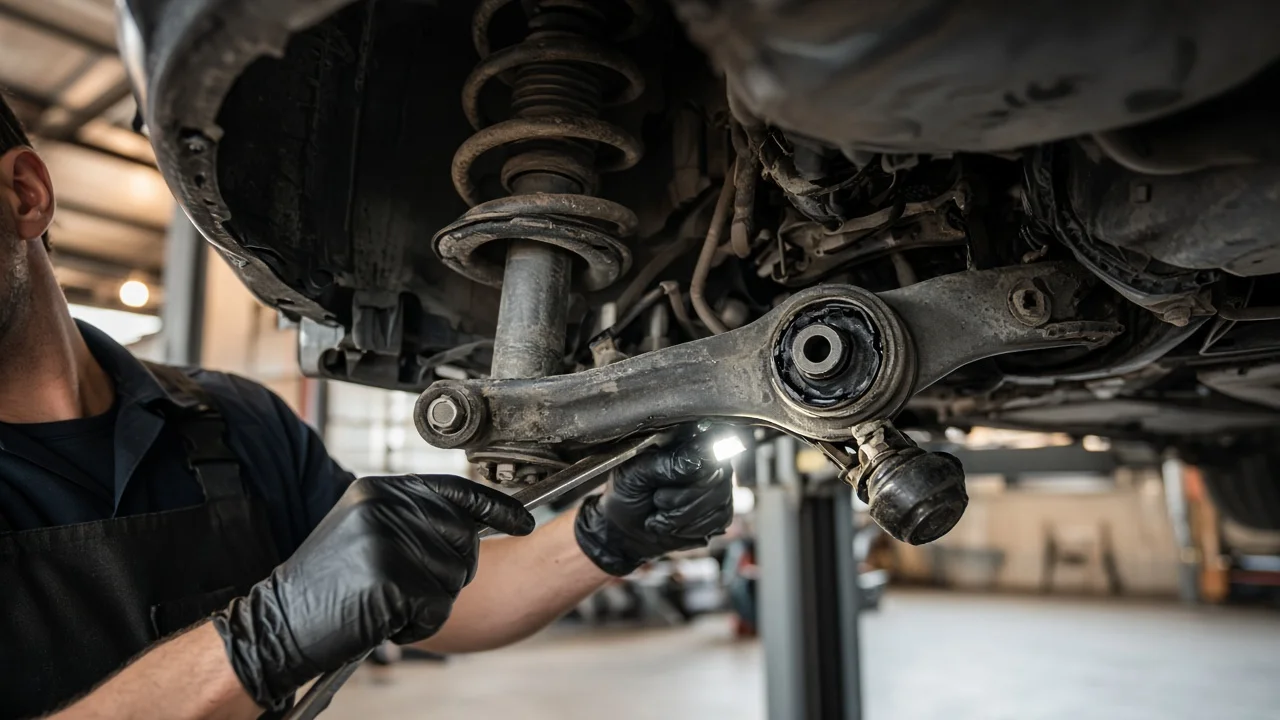
Worn control arm bushings rarely have one clear symptom. They usually show up as a clunk over bumps, vague steering, a shimmy under braking, or tire wear that returns after an alignment. Tires, wheel bearings, ball joints and brake parts can cause similar complaints, so confirm bushing wear through observation and controlled checks before buying parts. This guide covers the symptoms, the competing causes, a sensible inspection order and what the results actually tell you.
Establish the symptoms
Start by recording exactly when the problem happens. Note whether the shake appears at a certain road speed, only while braking, when accelerating from a stop, during turns, or over rough pavement. Note whether it changes when the car is cold or warm. Common signs of bad control arm bushings include a knock or clunk over bumps or when braking, a steering wheel shimmy under braking, wandering on the highway, a pull that changes between braking and accelerating, and uneven wear on the inner or outer tire edges. Squeaky control arm bushings usually squeak over speed bumps and driveway entrances. That noise can come from dry or binding rubber, or from polyurethane bushings that need lubrication.
Also write down anything that changed recently. Relevant events include new tires, a wheel balance or alignment, a pothole or curb strike, a lift or lowering kit, and suspension work. Previous work matters because some rubber bushings are damaged early if their bolts were tightened with the suspension hanging rather than at normal ride height. A shake that appears right after one of these events often points to that event rather than to gradual bushing wear.
Distinguish plausible causes
Tire and wheel problems are the most common source of shake. If the vibration builds at a particular speed whether or not you brake, suspect imbalance, a bent wheel, an out-of-round tire or a separating belt first. If rotating the tires moves or changes the shake, that strongly supports a tire cause. Brake rotor problems typically produce shake mainly during braking, often with pulsation you can feel in the pedal. Worn lower control arm bushings can also cause shimmy under braking, because the arm shifts as braking force loads it. That shimmy tends to come with a clunk at the start of a stop and no pedal pulsation.
Other parts can produce overlapping symptoms. Worn ball joints and tie rod ends show joint play when the wheel is rocked. Ball joints are usually checked top to bottom and tie rods side to side, though the method depends on the suspension design. A failing wheel bearing often adds a hum that changes with load in turns. Sway bar links and strut mounts commonly cause clunks over bumps. Shake that appears mainly under acceleration can come from axles or engine and transmission mounts.
Several observations support a bushing diagnosis: rubber that is cracked deep into its body, torn control arm bushings, rubber separated from the sleeve, fluid leaking from a hydraulic bushing, or the arm visibly shifting relative to its mounting points. A clunk that lines up with brake application or with shifting between drive and reverse also supports it. Intact, centered bushings weaken the case, and so does a shake that disappeared after balancing.
Checks in a useful order
Begin with checks that need no lifting. Park on level ground and look at the tire wear patterns. Compare ride height from side to side, since a sagging corner can mean a failed bushing or spring. Drive slowly through a parking lot over speed bumps and brake gently, listening for where a noise comes from. With the engine off, turn the front wheels fully to one side and use a flashlight to view the front bushings through the wheel opening. Never reach or crawl under a vehicle that is held only by a jack.
For a closer look, use the lifting points listed in the owner or service manual. Place the vehicle on properly rated jack stands on solid, level ground and chock the wheels that stay down. Some bushing problems are easier to see with weight on the wheels, because unloaded suspension can hide movement. Drive-on ramps or a lift that supports the tires are useful for that. When comparing good and bad control arm bushings, a good bushing looks uniform, firmly bonded and centered in its sleeve. A worn bushing may show deep cracks, tears, rubber pushed out of the housing, an inner sleeve sitting off center, or metal marks where parts have been contacting.
To test control arm bushings for movement, gently lever a pry bar between the arm and its mount near the bushing and watch for shifting. Some flex is normal by design, so compare both sides of the car. A helper can rock the steering wheel or apply the brake while you watch the bushings. Measuring joint play against limits, using a dial indicator, or evaluating hydraulic bushings requires model-specific service information. If you lack the tools or a safe workspace, leave these tests to a qualified technician.
Interpret the findings
Fine surface cracking on aging rubber is common and does not by itself mean a bushing has failed. Deeper cracks, rubber torn through, separation from the sleeve, metal-to-metal contact or obvious arm movement under the pry test are much stronger evidence of worn control arm bushings. Differences between the left and right sides are also telling. Keep in mind that finding one bad part does not prove it causes your shake. A torn bushing on a car whose vibration only appears at a steady highway speed may be a real but separate problem. In that case, check the tires and balance as well.
Before replacing parts, confirm that the ball joints, tie rods and wheel bearings check out, and decide whether to replace only the bushing or the complete arm. Many arms come with new bushings and a ball joint already installed. Pressed-in bushings need press tools. During installation, tighten fasteners to the fastener specification for your vehicle. Many rubber-bonded bushings must receive their final tightening with the suspension at ride height, so follow the service procedure. Plan a wheel alignment check afterward, then road test under the same conditions that originally produced the shake.
Urgency and next action
Stop driving and arrange an inspection or tow if you notice any of these signs: • a loud metallic bang over bumps; • steering that suddenly changes response; • a hard pull or lurch under braking; • a wheel visibly tilted or out of position; • a control arm that has shifted after an impact; • a bushing so separated that the arm is no longer held firmly; The condition of a worn bushing cannot be translated into a safe remaining distance. How quickly it deteriorates depends on the design, the damage and how the vehicle is driven.
When you book a repair, bring a clear record. Include when the symptoms occur, the speeds and maneuvers involved, the type of noise, which side it seems to come from, and any recent impacts, tire changes or suspension work. Photos of tire wear and of any damaged bushings help. Ask the shop to confirm which components have measurable play and whether an alignment is part of the quoted repair.