How to Check a Parking Spot for Door-Opening Room
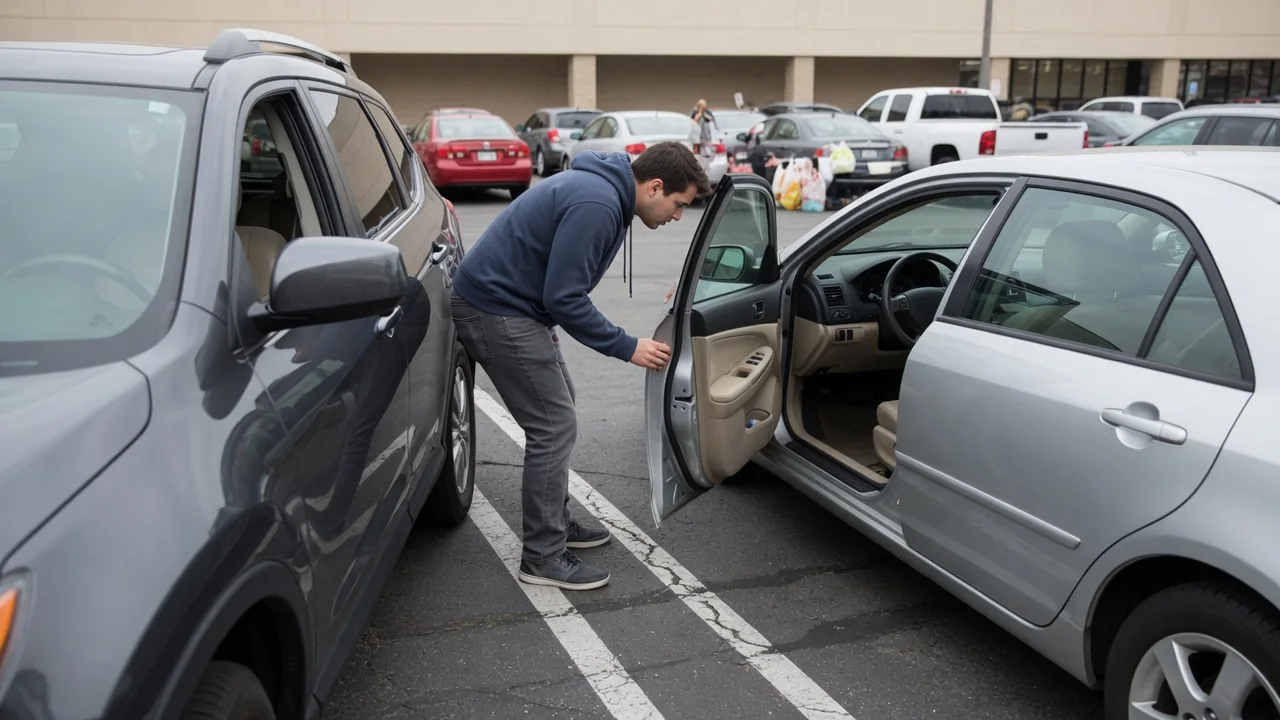
Knowing how to check a parking spot for door opening room saves passengers from squeezing out sideways and spares neighboring paint from dings. The check takes a few seconds before you commit to the space, and it relies on reading the gaps on both sides, the surfaces around the stall, and who needs to get in or out.
Neighboring cars
The vehicles on either side set most of the available room. As you approach, look at how each one sits relative to its painted lines. A car parked against or over the line on your side takes space from your stall, while one hugging its far line gives you some back. Also note which way each neighbor faces, because their driver's door will need to swing into the same gap your passengers use, and two doors sharing one narrow strip rarely works for either party.
Body style matters as much as position. A long two-door coupe has wide doors that sweep a large arc, so its owner may need more room than the gap suggests. A van with sliding side doors needs almost no swing space, though people still have to stand beside it. Wide pickups and vehicles with extended mirrors or running boards fill more of a stall than a compact sedan does. Door length and opening angle differ between vehicles, so judge the actual gap rather than assuming every neighbor behaves alike.
Wall clearance
End stalls and garage spaces often swap a neighboring car for a wall, pillar, or curb, and these do not move or forgive contact. A concrete column positioned near the middle of the stall can sit exactly where a front or rear door wants to open. Look for where the pillar falls along the length of your vehicle before you pull in, since stopping slightly forward or back can sometimes place it between the doors or beside a fender instead of directly against a door edge.
Low obstacles deserve the same attention as tall ones. Raised curbs, bollards, pipe guards, and landscaping borders can catch the bottom edge of a door that clears everything at window height, particularly on low-slung cars. Walls also remove any chance of borrowing extra room, so the gap you see is the gap you get. Scuffed paint or rubber marks on a wall or pillar are a useful warning that other drivers have misjudged the same space, and it is worth treating that stall with extra caution.
Passenger needs
The room required depends on who is riding with you. An adult traveling alone in the front seat can usually manage with a partly opened door, but installing a child in a rear car seat calls for the door to open wide enough for an adult to lean in with both arms. Someone using a cane, walker, or wheelchair needs space beside the vehicle as well as a fully open door, and an older passenger may need to swing both legs out before standing, which takes more room than a quick sideways exit.
Decide which side matters most before you choose the stall. If the only rear passenger sits behind the front passenger seat, favor the gap on that side and accept a tighter fit at the driver's door. Children tend to push doors open quickly, so a generous margin or an adult opening the door from outside protects the vehicle alongside. Rear doors on some cars open to a narrower angle than the fronts, and child locks or door check positions vary, so learn how your own doors behave.
Everyday Use and Observations
A practical habit is to pause at the mouth of the stall and compare the two side gaps before turning in. If the space looks tight, lowering a window or glancing at the side mirrors as you roll in shows how close the neighboring car or line really is. Many drivers find it helpful to center the vehicle between the lines by checking both mirrors, then adjust slightly toward the side with fewer passengers. Backing in can also change which doors face the wider gap, which is sometimes the easier fix.
Conditions change the picture from day to day. Sloped pavement can make a door swing open on its own or fall closed, and a strong gust can pull it from a passenger's hand and into the next vehicle. Winter clothing, grocery bags, and backpacks all add bulk that needs clearance. Camera views and parking sensors help with positioning, though they generally show obstacles around the bumpers rather than the arc a door will travel, and their coverage differs between vehicles, so a direct look remains the more reliable check.
Limits and Next Steps
No inspection guarantees the space will stay the same. The compact car beside you may leave and a wide truck may take its place, parked closer than its predecessor. Painted lines also vary in width between lots, and older facilities were often laid out for narrower vehicles than many on the road today. If your passengers will need full door opening on return, such as when loading a child seat or mobility aid, an end stall with open space on the needed side offers more certainty than a middle one.
When the room is not there, the simplest answer is to let passengers out in the driving lane or a safe drop-off area before pulling into the stall, then reverse the routine when leaving. Choosing a spot farther from the entrance, where empty stalls are common, usually costs only a short walk. Accessible spaces with marked side aisles are reserved for permit holders and should be left for those who qualify. For your own vehicle's door angles and detent positions, a quick trial in an empty lot gives a dependable reference.