How to Check a Car's Cooling System Before a Hot Trip
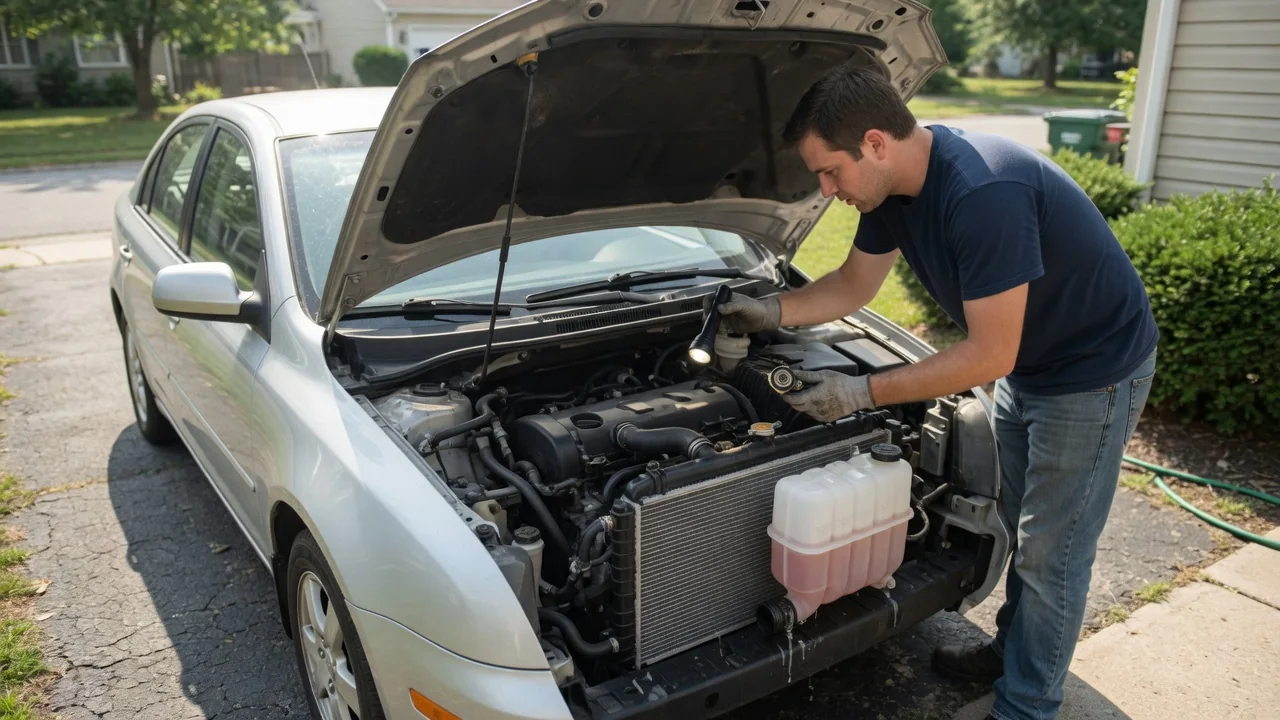
Summer heat, long grades and a loaded cabin ask more of an engine than daily commuting does. Knowing how to check a car's cooling system before a hot trip lets you spot low coolant, tired hoses and odd gauge behavior in the driveway, using only what you can see and feel with the engine cold and every pressurized cap left closed.
Coolant level cold
Start with the engine fully cold, ideally after sitting overnight. Most cars have a translucent plastic reservoir near the radiator or along a fender, molded with minimum and maximum marks. Coolant expands as it heats, so a cold reading is the only one that compares fairly against those marks. The level should sit between the two lines. A flashlight held behind the tank helps when the plastic has yellowed with age and the fluid line is hard to make out.
Look at the fluid as well as its height. Healthy coolant is clear and evenly colored, whether green, orange, pink or blue depending on the manufacturer. Rusty brown fluid, floating debris, an oily film or a milky appearance all deserve professional attention before a long drive. Some vehicles use a pressurized expansion tank instead of a simple overflow bottle, and hybrids may carry a second reservoir for electronics, so the owner's manual is the right guide to which tank is which and what coolant type belongs in it.
Hoses and leaks
With the engine cold and off, trace the large upper and lower radiator hoses and the smaller heater hoses running toward the firewall. Sound rubber feels firm yet slightly pliable when squeezed. Trouble shows up as cracking near the ends, a swollen bulge, a soft or spongy section, or a hose that feels hard and brittle. Check the clamps too, since dried crusty deposits in white, green or pink around a connection mark a spot where coolant has seeped and evaporated.
Leaks often reveal themselves away from the hoses. Look along the radiator seams and plastic end tanks for staining, and around the water pump area for streaks or residue, though on many engines the pump hides behind covers. Check the ground where the car parks overnight. Coolant is usually brightly colored, slightly slippery and sweet smelling, while clear water dripping near the front passenger footwell is normally air conditioning condensation. Any coolant puddle should be cleaned up promptly because it is toxic to pets and children.
Temperature behavior
The dashboard tells you how the system performs under load. On a normal drive, the temperature gauge should rise steadily during warm-up, settle at its usual position, often near the middle, and stay there in traffic and at highway speed. Many newer cars replace the gauge with a blue cold indicator and a red warning light, or bury a digital reading in a menu. Learn which display your vehicle uses and what normal looks like before the trip begins.
Patterns matter more than a single glance. A needle that creeps upward at idle but drops once moving can point toward airflow or fan issues, while one that climbs on hills or at speed suggests the system is struggling to shed heat under load. A gauge that never reaches its usual position also deserves a check, since an engine running too cool is not operating as designed. After a drive, listen for the electric cooling fan cycling on with the air conditioning running.
Everyday Use and Observations
Small habits in the weeks before departure build a useful baseline. Glance at the reservoir on a few cold mornings and note whether the level holds. A sealed system in good condition loses very little, so a level that keeps dropping means coolant is going somewhere, even without a visible puddle. A sweet smell after parking, wisps of steam from the grille area, or a film fogging the inside of the windshield when the heater runs are all worth mentioning to a technician.
Look through the front grille as well. Leaves, bugs, plastic bags and bent fins on the radiator and air conditioning condenser restrict airflow exactly when the engine needs it most. Cabin heat tells a story too: a heater that blows lukewarm when it used to blow hot, or that gurgles behind the dashboard, can hint at low coolant or trapped air. Consider how the trip differs from routine driving, since towing, roof cargo, mountain passes and stop-and-go desert traffic all raise the heat load considerably.
Limits and Next Steps
Driveway checks have clear boundaries. Never open a radiator cap or pressurized expansion tank on a warm engine, because scalding coolant can spray out under pressure. Visual inspection also cannot measure freeze and boil protection, coolant age, thermostat operation, radiator cap sealing or internal blockage. If the reservoir is low, topping up with the coolant type specified in the owner's manual is reasonable, but mixing incompatible formulas can cause problems, and a repeat drop means the underlying leak still needs finding.
Book a shop visit ahead of the trip if you find contaminated fluid, a damaged hose, a recurring low level or unusual gauge behavior. A technician can pressure test the system, check coolant condition and confirm fan operation. A stored fault code related to engine temperature is a starting point for diagnosis rather than proof that a specific part has failed. On the road, if the warning light comes on or the gauge climbs toward hot, pull over safely, shut the engine off and let it cool before seeking help.