How to Calculate the Cost of Charging Your Electric Car
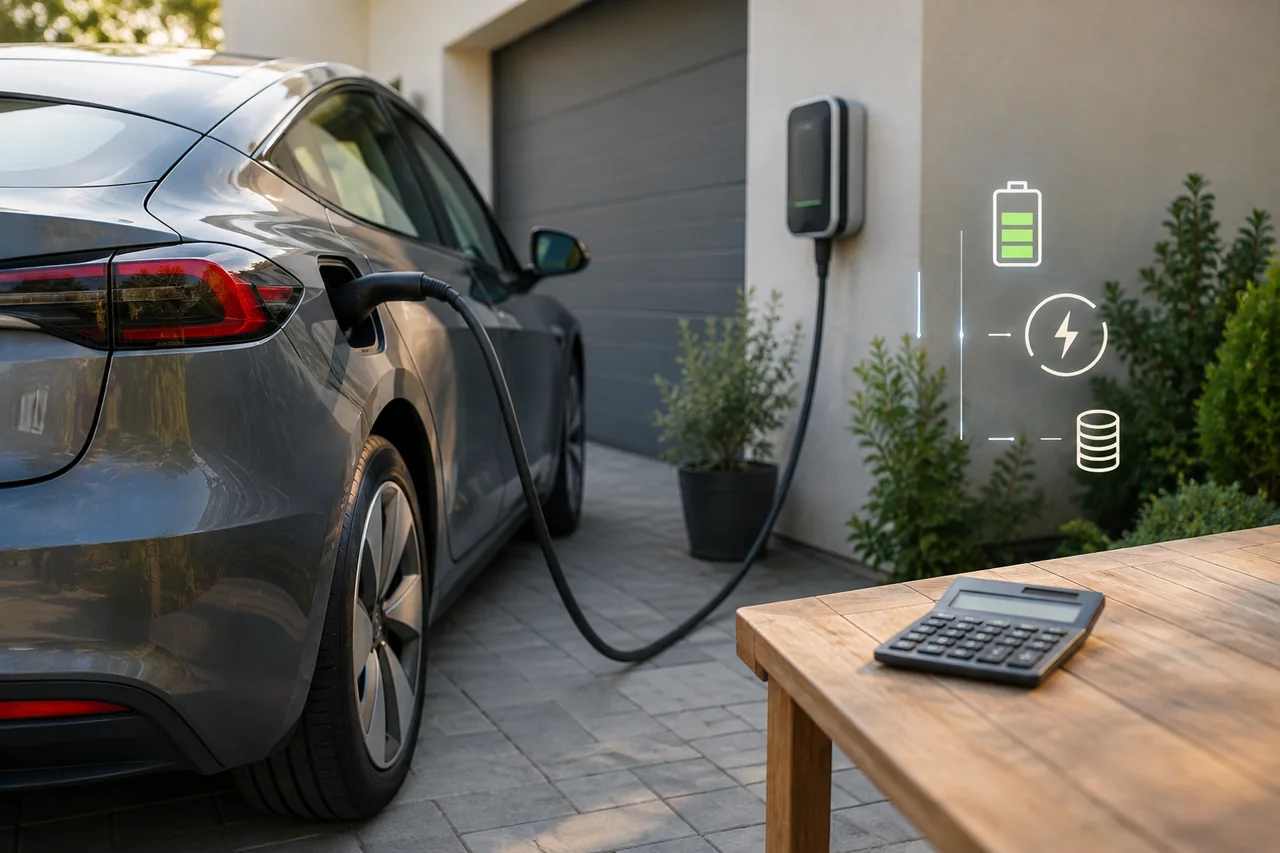
Learning how to calculate the cost of charging an electric car starts with energy in kilowatt-hours, the electricity rate you actually pay, and the difference between stored energy and billed energy. An electric car charging calculator simply packages that method. Whether you estimate home charging or a public session, the same inputs of usable battery capacity, state of charge, charging efficiency, and any session fees turn a charge into a dollar figure without relying on live tariff listings.
Gather the Inputs for Your Charging Estimate
To estimate a session, collect three battery figures: usable battery capacity in kilowatt-hours, the starting state of charge, and the target charge percentage you plan to reach. Usable capacity is the energy the vehicle can actually store and discharge for driving, which is the number that belongs in a charging cost calculation. The advertised pack size can be larger because manufacturers often reserve a buffer that never appears in the charge display, so substituting the headline total overstates the energy you can add.
Next, find the applicable electricity rate per kilowatt-hour for the hours you will charge, including time-of-use pricing windows and any extra charging fees that apply only when the vehicle is plugged in. Keep energy and power separate: kilowatt-hours measure how much electricity you buy, while kilowatts describe charging power, the rate of delivery. Entering a charger's kilowatt rating where a calculator expects kilowatt-hours produces a meaningless cost. Note idle fees or session fees only if they apply to the location you are modeling.
Calculate the Energy Needed for a Partial Charge
Energy added to the battery equals usable capacity multiplied by the difference between target and starting charge percentages, then divided by 100. In an explicitly hypothetical example, a 60 kWh usable battery charged from 30% to 80% stores approximately 30 kWh, because half of the usable pack is added in that window. That partial top-up is more typical than an empty-to-full cycle, which is why this formula is the practical starting point for how to calculate electric car charging cost.
Multiplying those 30 stored kilowatt-hours by the electricity rate gives only an initial estimate of charging cost, because the supply still has to cover charging losses before the energy sits in the pack. Treat the result as an estimate, not a meter reading. Displayed state of charge is rounded, usable capacity can drift with temperature and age, and the vehicle's own energy screens may not match household or public metered energy. Those practical measurement limits are why later steps adjust the stored figure rather than treating it as billed consumption.
Account for Energy Lost During Charging
Estimated supply energy is energy added to the battery divided by charging efficiency expressed as a decimal. Continuing the hypothetical example, 30 kWh stored at an assumed 90% efficiency requires 30 divided by 0.90, or about 33.3 kWh from the supply. That extra 3.3 kWh is conversion loss in the charger, cable, and battery thermal management, not energy available for driving. An electric car charging cost calculator that skips this step understates household and public bills whenever the wall or pedestal delivers more energy than the pack reports as stored.
Do not treat 90% as a universal charging efficiency. Cold weather, battery conditioning before a fast charge, the onboard charger or public equipment, and how long the session lasts can all change how much energy the supply must deliver for the same stored kilowatt-hours. When you have measured energy from the household meter, a smart charger log, or a public billing record, use that figure instead of an efficiency-adjusted estimate. Metered energy already includes losses at that measurement point, so applying a second loss factor would double-count them.
Estimate the Cost of Charging at Home
To estimate the cost of charging an electric car at home, multiply estimated household supply energy by the applicable electricity rate per kilowatt-hour. Completing the hypothetical example at an illustrative $0.20/kWh, about 33.3 kWh costs $6.67 when rounding is applied at the end. That home charging figure is the incremental energy cost of the session, which is what a cost of charging an electric car at home calculator should report when you supply the same rate and energy.
If the session crosses time-of-use pricing periods, split the kilowatt-hours into each window, multiply by that period's rate, and add the amounts rather than using a single blended figure. Include usage-based charges and taxes that rise with the extra kilowatt-hours. Existing fixed household charges, such as a standing fee or monthly service line, are not automatically an incremental charging expense unless you would not pay them without the vehicle. Leave those fixed items out of the session total so the home estimate stays limited to energy you actually used.
Include Public Charging Tariffs and Session Fees
At a public site, read the tariff for the selected location and identify every billed component: energy charges, time charges, session fees, minimum charges, and applicable taxes. For an energy tariff, multiply billed kilowatt-hours by the stated rate, then add those fees. Establish what the operator measures before you adjust for charging losses. If the pedestal already bills metered energy delivered to the vehicle, that quantity already includes conversion losses up to the meter; do not inflate it again with a separate efficiency divisor.
For a time tariff, multiply billable minutes by the stated per-minute or per-hour rate. Charge duration cannot reliably be inferred from the charger's maximum power alone, because the vehicle tapers current as state of charge rises, shares a stall, or pauses for thermal limits. Add parking and idle fees when their grace period has expired or the conditions on the tariff apply. Allocate a subscription or membership charge only when you are estimating a total that includes those membership costs, not when you are pricing a single walk-up session.
Use an Online Charging Cost Calculator Accurately
An online electric car charging calculator combines usable battery capacity, starting and target charge percentages, an electricity rate, and an optional charging efficiency allowance to estimate session cost. Before you rely on the result, check whether the tool assumes a full charge from empty, whether it includes losses, and whether it accepts public charging fees, idle fees, or session fees. An electric car charging costs calculator that silently assumes 100% efficiency and a complete fill will not match a 30-to-80% home top-up or a billed public stop.
For a UK electric car charging cost calculator, enter pounds, not pence, or convert pence per kilowatt-hour to pounds per kilowatt-hour by dividing by 100. Apply the same unit discipline to cents and dollars so a 20-cent rate is entered as 0.20, not 20. Validate the inputs against a completed charging session and its receipt or household meter record. The tool cannot predict changing tariffs or exact session conditions, so treat the result as a structured estimate rather than a substitute for the bill.