How to Back Up a Trailer Slowly
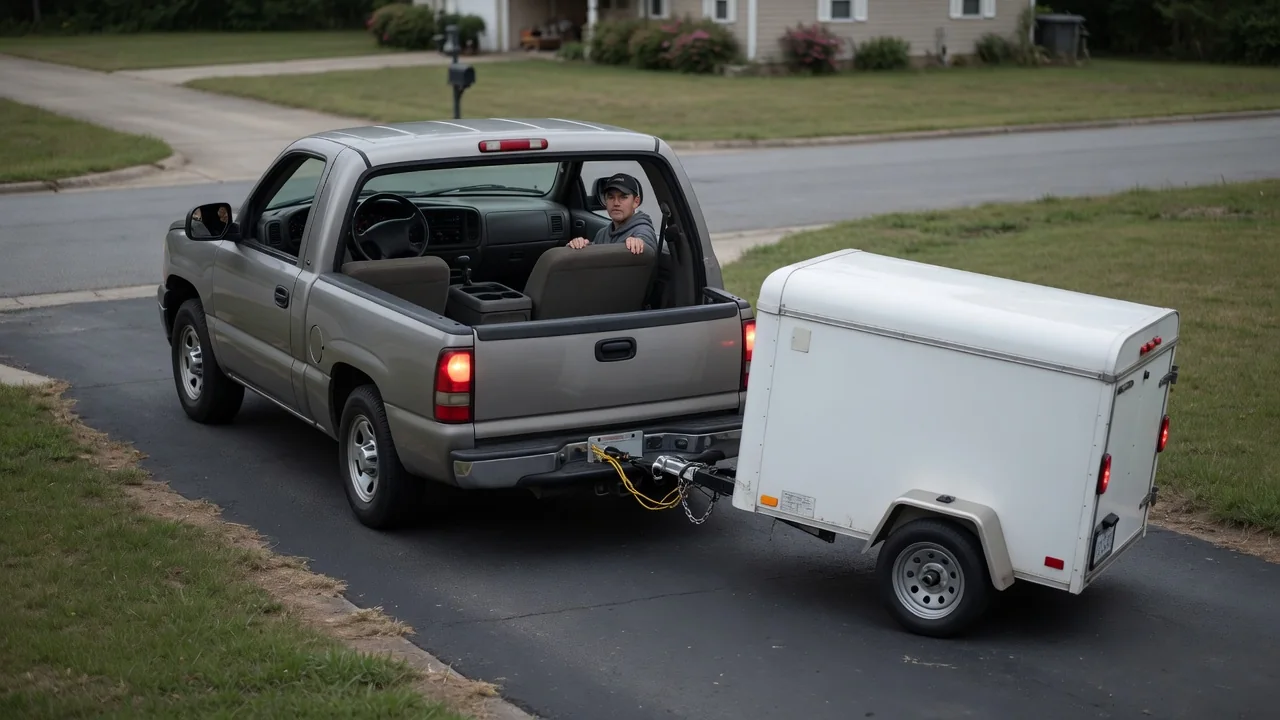
Learning how to back up a trailer slowly is mostly about giving yourself time to see what the trailer is doing before it gets away from you. At walking pace, steering inputs stay small, mistakes stay cheap, and the pivot at the hitch becomes predictable. The ideas below cover setup, steering, working with a helper, and knowing when to stop.
Start straight
A reverse maneuver goes best when the tow vehicle and trailer begin in one straight line. Pull forward far enough that the trailer follows directly behind and the front wheels point dead ahead. From that position, both side mirrors should show roughly equal slivers of the trailer's sides. That balanced view becomes your reference picture, so any later change in one mirror tells you immediately which way the trailer has started to drift.
Starting crooked means the trailer is already turning the moment you move, and you spend the whole reverse chasing it. Short trailers, such as small utility or personal watercraft trailers, react faster than long camping or boat trailers because the axle sits closer to the hitch. Mirror size, cab height, and whether a backup camera shows the coupler all vary by vehicle, so take a moment before moving to learn what you can and cannot see from the driver's seat.
Small corrections
The trailer pivots opposite to the direction the rear of the tow vehicle moves, which is why steering feels reversed. A common way to keep it straight is to hold the bottom of the steering wheel and move your hand toward the side you want the trailer to go. Whatever method you use, keep inputs to a small fraction of a turn, then pause and let the vehicle roll a few feet so the result shows up in the mirrors.
At idle or creeping speed, usually controlled with the brake pedal rather than the accelerator, there is time for that delay between input and reaction. When more trailer appears in one mirror, steer gently toward that mirror to bring it back in line, then unwind the wheel as the view evens out. Holding a correction too long is what produces a growing angle and eventually a jackknife. If the angle keeps increasing, stop, pull forward to straighten, and begin again.
Spotter communication
A spotter covers the areas mirrors and cameras miss, especially the far rear corner of the trailer and anything low behind it. Agree on signals before the vehicle moves, because shouted words are easily lost over engine noise or closed windows. Simple hand signals for keep coming, turn the trailer left or right, and stop are enough. It helps to decide whether directions refer to the trailer's rear or the driver's steering, since mixing the two causes confusion.
The spotter should stand where the driver can see them in a mirror at all times, off to one side rather than directly behind the trailer. If the driver loses sight of the helper, the right response is to stop until they reappear. Some people prefer a phone call on speaker or handheld radios in tight campsites or at dusk. Whatever the arrangement, the stop signal should be unmistakable and obeyed instantly, without waiting to understand why.
Everyday Use and Observations
Ordinary situations give the best practice: backing into a driveway, lining up at a boat ramp, or placing a camper on a pad. Before reversing, walking the path reveals posts, low branches, drainage dips, and slopes that mirrors flatten out. On an incline the rig may roll faster than expected, so brake control matters more. Loose gravel and wet grass can also let the trailer tires slide slightly sideways, changing how quickly it responds to steering.
Watch the trailer tires and fenders in the mirrors rather than the front of the trailer body, because the wheels show where it is actually heading. Fixed references such as a painted line, a curb edge, or the lip of a driveway make drift easier to judge. Vehicles with trailer backup assist, guideline overlays, or towing mirrors change what the driver sees and does, so the owner's manual is the place to confirm how those features behave on a particular model.
Limits and Next Steps
Slow speed reduces risk but does not remove limits. Every combination has an angle beyond which the trailer cannot be recovered in reverse and may contact the bumper, tailgate, or the vehicle's corners. Visibility has limits too: a tall enclosed trailer blocks the rear view entirely, and cameras lose usefulness in rain, glare, or darkness. When the picture stops making sense, stopping, setting the parking brake, and getting out to look is routine practice, not a sign of failure.
Skill builds fastest in an empty parking lot with a few cones or marked stalls, repeating straight-line reverses before attempting turns into a space. Practicing with the actual trailer matters, since length, axle position, and load affect its behavior. Before any session, checking that the coupler is latched, safety chains are attached, and lights work keeps the practice realistic. For hitch ratings, mirror requirements, and assist features, the vehicle and trailer documentation remain the reliable reference.