How to Assess a Project Car's Completeness
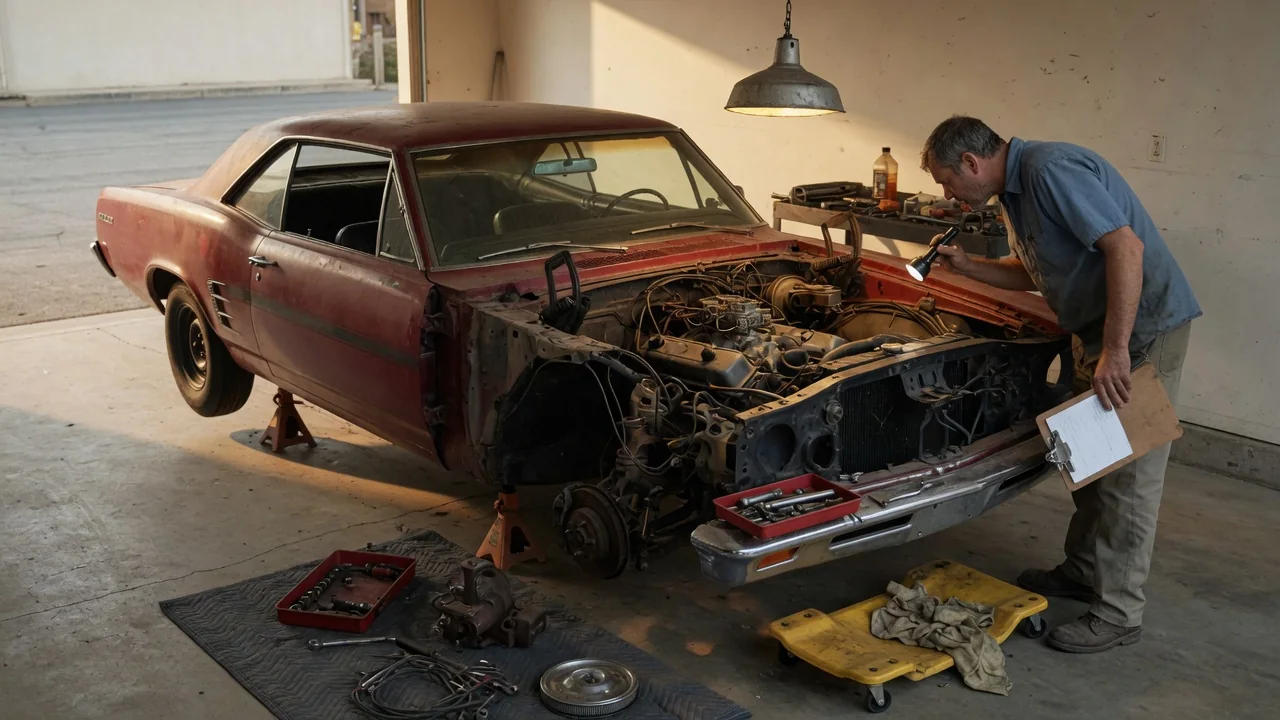
A project car that looks whole in listing photos can still be missing dozens of small parts, and each one can stall a restoration or stretch its budget. To assess a project car's completeness, check three areas methodically: exterior trim, mechanical systems, and the interior. This guide covers what to look for in each area, why small items matter, and how to turn your notes into a useful project car missing parts checklist.
Body trim
Exterior trim is often the first thing removed when a project stalls and the last thing anyone can find later. Walk around the car panel by panel and record what is actually attached: bumpers and their brackets, grille, headlight bezels, taillight housings and lenses, emblems and badges, window and wheel-arch moldings, drip rail and rocker trim, door handles, lock cylinders, mirrors, and wiper arms. Note condition alongside presence. Dented stainless, pitted chrome, cracked lenses, and faded plastic count as present but needing work, which is a different line item from missing. Pay close attention to fasteners. Clips, studs, and retainers tend to break or disappear when trim comes off. A molding without its mounting hardware may not reinstall cleanly, even though the visible piece is in hand.
Check glass and seals on the same walk-around. Confirm that the windshield, side glass, rear window, and any vent or quarter windows are present, and look for the channels, regulators, and retainers that hold them. Rubber weatherstripping is usually replaced during a restoration, but the metal or plastic parts it mounts to may not be easy to replace. If the seller has removed parts and stored them in boxes, ask to see them laid out so each one can be identified. Trim often varied by model year, trim level, and market, so a part that looks correct may belong to a different version of the car. Compare what you find against factory documentation for the specific vehicle, such as a parts catalog or assembly illustrations, rather than memory or photos of other cars.
Mechanical systems
Start with the engine and drivetrain. Confirm the engine is present and note any identification numbers so you can check them against documentation for the vehicle later. Do not assume they match. Then look at the components that bolt onto the engine, because these are the items most often borrowed for other projects: carburetor or fuel injection parts, intake and exhaust manifolds, starter, alternator or generator, water pump, fan, shroud, radiator, pulleys, and brackets. Brackets and pulleys deserve extra attention. They are often specific to one combination of engine and accessories and can be harder to identify than larger parts. Continue rearward to the transmission, shifter and linkage, any visible clutch or torque converter components, driveshaft, and rear axle or transaxle.
Chassis systems complete the picture. Follow the braking system from the master cylinder and booster through the lines to the wheel components. Follow the steering system from the column through the box or rack to the linkage. Look at springs, shock absorbers, control arms, and sway bar hardware. Trace the fuel system from the tank and sending unit through the lines to the engine. The wiring harness is easy to overlook and costly in effort to replace. Cut, spliced, or missing sections affect lighting, gauges, and starting circuits. A complete original harness also gives you a reference, even if it is later replaced.
Treat completeness and condition as separate questions. A seized or partly disassembled engine may still be complete, while a running engine can be missing accessories that were swapped for generic replacements. If parts are bagged, check whether the bags are labeled and whether the hardware for each assembly has been kept together.
Interior
Inside the car, work front to back and top to bottom. Record the seats and seat tracks, door panels, armrests, window cranks or power switches, headliner, sun visors, carpet, kick panels, sill plates, dash pad, instrument cluster and gauges, heater or climate controls, radio or radio delete panel, glovebox door, ashtrays, console, and seat belts. Open the trunk or cargo area and check for the lining, spare wheel, and jack components. As with exterior trim, small fasteners matter. Interior panels often rely on hidden clips and retainers that break with age.
Interior parts vary widely in how replaceable they are. Soft goods such as carpet, upholstery, and headliners are routinely replaced during a restoration. For those, the frames, springs, and mounting hardware underneath matter more than the fabric itself. Molded plastic pieces, switch bezels, gauge lenses, and panels specific to one trim level are harder to replace, because availability depends heavily on the vehicle and is not guaranteed for any given model. Give these hard-to-source pieces the most weight when you judge how complete the interior really is.
Practical implications and limits
Once the inspection is done, sort every item into three groups: present and usable, present but needing restoration, and missing. Then rank the missing items by how hard they are likely to be to find, not only by what they might cost. This ranking is the core of a working project car missing parts checklist. It often shows that a project's difficulty depends more on a handful of scarce parts than on the length of the list. A car missing many common items can be a more practical project than one missing a single part that rarely becomes available.
A visual assessment has limits. It cannot confirm the internal condition of the engine or transmission, reveal damage hidden behind trim, or prove that a part is correct for the specific car. Parts support varies by make, model, and era, so research what is available for the vehicle before committing to it. Use factory service manuals and parts catalogs as the reference for what should be there. Photograph the car thoroughly before anything else is removed. Also decide early whether your goal is a usable driver or an original-specification restoration, because that choice determines how strictly completeness and correctness need to be judged.