How Much Does an EV Battery Weigh and Why It Matters
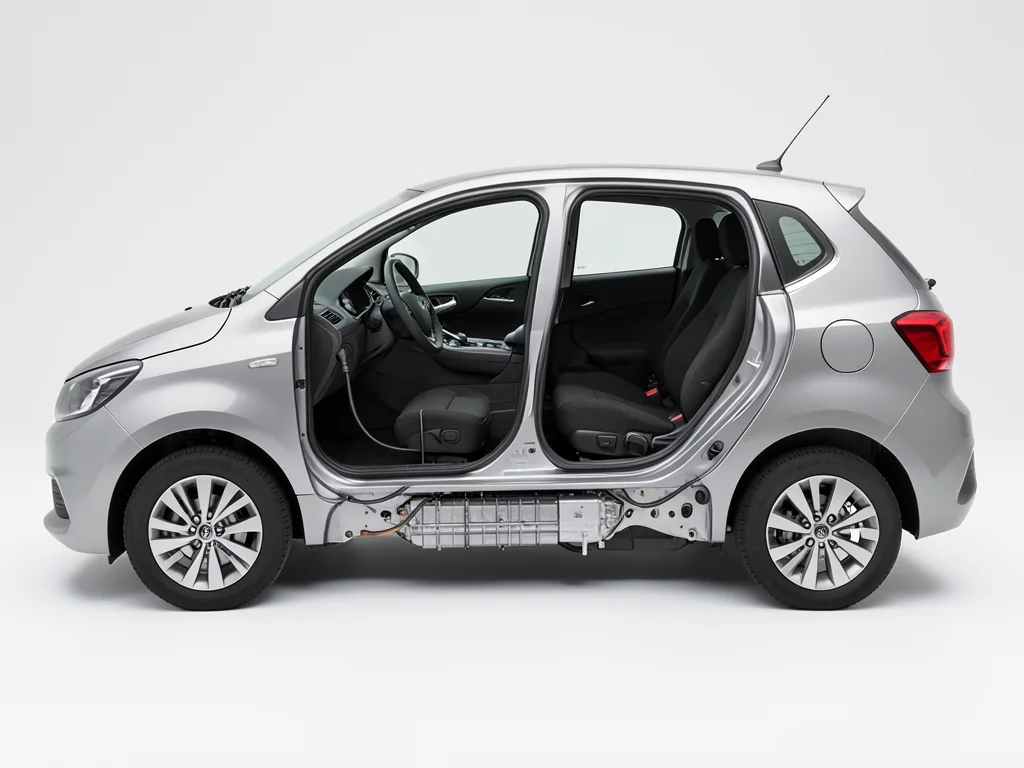
An electric vehicle's battery pack is one of its heaviest single components, typically weighing between 600 and 1,500 pounds, with some large packs exceeding 2,000 pounds. That mass affects acceleration, braking, tire wear, and driving range. Understanding what makes a pack heavy and how weight is measured helps owners interpret specifications and make better service and tire decisions.
Typical EV Battery Pack Weight and What It Includes
For many passenger EVs, the complete battery assembly weighs roughly 600 to 1,500 pounds, though small city cars may be lighter and long-range trucks or SUVs can top 2,000 pounds. These figures cover the entire pack, not just the cells. The enclosure, structural reinforcements, high-voltage wiring, busbars, contactors, cooling plates, and battery management hardware all add mass. Some packs fall outside this range because of differing battery capacity, energy density, and design priorities.
A weight figure is only useful if its scope is clear. Individual cells, a module containing several cells, and the full battery pack give very different numbers. Because manufacturers rarely publish cell-level weight, owners should assume a quoted figure refers to the whole assembly unless stated otherwise. Treat any published range as broad guidance, not a specification for a particular vehicle. The exact weight depends on the vehicle's architecture and the components included in the measurement.
What Determines a Battery Pack’s Mass
A pack's mass depends first on its stored energy, measured in kilowatt-hours. Larger capacity generally means more cells and greater weight, but the relationship is not a fixed pounds-per-kWh constant. Two packs with the same usable capacity can weigh differently because of cell chemistry, form factor, and how conservatively the battery management system limits charging. The total energy stored requires a certain amount of active material, so higher capacity typically increases mass, though improved energy density can offset some of that.
Pack architecture adds substantial weight beyond the cells. Crash protection, waterproof sealing, cooling hardware, and structural frames can account for a large share of total mass. Energy density—watt-hours per kilogram at the cell level—also matters, but design choices for cooling, module assembly, and enclosure rigidity mean usable capacity alone cannot predict pack weight. For example, a pack with liquid cooling and a heavy steel enclosure will weigh more than one with air cooling and an aluminum enclosure, even at similar capacity.
How Battery Placement Influences Handling
Most EVs mount the battery under the floor, placing hundreds of pounds low in the chassis. This lowers the center of gravity compared to a conventional car, reducing body roll and improving cornering stability. The effect is often noticeable, but it is not the only factor: suspension geometry, tire grip, weight distribution, and road surface all influence how the vehicle responds. A low center of gravity helps keep the vehicle planted, but heavy total mass still demands robust suspension and tires.
Greater total mass increases inertia, so a heavier EV needs more force to accelerate, brake, and turn. However, pack weight or placement alone cannot determine stopping distance, stability, or crash performance. Engineers tune suspension, brakes, and stability systems around the vehicle's mass, so a heavy EV can still handle predictably—though it may demand more from tires and brakes. The interaction between battery mass, chassis design, and electronic controls ultimately defines the driving experience.
What Battery Weight Means for Tires and Energy Use
Tires support the entire vehicle, including the battery pack. Higher load increases stress and can accelerate wear, but driving style, alignment, inflation pressure, and tire construction matter just as much. Owners should check the vehicle placard and approved tire specifications for the correct load rating and pressure; guessing based on battery weight is unreliable. Selecting tires with an appropriate load index helps ensure they can handle the vehicle's mass safely over their service life.
A heavier vehicle requires more energy to reach speed and to climb hills. Regenerative braking recovers only part of that energy, and losses occur in the motor, battery, and drivetrain. Temperature, speed, aerodynamics, terrain, and climate control all affect efficiency, so battery weight alone cannot predict range. A lighter pack helps, but it is only one input among many. For example, a heavy EV driven slowly on flat roads may use less energy than a lighter one driven fast in cold weather.
Finding a Reliable Weight for Your EV’s Battery
To find a reliable battery weight for your EV, first identify the exact model year, battery configuration, and vehicle variant. Manufacturer technical specifications or qualified service documentation give the most accurate figures, but check the units and what the stated weight includes—cells, modules, or the complete pack with enclosure and cooling. Often the owner's manual or a technical data sheet will list curb weight and sometimes battery weight separately.
Curb weight includes the installed battery, so it offers a broad reference, while payload and gross vehicle weight ratings address separate loading questions. Owners should limit checks to documentation; battery removal, lifting, or high-voltage inspection requires qualified professionals and appropriate equipment. Never attempt DIY disassembly based on a weight figure alone. The high-voltage system can be lethal even when the vehicle is off, so any physical inspection must be left to trained technicians.