How Is Tempered Side Glass Made? Heating, Quenching and Safety Breakage
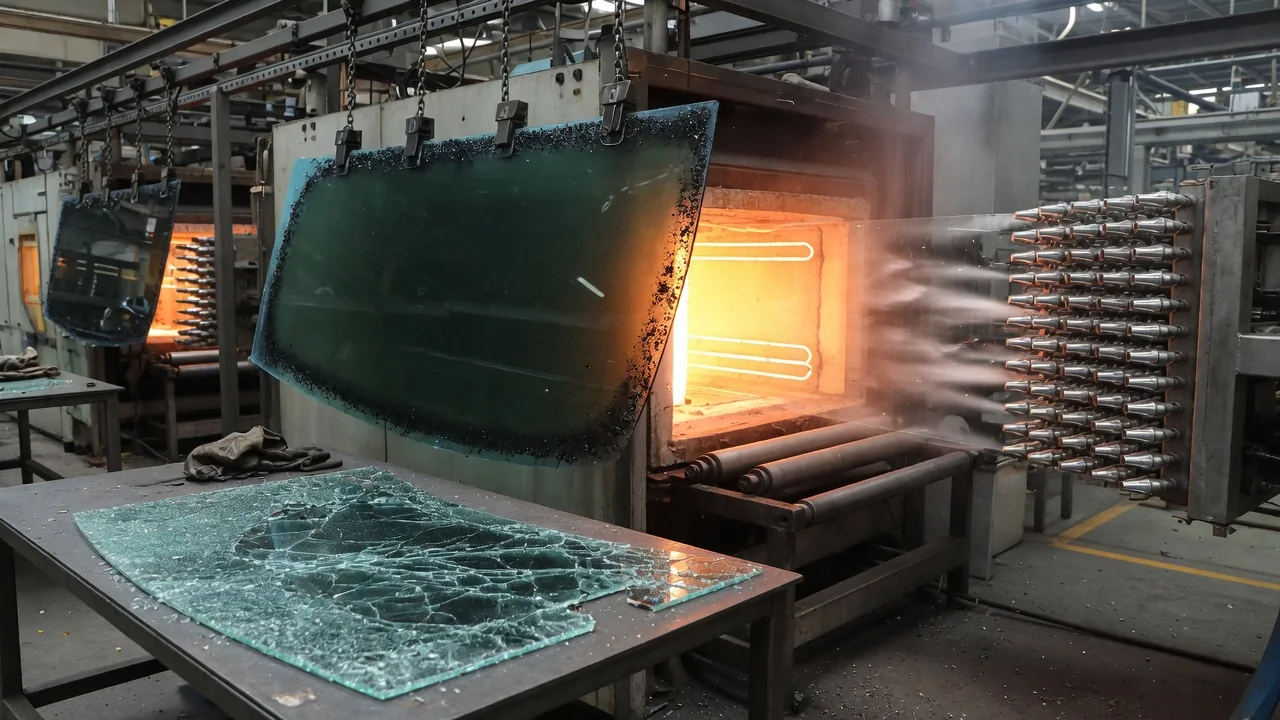
Most car door windows and many rear quarter windows are made from tempered glass, a single sheet of ordinary glass that has been heat-treated to change how it carries stress. Understanding how tempered side glass is made explains why these windows resist everyday loads well, why they cannot be cut after production, and why they collapse into small pieces instead of long shards. This guide walks through the heating and quenching process, the source of the added strength, and the characteristic break pattern.
Heating and quenching
Tempered car window manufacturing usually starts with flat soda-lime float glass, the same basic material used across the glazing industry. The sheet is cut to the outline of the finished window, and its edges are ground or seamed to remove sharp corners and small flaws that could later start a crack. Any holes, notches or mounting features are made at this stage, and decorative or functional ceramic prints, such as the dark border band, are typically applied before heat treatment. All of this work has to happen first, because once the glass is tempered it can no longer be cut, drilled or edged without destroying it.
The prepared blank then travels through a furnace, where it is heated evenly until it approaches its softening point. Uniform heating matters: hot and cool zones would leave uneven stresses or optical distortion in the finished part. Because most side windows are curved to follow the body shape, the softened glass is formed while it is hot, using methods such as roller forming, press bending against a shaped mold, or letting the sheet sag onto a frame. The exact method depends on the window shape and the production line, not on a single universal recipe.
Immediately after forming, the glass enters the quench, where banks of nozzles blow high-velocity air onto both surfaces at once. The outer surfaces cool and stiffen within moments, while the interior of the sheet stays hotter for longer. As that core gradually cools, it tries to shrink, but it is now bonded to surfaces that have already set. The result is a permanent, built-in stress profile: the surfaces end up in compression and the center of the glass in tension. The speed and balance of the air flow on each side are what make this profile consistent across the whole pane.
Strength
Glass almost always fails from the surface, where microscopic scratches and flaws act as starting points for cracks under tension. Ordinary annealed glass has very little stress locked into it, so a bending load or impact can quickly open those surface flaws. In tempered glass, the compressive layer at the surface has to be overcome before any surface flaw experiences tension at all. That pre-load is the main reason tempered glass is commonly described as several times stronger in bending than annealed glass of the same thickness.
This added strength helps a side window cope with the loads it sees in normal use: being driven up and down in its channels, door slams, wind pressure at speed, temperature changes between a heated cabin and cold outside air, and minor contact from washing or ice scraping. Tempered glass also tolerates temperature differences across the pane better than annealed glass, which reduces the risk of cracking when one area heats or cools faster than another.
The strength is not unlimited, and it is not evenly robust in every direction. The compression layer is relatively thin compared with the full thickness of the sheet, and the edges are typically the most sensitive area because they are harder to temper as uniformly as the flat faces. A sharp, concentrated point load, or damage that reaches through the compressive skin, can still break the glass. The internal tension in the core stores energy, which is useful for safety but also explains why the failure, when it comes, is sudden and complete.
Break pattern
Once a crack penetrates the compressive surface and reaches the tensioned core, the stored energy is released almost instantly. The crack branches rapidly in many directions across the entire pane, rather than running as one or two long lines. Because the whole sheet carries the same balanced stress, the fracture continues until the window has broken into a mass of small, roughly cube-shaped fragments. This is why a broken door window typically turns into a pile of granular pieces instead of a partly intact sheet.
These fragments tend to have relatively blunt edges compared with the long, dagger-like shards that annealed glass can produce. That behavior is the central safety reason for using tempered glass in side and rear positions: the pieces are less likely to cause deep cuts to occupants or rescuers. Safety glazing standards, such as FMVSS 205 in the United States, set requirements for automotive glass, and fragmentation behavior is one of the properties that tempering is meant to deliver consistently from part to part.
The trade-off is that a tempered window offers no barrier once it breaks. Unlike laminated glass, which has a plastic interlayer that holds broken pieces together, a tempered pane simply falls out of its frame or into the door cavity. The fragments may hold together briefly in a crazed sheet before dropping, but the window no longer keeps out weather, noise or objects.
Practical implications and limits
For owners, the manufacturing method has direct consequences for repair. Because tempered glass cannot be reshaped or trimmed after heat treatment, a damaged side window is replaced as a complete, pre-formed part rather than repaired or cut from stock. Chip and crack repair techniques used on laminated windshields do not apply to tempered side windows, since damage deep enough to matter usually breaks the whole pane. After a break, fragments often collect inside the door shell and around the regulator, so a proper replacement includes clearing that debris to protect the new glass and the window mechanism.
Edge care is worth remembering. Chips or nicks along an exposed edge, along with bent window channels or a misaligned regulator that pinches the glass, can leave it vulnerable to breaking later, sometimes without an obvious impact at the moment it fails. Rare internal inclusions in the glass can also cause occasional spontaneous breakage in tempered products generally. These events are uncommon, but they explain why a tempered window may occasionally break with no clear cause.
Not every side window is tempered. Some vehicles use laminated side glass for reasons such as noise reduction, security or occupant retention, and the construction can vary by position on the same vehicle. That difference matters if you carry an emergency window-breaking tool, which is designed for tempered glass and is far less effective against laminated panes. Markings printed on the glass and the vehicle documentation are the reliable way to confirm what a specific window is made of, rather than assuming based on general practice.