How Is EV Motor Torque Delivered to the Wheels?
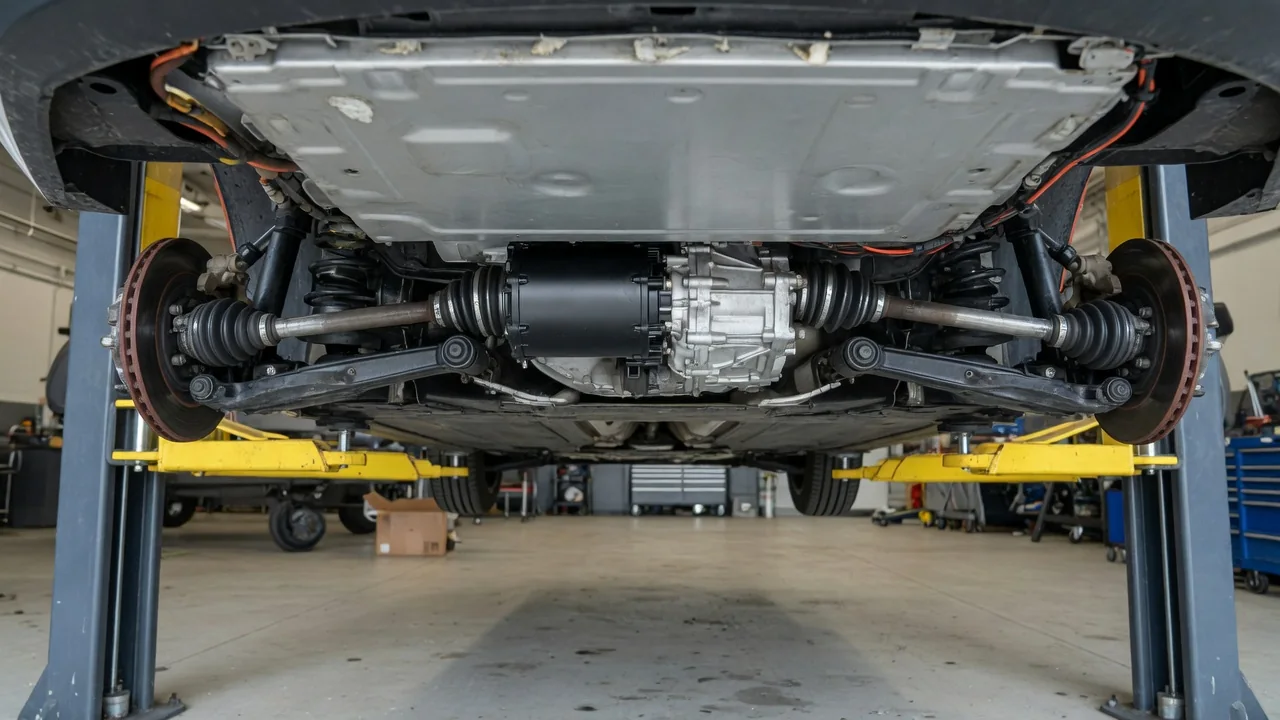
In an electric vehicle, torque does not travel from the motor straight to the tires. It passes through a short mechanical chain. A reduction gear trades motor speed for torque, a differential splits that torque between the left and right wheels, and a pair of axle shafts carries it to the hubs. This torque path is simpler than a conventional drivetrain, but each stage shapes how the car accelerates, turns, and recovers energy when slowing down.
Reduction gear
Most EV traction motors work best at high rotational speeds, often far faster than a wheel needs to turn even at highway speed. A reduction gear sits between the motor shaft and the differential to bridge that gap. It lowers the rotational speed and multiplies torque in the same proportion, minus small losses to friction and heat. As an illustration, a hypothetical 9:1 reduction would turn the motor nine times for each turn of the output and raise torque by nearly the same factor. The actual ratio varies by vehicle and is chosen to balance acceleration, efficiency, and top speed.
Unlike a gasoline engine, an electric motor can deliver torque from zero rpm and operate across a very wide speed range. For that reason, most EVs use a single fixed ratio rather than a multi-speed gearbox, with no clutch and no gear shifting in the usual sense. Reverse is typically achieved by commanding the motor to spin the other way rather than by engaging a separate reverse gear. The reduction is commonly built from helical gears, sometimes in two stages, inside a sealed housing filled with lubricant. In many designs the motor, inverter, and gearset are packaged together as one drive unit, which keeps the torque path short and compact. Some EVs use more than one gear ratio, so a single speed is a common approach rather than a universal rule.
The same gears work in reverse during regenerative braking. When the driver lifts off the accelerator or presses the brake, the wheels drive the gearset, which spins the motor faster than the wheels and lets it act as a generator. The reduction gear therefore carries torque in both directions, and its tooth geometry and bearings must handle those alternating loads.
Differential
After the reduction gear, torque reaches the differential, which is often housed in the same casing as the gearset. Its job is to send drive torque to both wheels on an axle while allowing them to rotate at different speeds. In a turn, the outer wheel travels a longer path than the inner wheel, so it must spin faster. Without a differential, one tire would have to scrub or slip, which would wear the tires, load the driveline, and make the car resist turning.
Most EVs use an open differential: a set of gears inside a carrier that is driven by the final reduction stage. An open differential splits torque roughly equally between the two sides. The trade-off is that the total torque it can deliver is limited by the wheel with less grip. If one tire sits on ice, the other cannot receive much more torque than the slipping wheel can use. Some vehicles add a mechanical limited-slip differential, but many rely on electronic control instead. The stability system can brake a spinning wheel, and the motor controller can reduce torque very quickly, which helps direct usable force to the wheel that still has traction.
Vehicles with one motor per axle usually have a separate gearset and differential on each driven axle, and software decides how much torque each axle receives. Some designs place separate motors on the left and right wheels of an axle and control them independently, replacing the mechanical differential's speed-splitting role with electronic control. These layouts are vehicle-specific, so the arrangement in a particular car should be confirmed from its own documentation.
Axles
The differential's two outputs connect to the wheels through axle shafts, often called half shafts or drive shafts. With independent suspension, which is common on EVs, these shafts must keep transmitting torque while the wheels move up and down over bumps and, on a steered axle, turn left and right. Constant-velocity joints at each end make this possible by passing rotation through changing angles without the speed fluctuations a simple universal joint would introduce.
The inner joint, near the drive unit, is usually a plunging type that lets the shaft change length slightly as the suspension moves. The outer joint, near the wheel hub, is usually a fixed type that tolerates larger angles, which matters most on front axles where steering adds angle. Each joint is packed with grease and sealed by a flexible boot. The shaft engages the wheel hub through splines, and the hub bearing supports the weight of the car while the axle supplies only the twisting force.
Axles are the final mechanical link, but the force that actually moves the car is generated where the tire meets the road. Tractive force equals the torque at the hub divided by the tire's rolling radius, so tire size influences the effective overall gearing. The axle shafts also carry regenerative braking torque back from the wheels, so they are loaded in both directions each time the driver accelerates and slows down.
Practical implications and limits
Because an electric motor can apply strong torque almost immediately, the driveline sees sharp load changes. Manufacturers manage this mainly through software: torque is ramped and capped to protect gears, joints, and tires, and traction control trims output when wheel slip is detected. That is why vehicles with similar motor ratings can feel quite different, and why available acceleration may be reduced at low battery charge, in cold weather, or when components are hot. The exact behavior depends on each vehicle's calibration.
The absence of engine noise makes driveline sounds easier to hear. A faint gear whine under acceleration or regeneration is a normal trait of many reduction gearsets. A new or changing noise, a clunk when switching between acceleration and regeneration, or a clicking sound while turning can point to wear in the gears, mounts, or CV joints. A torn CV boot lets grease escape and dirt enter, so it is worth checking during routine tire or brake service. Whether the gear oil needs periodic replacement varies by manufacturer, so the service schedule in the owner's manual is the reference rather than general assumptions.
Towing also deserves attention. Because the drive wheels are mechanically linked to the motor through the differential and reduction gear, rolling an EV on its drive wheels can spin the motor and may generate voltage or cause wear. Many manufacturers call for flatbed transport or wheel dollies, but the correct procedure is defined in each vehicle's manual. Finally, a single fixed ratio means top speed is bounded partly by the motor's maximum safe speed, which is a deliberate design compromise rather than a fault.