How Is Car Paint Color Matched After a Repair?
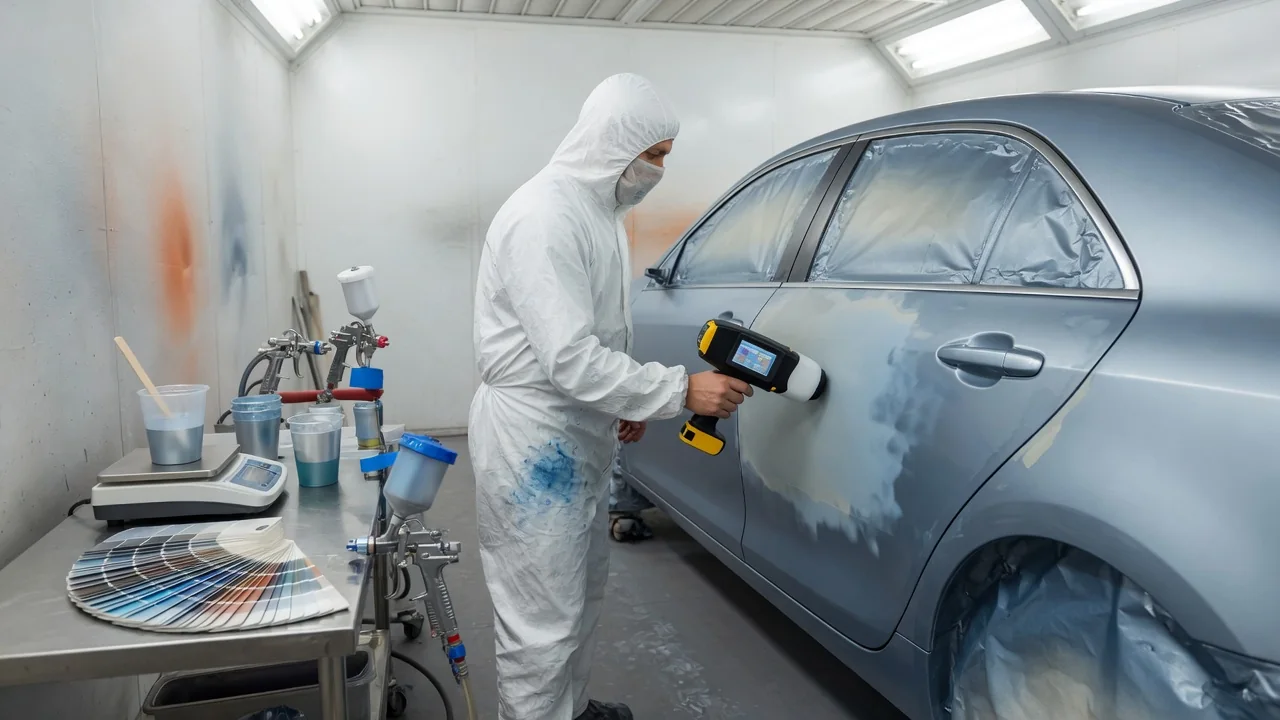
When a panel is repaired or replaced, the new paint has to sit beside finish that left the factory years earlier and has been outdoors ever since. Automotive paint color matching is less about finding a single correct can of paint and more about a sequence of steps. The shop identifies the original color, chooses the closest production version of it, and applies it so the eye cannot find the edge. Here is how body shops typically handle each stage.
Color code: the starting point for a paint match
Most vehicles carry a paint code assigned by the manufacturer, usually printed on an identification label. Common locations include the driver's door jamb, the inside of the door frame, under the hood, or in the trunk area, though placement varies by manufacturer and model. The code may appear next to labels such as 'paint,' 'color,' or 'EXT,' and some labels list separate codes for interior trim. If the label is missing or unreadable, a dealer or paint supplier can often retrieve the original color from the vehicle identification number.
The code points to a formula in a paint manufacturer's database, which lists the toners and their proportions needed to mix that color. This is why the code matters: it narrows a huge range of possible shades down to one named color. It does not guarantee an exact match. The code describes the color as it was specified, not necessarily as it was sprayed on a particular car, and it says nothing about how the finish has changed since. Treating the code as the starting point rather than the final answer is what separates a careful match from a visible one.
Variant sampling: finding the version that matches your car
A single factory color can be produced in slightly different versions. Cars with the same code may have been painted at different assembly plants, with paint from different suppliers, or in different production periods, and each of these can shift the shade a little lighter, darker, warmer or cooler. Paint companies account for this by publishing variants of a formula alongside the standard mix. Shops often use variant chip decks, which are sprayed or printed samples of these alternatives, to compare against the car.
The comparison is made against a clean, polished area of the car close to the repair, since dirt and oxidation distort what the painter sees. Many shops also use a spectrophotometer, a handheld instrument that reads the color of the existing finish and suggests the closest formula or variant from the paint system's database. The reading is useful, especially for narrowing the choices, but it is still checked by eye because effect finishes and curved surfaces can complicate the measurement.
Before anything goes on the car, painters commonly make a spray-out card: a test panel sprayed with the chosen mix using the same technique, number of coats and clearcoat planned for the repair. Holding the card next to the vehicle in daylight and under other light sources shows whether the variant is right or needs adjustment. If it is close but not quite there, the painter may tint the formula by adding small amounts of specific toners, then spray another card. Metallic and pearl colors are checked both straight on and at a low angle, because the way the flakes reflect light changes how the color reads from different viewpoints.
Blending: making the repair disappear into nearby panels
Even a well-chosen and tinted mix can look slightly different once it sits directly against the original paint, so many repairs rely on blending. Instead of painting the repaired panel to a hard edge, the painter applies full color coverage over the repaired area and then gradually fades the basecoat into the neighboring panel or the undamaged part of the same panel. The transition is spread across a wide area, which makes any small difference in shade far harder for the eye to pick out.
Blending is particularly common with metallic, pearl and tri-coat finishes, where the orientation of effect particles depends on spray technique as well as the formula. A door repaired in a silver metallic, for example, might be blended into the fender and the adjacent door so the change happens gradually rather than at a panel gap. After the basecoat is blended, clearcoat is usually applied over the whole affected panel or panels so the gloss and texture look uniform, since a visible edge in the clear can be as noticeable as a color mismatch.
Solid colors without metallic or pearl effects are sometimes painted without a blend when the match on the spray-out card is very close. That decision depends on the color, the condition of the surrounding paint and the painter's judgment rather than a fixed rule.
Practical implications and limits of paint matching
For owners, the practical consequence is that a repair often involves more of the car than the damaged area. An estimate may list labor and materials for adjacent panels that were never touched, because blending into them is part of producing an invisible repair. That is normal practice, though it is reasonable to ask a shop which panels will be blended and why. Bumper covers and other plastic parts can also look slightly different from metal panels painted in the same color, since the substrate and preparation affect how the finish appears.
There are real limits to how close a match can get. Paint that has faded, oxidized or been polished many times may no longer resemble any published variant, and the shop has to match the car as it is today. Two colors can also appear identical under one light and different under another, an effect called metamerism, so a match that looks right in a paint booth may read slightly off in sunlight or under streetlights. Multi-layer finishes such as tri-coat pearls are generally harder to match because the final appearance depends on the thickness of the mid-coat as well as the formula.
Replacement panels supplied already painted, and touch-up paint bought by code alone, skip the sampling and blending steps, which is why they can stand out even when the code is correct. When evaluating finished work, look at the repair in natural daylight from several angles and distances. A slight difference visible only at certain angles may be within what blending can realistically achieve, while an obvious shade shift across a panel gap usually means the variant or tint needs to be revisited.