How Is a Tire Speed Rating Tested? Lab Methods, Meaning and Limits
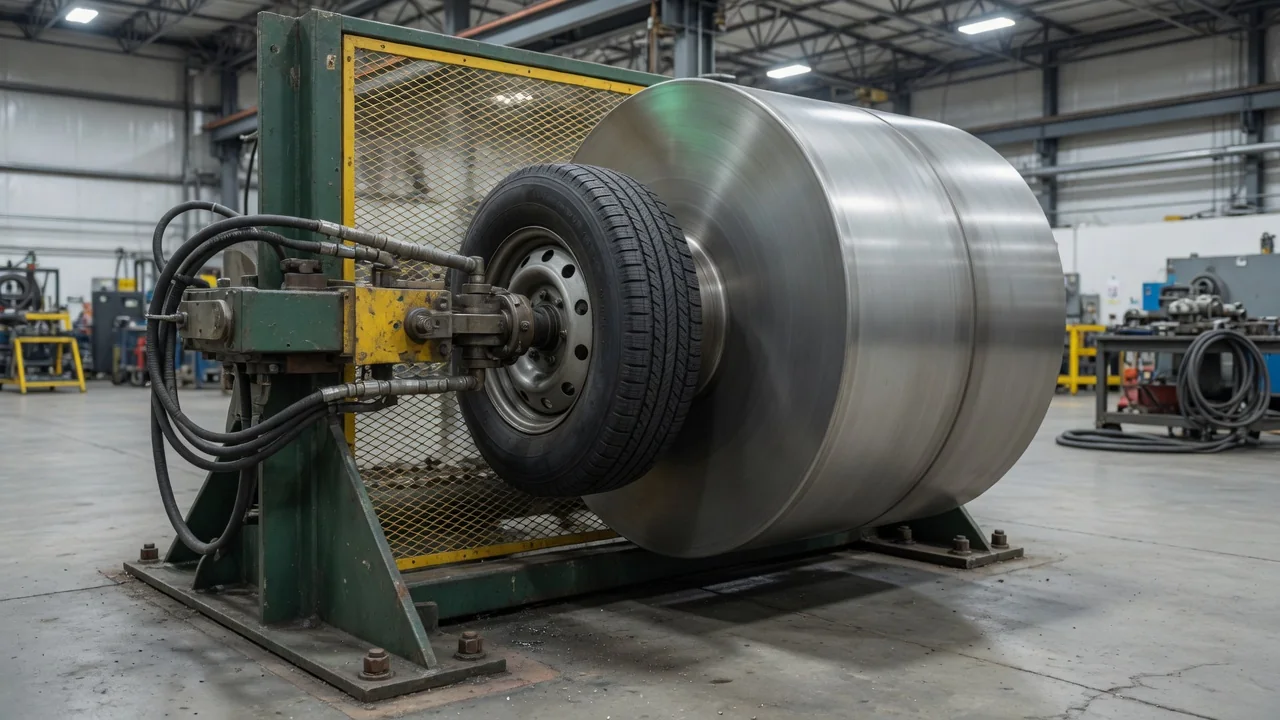
The speed rating letter on a tire sidewall looks simple, but it summarizes a controlled laboratory test. It is not a promise about how fast a car can safely travel. Knowing how a tire speed rating is tested explains what the letter certifies, why heat is the central concern, and where the rating stops being useful. This guide covers the concept behind the tire speed rating test, what the result means, and the conditions under which it no longer applies.
Lab conditions
Speed ratings are established indoors, not on a track. The tire is mounted on a standard test rim, inflated to a specified pressure, and pressed against a large steel drum, often called a roadwheel, under a controlled load. A motor drives the drum, so the tire spins as if the vehicle were rolling down a road at the selected speed. The test room holds ambient temperature within a defined range. The test is essentially about how the tire manages heat, so outside variables would make results hard to compare. Before the run, the tire is typically conditioned at room temperature so every sample starts from a consistent state.
The run follows a stepped profile. The drum starts below the target speed, and the speed is raised in increments, with each step held for a fixed period. The final stage brings the tire up to the speed tied to its intended letter and holds it there for a prescribed time. Regulatory and industry procedures differ in their exact speeds, durations, loads and pressures. In the US, a federal high-speed requirement for passenger tires sets a baseline that applies regardless of the letter a tire carries. Letters above that baseline are qualified using standardized industry or international procedures, and the manufacturer is responsible for certifying that the tire meets them.
At the end, the tire is judged mainly by what did not happen. Inspectors look for tread or sidewall separation, chunking, cracked or broken cords, open splices and bead damage. They also confirm that inflation pressure has not dropped. A tire that completes the full profile without these failures qualifies for that speed category. The result is pass-or-fail. It does not measure how far beyond the rating the tire could go, and it gives no extra credit for finishing cooler than required.
Rating meaning
The speed rating is formally called a speed symbol. It is the final character of the service description molded into the sidewall, after the load index, as in a marking such as 94H. Each letter corresponds to a maximum speed. Common passenger examples include S at 112 mph, T at 118 mph, H at 130 mph, V at 149 mph, W at 168 mph and Y at 186 mph. The sequence is mostly alphabetical, but H is a historical exception that sits between U and V. A ZR designation within the size marking indicates capability above 149 mph. A Y symbol in parentheses indicates capability above 186 mph.
What the letter certifies is narrow. It says the tire can carry its rated load at that speed for a sustained period, provided it is correctly inflated and undamaged. It is a ceiling under ideal conditions, not a recommended cruising speed. The physics explains why speed matters. On every rotation, the tread and sidewalls flex as they pass through the contact patch, and that flexing generates heat. Faster rotation means more flex cycles per second and less time for the heat to escape. Rubber, and the bond between rubber and reinforcing cords, weakens as temperature rises. The rating marks the speed at which the construction can still shed heat fast enough to stay intact.
Speed and load are linked. For the higher categories, industry load tables reduce the permitted load as speed approaches the rated maximum, so the load index and speed symbol should be read together. A higher letter usually reflects construction choices, such as added reinforcement under the tread and compounds that tolerate heat. Even so, the letter alone does not grade grip, ride comfort, wet braking or tread life.
Limits
A drum test is a controlled approximation of the road, and the differences matter. A curved drum shapes the contact patch differently from flat pavement. The test also runs in a straight line, with no cornering forces, braking, crosswinds, potholes, curbs or debris. Pavement temperature, sun exposure and heat from nearby brakes are not part of the procedure. The rating isolates one question: whether the construction survives sustained speed under a set load and pressure. Every other real-world variable is left aside.
The rating also assumes the tire is in the condition it left the factory. Underinflation is the biggest threat because it increases sidewall flexing and heat buildup, and overloading has a similar effect. Impact damage, cuts, driving while seriously underinflated, age-related hardening and improper repairs can all weaken the structure in ways the original test never considered. Many tire manufacturers advise that a repaired tire should not be treated as keeping its original speed capability. And because the rating comes from a qualification test on new tires, it says nothing about how much margin a particular tire has left after years of service.
Finally, the speed rating describes the tire, not the vehicle. Suspension, aerodynamics, brakes and any electronic speed limiter shape how a car behaves at speed, and these differ from one vehicle to another. A high rating does not make a vehicle stable, or legal, at that speed.
Practical implications and limits
For most drivers, the useful question is not how fast the tire can go but whether it meets what the vehicle requires. The vehicle maker lists the minimum speed symbol on the tire information placard, usually on the driver's door jamb, and in the owner's manual. Replacement tires should generally match or exceed that symbol, because it was chosen with the vehicle's weight, performance and handling in mind. Some exceptions exist, such as certain winter tires with a lower symbol. In those cases, the vehicle maker's guidance or local rules typically call for respecting the lower limit, sometimes with a reminder label placed in the driver's view.
Mixing speed symbols on one vehicle is generally discouraged, because tires with different construction can respond differently in handling and braking. If it cannot be avoided, common guidance is that the lowest-rated tire sets the effective limit for the whole vehicle and that matching tires go on the same axle. Some owner's manuals also call for higher inflation pressure during sustained high-speed driving or heavy loads. That advice follows the same heat-management logic as the lab test.
Day to day, maintenance protects the rating more than watching the speedometer does. Checking cold inflation pressure regularly, staying within the load the placard allows, and inspecting for bulges, cuts and uneven wear keep a tire close to the conditions under which it earned its letter. Treat the speed symbol as proof that the tire passed a demanding heat-endurance test when new. It is not a guarantee that holds for every road, every vehicle or every stage of the tire's life.