How Is a Car Windshield Curved During Manufacturing?
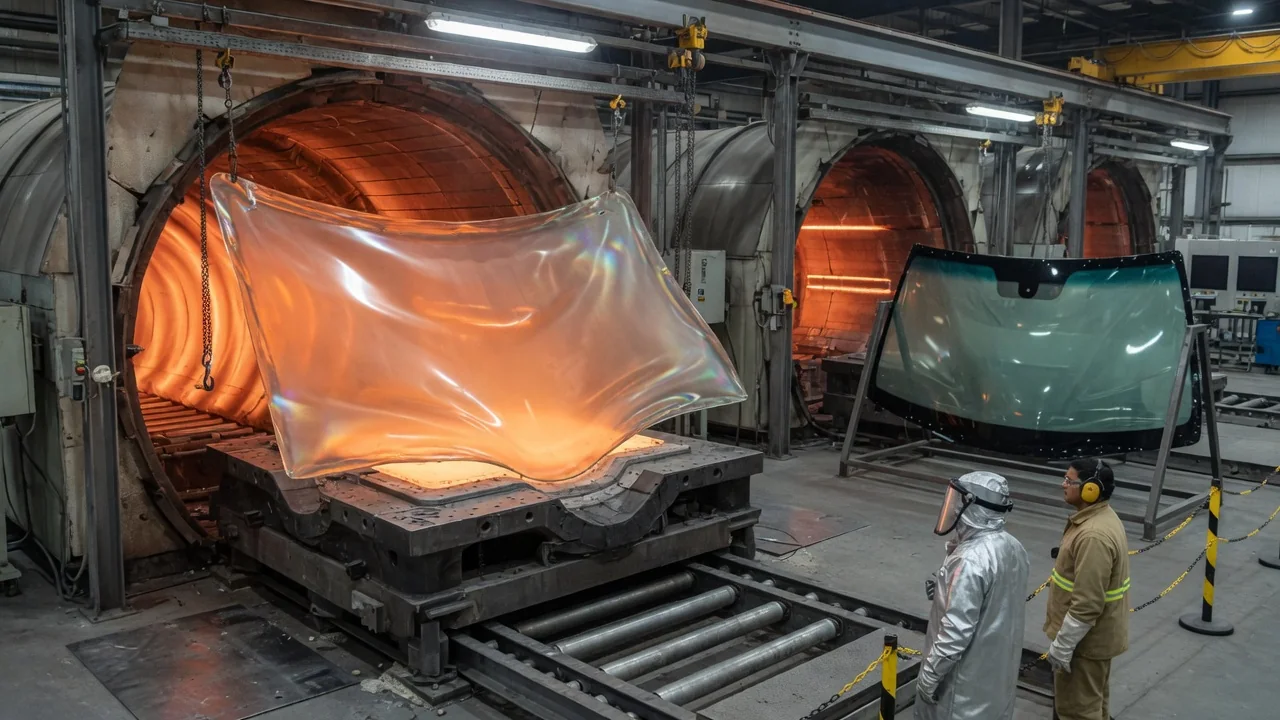
A car windshield starts as flat sheets of float glass, yet it ends up with a precise compound curve that has to match the body opening and give the driver a clear view. The windshield glass bending process depends on three things working together: carefully controlled heat that softens the glass, a mold or press that defines the final shape, and tight control of optical quality so the curved glass does not distort what the driver sees.
Heating: Softening the Glass in a Controlled Furnace
Most windshields are laminated, meaning they consist of two glass plies bonded to a plastic interlayer. Before bending, both plies are cut to their outline from flat float glass, and their edges are ground or seamed so they are less likely to chip or crack under heat. The black ceramic band seen around the edge of most windshields is usually screen-printed onto one ply at this stage, and it fuses into the glass surface during the heating that follows. In many plants, the inner and outer plies are then stacked with a thin parting powder between them, so they can be bent as a matched pair without sticking together.
The stacked pair travels through a long furnace, often called a bending lehr, where the temperature rises gradually. Glass does not melt at a single point; it softens progressively as it heats, and bending takes place in a narrow range where the glass becomes viscous enough to deform under its own weight or light pressure while keeping its surface quality. Heating too quickly creates thermal stress that can crack the glass, while overheating can make it sag too far or pick up marks from the tooling. Furnaces therefore use zoned heating, and some designs direct extra heat to areas that need deeper curvature, so different parts of the same sheet reach slightly different temperatures.
After the shape is formed, the glass is cooled slowly in a process called annealing, which relieves internal stresses rather than locking them in. This is a key difference from side and rear windows, which are typically tempered by rapid cooling so they break into small granules. A windshield is left annealed because, once laminated, it is meant to crack while staying in one piece, held together by the interlayer.
Mold Shape: How the Final Curve Is Defined
The traditional method is gravity sag bending. The flat glass pair rests on a ring-shaped or skeletal mold that supports only the edges and follows the outline of the finished windshield. As the glass softens in the furnace, gravity pulls the unsupported center downward until the edges settle onto the mold and the sheet takes on the intended curvature. For shapes with deeper wrap at the corners, molds may have hinged or articulated sections that start in a flatter position and swing upward as the glass softens, guiding the ends into tighter bends.
Where gravity alone cannot produce the required geometry, press bending is used. The softened glass is pressed between a shaped full-surface tool and a ring, or pushed against a form, to create sharper or more complex compound curves in less time. Contact surfaces are typically covered with heat-resistant fabric so they do not mark the glass. Some production lines combine both techniques, letting the glass sag first and then pressing it to its final shape.
Designing the mold is not as simple as copying the target shape. Hot glass keeps moving slightly as it cools, the two plies behave a little differently because of their positions in the stack, and areas with the printed ceramic band absorb heat differently from clear glass. Mold designers account for these effects, commonly through computer simulation and trial adjustments, so the cooled windshield matches the vehicle design within tolerance. The inner and outer plies must also match each other closely; gaps between them make lamination harder and can trap air or create stress.
Optical Quality: Keeping the View Undistorted
Every curve changes how light passes through the glass. A smooth, uniform curve has little visible effect, but local variations in curvature or thickness act like weak lenses, making objects appear to wobble, stretch or shift as the driver moves their head. Reflections in the glass can also look warped. Because a windshield is mounted at a steep angle, small surface irregularities are exaggerated along the line of sight, so bending must avoid ripples, dents and abrupt curvature changes, especially in the main viewing area in front of the driver.
A specific concern is the double or secondary image. Light reflects between the inner and outer surfaces, and on an inclined, curved windshield this can produce a faint second image offset from the first, most noticeable with bright lights at night. Windshields designed for head-up displays address a related problem: the projected image reflects off both surfaces, so these windshields often use a wedge-shaped interlayer that is slightly thicker at one edge to bring the two reflections into alignment. That design only works if the bent glass matches the shape the optics were designed around.
Manufacturers inspect bent glass for both shape and distortion, using methods such as checking parts against gauges or fixtures and viewing patterned grids through the glass or reflected in it, often with automated optical scanning. Safety glazing standards set limits on optical distortion, with the strictest requirements usually applied to the driver's primary vision zone and more tolerance near the edges, where the glass curves most sharply and the ceramic band covers part of the surface.
Practical Implications and Limits
For car owners, the most visible consequence is that a windshield is a shape-specific part. Its curvature is set during bending and cannot be changed afterward, so a replacement must be made for the exact body opening, and glass that is slightly off in shape may not seat evenly in the urethane bead. Poor fit can contribute to wind noise, leaks or stress at the edges. Mild waviness near the perimeter is generally a normal byproduct of tight curves rather than a defect in itself, while distortion directly in front of the driver is worth raising with the installer.
Optical quality also matters for equipment mounted behind the glass. Forward-facing cameras for driver-assistance systems look through a defined area of the windshield, and head-up displays depend on the glass geometry and interlayer. Because the mechanisms described here are general, the requirements for a particular vehicle, such as which windshield variant it needs or whether camera recalibration is required after replacement, come from the vehicle manufacturer's service information. Furnace temperatures, cycle times and mold designs also vary by manufacturer and cannot be verified by looking at the finished glass.