How Is a Car Seat Frame Built? Structure, Recliner and Mounting Explained
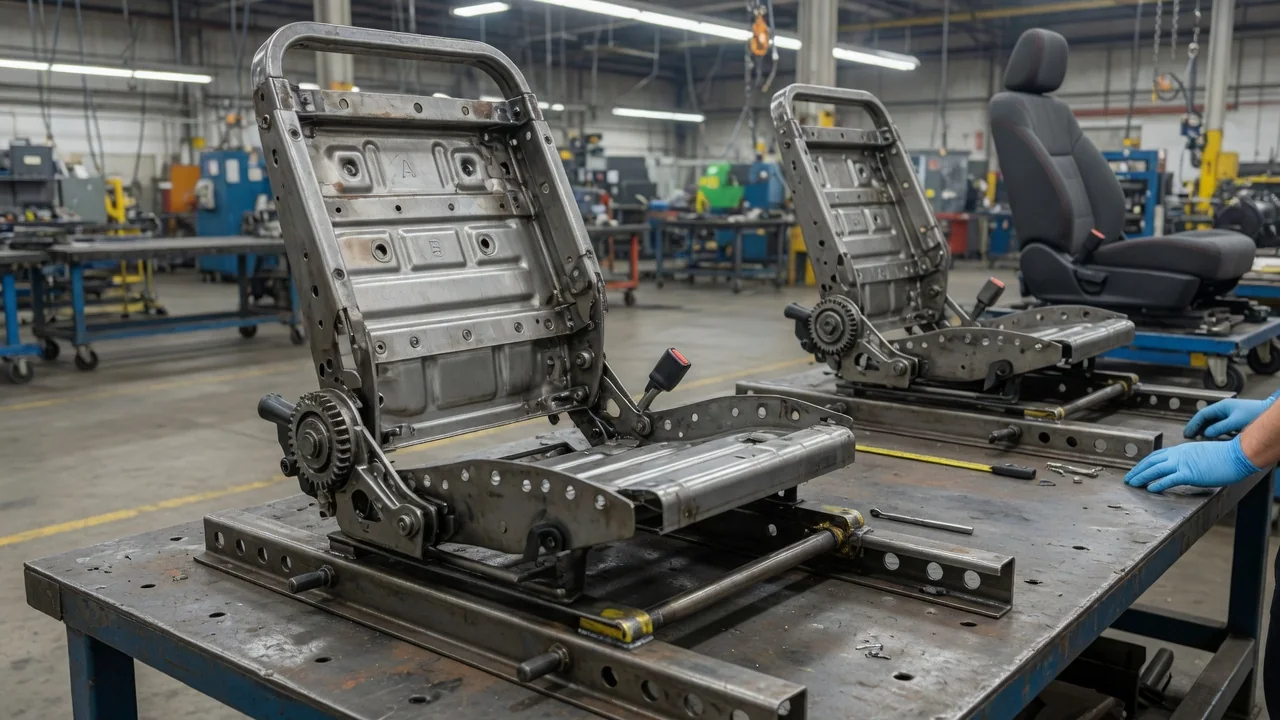
A car seat looks like foam and fabric, but its shape, adjustability and crash behavior come from a hidden metal skeleton. Knowing the basics of car seat frame construction explains why a seat feels solid or loose, why some damage calls for replacement rather than repair, and how the seat connects to the body of the vehicle. This guide explains how a car seat frame is built by walking through the metal structure, the recliner and the mounting hardware.
Metal structure: the seat's hidden skeleton
Most front seat frames are made of two main subassemblies: a cushion frame that you sit on and a backrest frame that supports your back. Each is typically built from stamped sheet steel, steel tubing, or a combination of the two. Stamped side members give the frame its outline, while cross tubes or stamped cross members tie the sides together and keep the structure square. The parts are joined mainly by welding, with some bolted or riveted connections where components need to be serviceable or assembled in stages. Many modern designs use higher-strength steel grades so the frame can stay stiff with thinner, lighter sections, and some designs use aluminum or other light alloys for selected parts, although steel remains the common choice.
The open area inside the cushion frame is spanned by a suspension layer. Depending on the design, this may be a set of sinuous (zigzag) wire springs, a welded wire grid, or a plastic or fabric suspension mat hooked between the side members. The molded foam pad rests on this layer and the stamped front pan, which supports the thighs. The backrest frame usually has a tubular or stamped perimeter, with guide tubes at the top for the headrest posts. It also carries brackets for trim attachment, wiring clips and, where fitted, mounting points for a lumbar support mechanism or a side airbag module.
The shape of these parts is not only about comfort. The frame has to carry the occupant's weight over years of use and manage loads during a collision, especially a rear impact, when the occupant is pushed back into the backrest. Those loads travel from the backrest frame through the pivot joint into the cushion frame and then down to the floor. Rear seats follow the same logic with different packaging: a folding rear backrest is often a large stamped panel that also acts as a barrier between the cabin and the cargo area, latching to the body when upright.
Recliner: the joint between cushion and backrest
The recliner is both a hinge and a lock. It lets the backrest pivot relative to the cushion and then holds it firmly at the chosen angle. Front seats commonly have a recliner mechanism on each side, or a mechanism on one side and a matching pivot on the other. When both sides lock, a cross rod or shaft usually connects them so they release and engage together, which keeps the backrest from twisting. A coil or clock spring typically biases the backrest forward, so it rises toward the occupant when the lock is released and no one is leaning on it.
Two broad recliner designs are widespread. The lever type uses a toothed sector and a spring-loaded pawl: pulling the lever lifts the pawl out of the teeth, and releasing it lets the pawl drop back in, giving a series of stepped positions. The rotary or disc type uses two round housings with internal gear teeth and an eccentric drive between them. Turning a knob or a motor-driven shaft makes one disc walk around the other in small increments, giving near-continuous adjustment. Power recliners generally pair a disc-style mechanism with an electric motor and gearbox. In every type, the engaged teeth carry the load, so their condition largely determines how solid the backrest feels.
Some seats add secondary releases. Front seats in two-door cars or vehicles with third-row access often have an easy-entry mechanism that folds the backrest forward and, on some designs, slides the seat ahead, then returns it to a remembered position. Folding rear backrests use a separate latch at the top or side that engages a striker on the body, in addition to the pivots at the bottom.
Mounting: tracks, risers and floor anchors
The cushion frame rarely bolts directly to the floor. Instead it sits on a pair of seat tracks, also called rails or slides. Each track has a lower rail and an upper rail that slides within it on balls, rollers or low-friction pads. On manual seats, a release bar under the front edge lifts locking teeth or pins out of a row of slots in the track; releasing the bar lets them re-engage. Power seats replace the bar with a motor driving a screw or gear along each track. Between the tracks and the cushion frame there may be height-adjustment linkages, operated by a ratcheting pump lever or by additional motors that raise and tilt the cushion.
The lower rails, or separate risers beneath them, are bolted to the floor pan, commonly at four points. The bolts usually thread into nuts or reinforcement plates welded to the floor or to crossmembers so the load spreads into the body structure. In many vehicles the seat belt buckle is mounted to the seat frame or track so it moves with the seat, and some designs carry the entire belt on the seat itself. That makes the mounting bolts structural fasteners: manufacturers specify tightening torque and often state whether the bolts may be reused, details that belong to the vehicle's service information.
The space under the seat also carries electrical connections. Depending on equipment, the harness may feed power-adjustment motors, heating or ventilation elements, a buckle switch, an occupant detection sensor and a seat-mounted side airbag. These connectors are usually clipped to the frame or tracks and routed so they can follow the seat through its range of travel.
Practical implications and limits
For owners, the construction explains where common complaints come from. A seat that rocks or clunks as a whole points toward the tracks or floor attachment, such as worn slides or fasteners that need checking against the specified torque. A backrest that wobbles while the cushion stays still usually points toward the reclining joint or its cross connection. Because recliners are sealed, load-bearing assemblies, they are typically serviced by replacing the mechanism or the backrest frame assembly rather than by rebuilding internal teeth, though the available parts depend on the vehicle.
After a collision, a bent frame, cracked weld or deformed track is a safety concern rather than a cosmetic one. Manufacturers generally call for inspection and replacement of damaged seat structure instead of straightening or welding it, since heat and reshaping can change how the steel behaves and there is no practical way at home to confirm the repaired part will perform as designed. Seats with side airbags or occupant sensors add another layer of caution: service procedures typically require disconnecting power and following specific steps before unplugging or removing the seat.
This overview describes general principles, not any particular vehicle. Frame materials, recliner type, number of anchor points and electrical content vary between manufacturers, models, trim levels and seating positions. For torque values, part numbers, bolt reuse rules and removal procedures, the factory service information for the specific vehicle is the reference to follow. The same applies to swapping in seats from another vehicle or the aftermarket: the mounting, belt anchorage and electrical connections all have to be compatible with the car they are going into.