How Far Can an Electric Car Go? Using Range Calculators and Maps
How far and how long can an electric car drive without charging? The honest answer depends on the energy in its battery and how quickly your driving uses it. This guide explains what shapes EV range, how a range calculator, range map and charging network tools turn those factors into a usable estimate, and how to choose a charging station with margin to spare.
How Far and How Long Can You Drive Between Charges?
There is no single mileage figure that answers how long you can drive an electric car without charging. Distance between charges comes from two quantities: the usable battery energy available to the drivetrain and the energy consumption of the trip, expressed in kilowatt-hours per mile. A compact car cruising through mild weather may stretch a charge much farther than a heavy vehicle driving fast into a headwind. When people ask how long an electric car battery lasts before charging, they mean driving range; how many years the pack stays healthy is a separate question outside this article.
Time behind the wheel follows from distance. If an estimate suggests roughly 180 miles remain and your average speed will be about 60 mph, that works out to around three hours of driving, although traffic, rest breaks and changing weather stretch the elapsed trip time. Also separate the full-charge figure quoted for a vehicle from the distance available right now. If you leave home at 65 percent state of charge, only that portion of usable energy, minus whatever reserve you want at arrival, is actually available for the trip.
What Changes an EV’s Range Prediction During a Trip?
Energy demand rises with speed because aerodynamic drag grows sharply as you go faster, so a highway stretch can use far more energy per mile than suburban roads. Cold outdoor temperatures affect the battery and add cabin heating load, while hot weather adds air-conditioning demand. Headwinds, long climbs, heavy cargo and especially towing increase consumption further. Some energy returns through regenerative braking on descents, but route elevation rarely balances out perfectly. Each factor alone may seem modest; stacked together, they can reshape an EV range prediction considerably.
Dashboard estimates differ by manufacturer. Some base the remaining-miles figure mostly on recent driving, while others fold in navigation route data, elevation and temperature once a destination is entered. That is why the number can drop after you merge onto a highway, start a long grade or drive into rain and wind; the system is recalculating with new consumption. When safely parked, check recent average consumption and the predicted arrival charge. Treat both as informed guidance rather than a guarantee, and watch whether the trend is holding steady or sliding.
Use a Range Calculator With Realistic Inputs
A useful EV range calculator or range estimator needs a few realistic inputs: usable battery capacity in kWh, your current state of charge, the arrival reserve you want to keep, and expected consumption. The core math is simple. Multiply usable capacity by the percentage of charge you can spend above the reserve, then divide by consumption in kWh per mile. If consumption is listed in kWh per 100 miles, divide that figure by 100 first, or divide the available energy by it and multiply the result by 100.
Hypothetical example: a 75 kWh usable battery at 80 percent charge, keeping a 15 percent reserve, leaves 65 percent to spend, or 48.75 kWh. At 30 kWh per 100 miles, which equals 0.30 kWh per mile, that gives roughly 162 miles. Any EV car range calculator only reflects its assumptions, and many omit weather, battery condition, accessory use or route detail. Choose a reserve that matches the uncertainty: a larger buffer suits remote roads and sparse chargers, while a dense, dependable network may justify less.
Read Range Maps Along the Roads You Will Drive
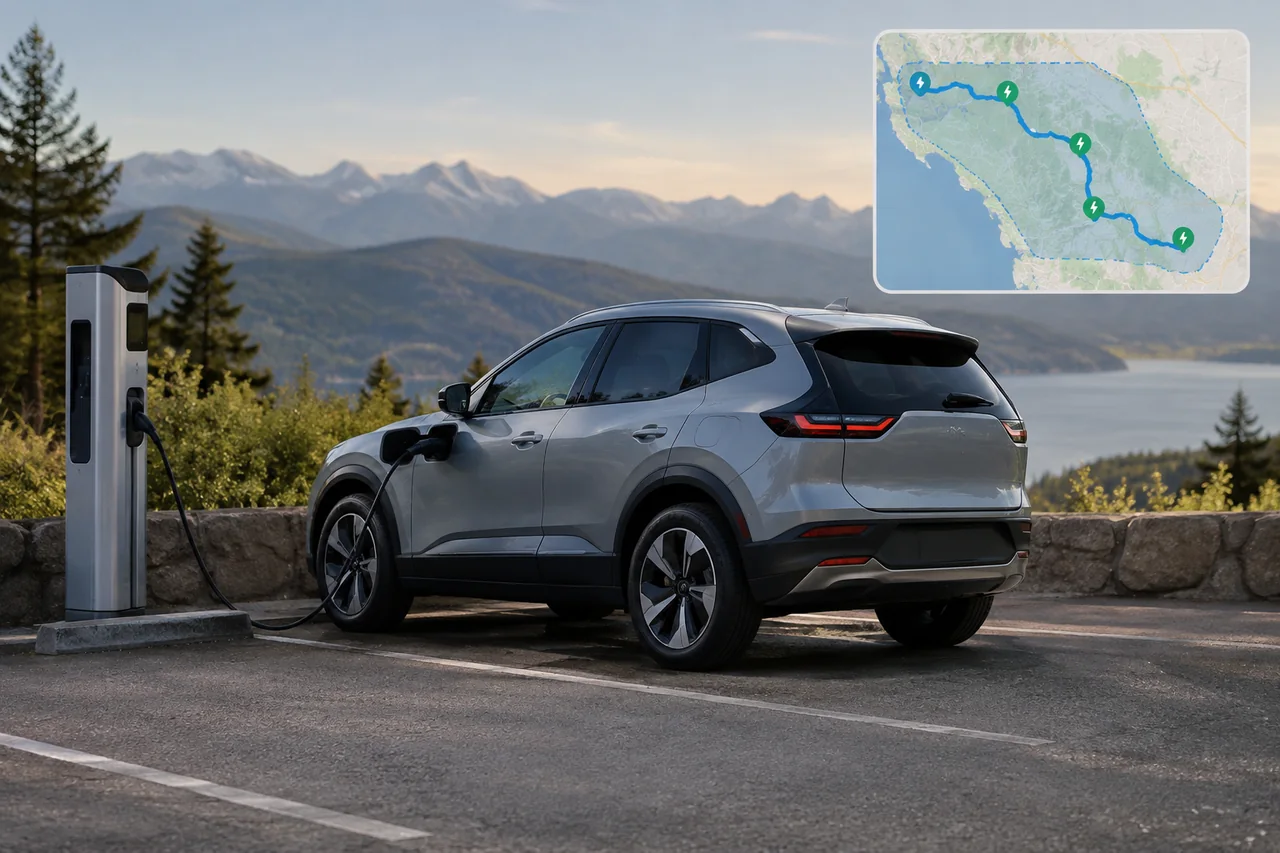
An EV range map shades the area you can supposedly reach from your current location with the energy on board. Its boundary is an estimate, not a hard line. Before trusting it, check how the map was built: whether it follows actual road routes or draws a simple radius, whether it accounts for terrain, what consumption assumption it uses, which starting charge it applies, and whether an arrival reserve is already subtracted. A straight-line circle drawn across mountains can badly overstate what the roads actually allow.
An EV range calculator map is most useful when it converts available energy into real destinations, showing which towns, routes or charging stops fall inside comfortable reach. Compare route options too, since a slightly longer road with gentler grades or lower speeds may cost less energy. If you cannot charge at the destination, or charging there is unconfirmed, count the return journey as part of the budget. A place you can reach with little charge remaining is not a practical round trip unless charging there is certain.
Choose Charging Stations Your EV Can Reach and Use
When searching for an EV range charging station, look for sites along the planned route and check the estimated arrival charge at each one, including the detour off the highway and back. Then confirm the basics: a charging connector your vehicle accepts, or an adapter the vehicle maker supports for that network, plus site access, operating hours and payment requirements such as an app, account or card reader. A station inside a gated garage or at a business that closes at night may not help on a late arrival.
EV range charging network listings and live availability indicators are helpful but can be incomplete or change before you arrive. Stall status may lag, and a charger shown as free can be occupied or out of service. Stop duration depends on the vehicle's charging capability, battery temperature, arrival charge and the power the station actually delivers, so similar stops can take very different times. Always identify an alternate charging location that stays reachable within your remaining energy budget in case the first choice fails.
Update the Plan When Actual Consumption Changes
Before departure, confirm the starting charge, review weather and road conditions, note planned stops and verify that charging access is confirmed rather than assumed. During the trip, reassess the arrival charge at safe stopping points such as rest areas or service plazas. If the reserve is shrinking faster than planned, choose an earlier charging stop instead of pressing on in hope. Easing off the speed can also stretch energy, but never test remaining range by deliberately driving toward empty or stopping on a narrow shoulder.
Occasional drops in range usually trace back to speed, temperature or load. Persistent, unexplained range loss under familiar conditions, repeated charging faults, or a battery or high-voltage warning light deserve evaluation by a qualified technician, ideally one familiar with your make. Range estimates alone cannot diagnose battery health, and any stored fault code is evidence to interpret, not proof that a component has failed. Diagnosis may require manufacturer-specific tools and procedures, so leave high-voltage system work to trained professionals.