How Does Traction Control Reduce Wheelspin?
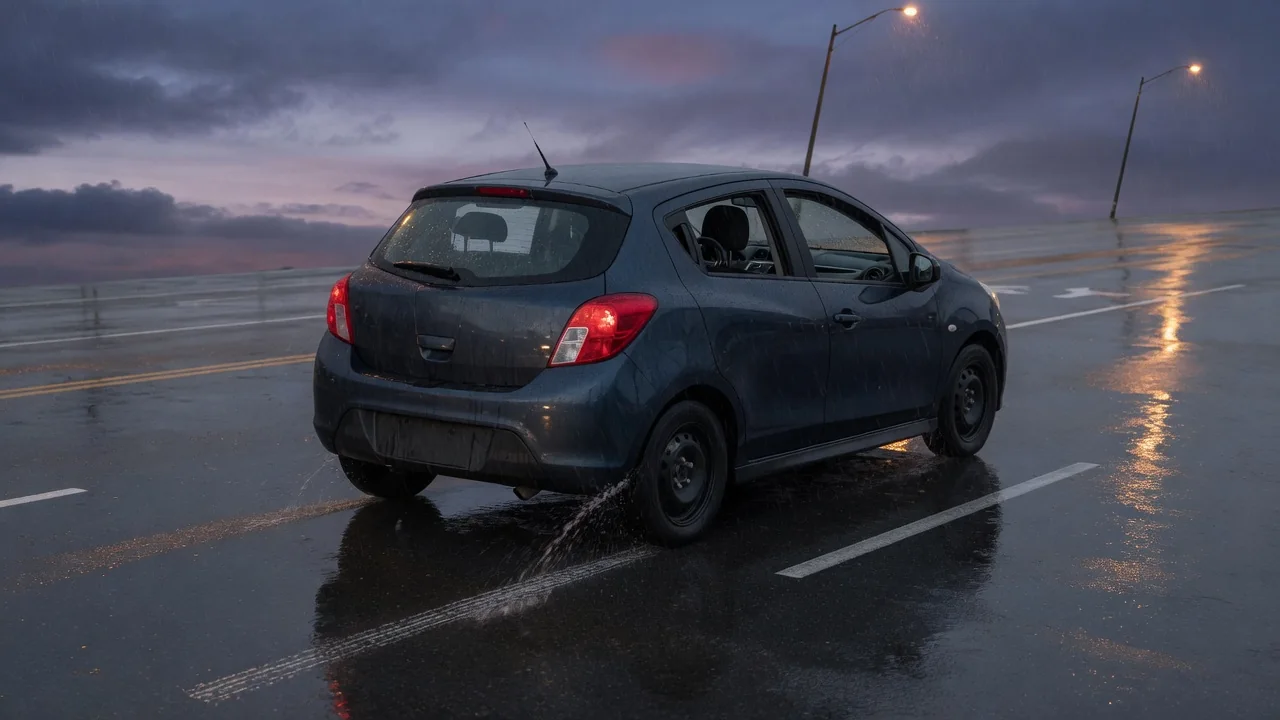
Traction control reduces wheelspin by watching how fast each wheel turns, spotting a driven wheel that rotates faster than the vehicle is actually moving, and then trimming engine torque, braking the slipping wheel, or doing both. The goal is not to stop the car from accelerating. It is to keep the tires close to the point where they grip best. Here is how detection, intervention, and feedback to the driver typically work.
Wheel-speed comparison
Everything starts with the wheel speed sensors, the same sensors used by the anti-lock braking system. Each wheel usually has a sensor reading a toothed tone ring or a magnetic encoder that turns with the hub. As the wheel rotates, the sensor produces a signal whose frequency rises with wheel speed. The control module reads all of these signals continuously and converts them into individual wheel speeds. Wheelspin, in control terms, is simply a driven wheel turning noticeably faster than the road surface passing beneath it.
To know how fast the road is passing, the module needs a reference for true vehicle speed. On a two-wheel-drive vehicle, the non-driven wheels provide a good estimate because engine torque is not trying to spin them. On all-wheel-drive vehicles every wheel can slip at once, so the system has to estimate vehicle speed from a combination of wheel speeds and, where fitted, other inputs such as a longitudinal acceleration sensor. The difference between driven-wheel speed and this reference is the slip. Systems deliberately tolerate a small amount of slip, because a tire generally produces its strongest forward push while slipping slightly rather than not at all.
The module also compares wheels against each other. If the left driven wheel sits on ice and the right one on dry pavement, the speed difference across the axle reveals the problem immediately. Not every speed difference means slip, though. In a turn, the outer wheels travel farther and spin faster than the inner ones, and a smaller spare tire changes rolling speed too. Many systems use steering angle and yaw rate signals, where available, along with built-in tolerances, so that normal cornering is not mistaken for wheelspin.
Brake or torque action
Once slip exceeds the target, the system has two main tools. The first is reducing engine or motor torque. On vehicles with electronic throttle control, the module can close the throttle regardless of pedal position. Depending on the powertrain, it may also retard ignition timing, cut fuel to some cylinders, or reduce turbocharger boost. Spark and fuel changes act quickly, while throttle changes take a little longer to show up as reduced torque. Electric drive motors can generally have their output reduced very rapidly, which suits traction control well.
The second tool is braking the spinning wheel. The hydraulic modulator shared with ABS and stability control contains a pump and valves that can build pressure at an individual brake without the driver touching the pedal. This matters because of how an open differential behaves: it tends to send torque toward the wheel that turns most easily, so one wheel on a slick patch can spin while the other barely moves. Applying brake force to the spinning wheel gives the differential something to push against, which allows more drive torque to reach the wheel that still has grip. In effect, the brakes imitate some of the behavior of a limited-slip differential.
Many systems blend the two methods. Brake intervention is especially useful when only one side is slipping, such as one tire on ice. Torque reduction is the natural choice when both driven wheels lose grip together, because braking both would simply waste power and generate heat. Brakes are also not meant to absorb engine output for long periods, so brake-based control is typically used in short bursts and may be scaled back at higher speeds. The exact balance, thresholds, and speed limits are set by each manufacturer's calibration and vary between vehicles.
Driver feel
The most obvious sign of intervention is usually a flashing warning lamp on the instrument cluster, often an icon of a car with wavy lines behind it. When torque is being reduced, the engine may sound like it is hesitating or bogging down, and the accelerator pedal can feel unresponsive. That sensation comes from the electronic throttle no longer following the pedal exactly: the driver may press further while the system holds power back until wheel speeds settle.
Brake intervention feels and sounds different. The hydraulic pump and valves may produce a buzzing, grinding, or rapid clicking noise similar to ABS activity, and the brake pedal can sometimes move or pulse slightly. The vehicle may also tug gently toward one side as a single wheel is braked. These noises and sensations are normal operation, not signs of damage, and they usually stop as soon as grip returns.
How intrusive this feels depends heavily on calibration. Some systems step in early and firmly, while others allow more slip before reacting, and some vehicles offer driving modes that change the threshold. Not every hesitation on a slippery road is traction control, either, so the flashing lamp is the most reliable indicator that the system is actually working.
Practical implications and limits
Traction control cannot create grip that the tires do not have. On a surface that is slippery under every wheel, the best it can do is limit power to whatever the road will accept, which may mean very slow progress. Tire type, tread depth, and inflation still set the ceiling for acceleration, so suitable tires for the season remain important. Traction control also addresses acceleration only; preventing locked wheels under braking is the job of ABS, and correcting skids in a turn is the job of stability control, even though all three share hardware.
There are situations where some wheelspin is useful. In deep snow, mud, or sand, a spinning tire can clear material and keep momentum, and rocking a stuck vehicle back and forth may require it. A system that cuts power aggressively can stall progress in those conditions. Many vehicles therefore allow traction control to be reduced or switched off, sometimes only partially, and some re-enable it automatically after a restart or above a certain speed. The owner's manual describes how a particular vehicle behaves.
A traction control lamp that stays lit, rather than flashing briefly, usually means the system has detected a fault and disabled itself. Common causes include a contaminated or damaged wheel speed sensor, a cracked tone ring, wiring problems, or tires of mismatched sizes confusing the speed comparison. Normal braking generally remains available in that state, but wheelspin protection may not, so the fault is worth having diagnosed with a scan tool rather than ignored.