How Does Throttle Position Affect Engine Load?
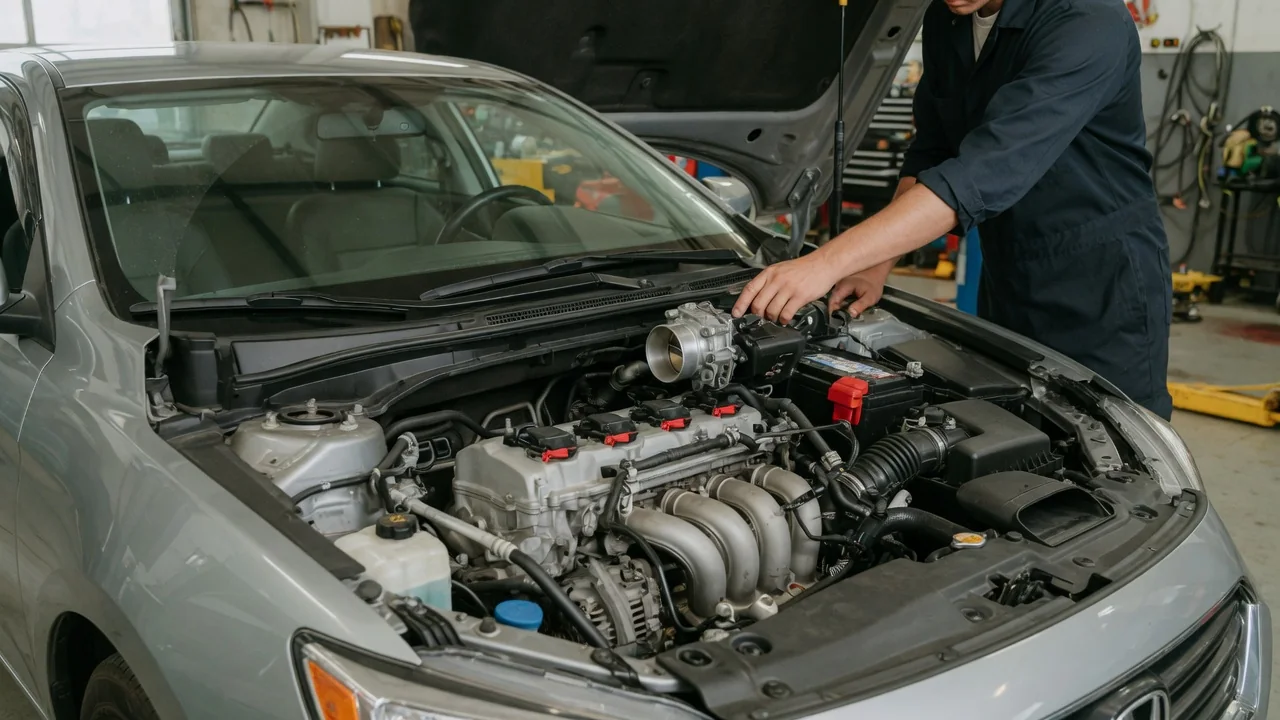
Throttle position is one of the most direct ways a driver influences how hard a gasoline engine works, but it is not the same thing as engine load. The throttle regulates how much air can enter the intake. That air, combined with engine speed and the control module's calculations, determines how much load the engine actually carries. Following the chain from pedal to airflow to fuel and spark explains how throttle position and engine load data behave while driving and on a scan tool.
Airflow request: how the throttle limits cylinder filling
In a conventional spark-ignition engine, the throttle plate sits between the air filter and the intake manifold. When the plate is nearly closed, the pistons pull air through a small opening, which creates strong manifold vacuum. Each cylinder then fills with only a fraction of the air it could hold. Opening the throttle reduces that restriction, manifold pressure rises toward atmospheric pressure, and each intake stroke traps more air. Because the engine meters fuel to match the air, more air per cycle means more fuel burned and more torque produced. The amount of air an engine takes in, compared with its maximum capacity, is essentially what engine load describes.
The relationship between throttle position and load is not linear. The first part of throttle travel usually changes airflow much more than the last part does, and engine speed shifts the picture further. At low rpm, a modest opening may already let manifold pressure approach atmospheric, so opening the throttle further adds little. At high rpm, the engine consumes air much faster, and the same opening leaves the manifold under significant vacuum. So to answer how does throttle position affect engine load, you have to consider rpm alongside the pedal or throttle angle.
There are important exceptions. Most diesel engines do not use a throttle to control load. They vary the fuel quantity instead, and any intake throttle they have serves other purposes, such as emissions control or smoother shutdown. Turbocharged gasoline engines add boost, so manifold pressure can exceed atmospheric pressure once the throttle is open. Some engines with variable valve timing or lift can manage cylinder filling partly with the valves, so the throttle alone governs less of the load.
Control module: from pedal signal to calculated load
On most modern vehicles, the accelerator pedal has no mechanical connection to the throttle. A pedal position sensor sends the driver's request to the engine control module, which commands an electric motor in the throttle body. A throttle position sensor reports the actual plate angle back to the module, typically through two independent signals that can be cross-checked. Because the module sits in the middle, the throttle opening does not always mirror the pedal. Many systems treat the pedal as a torque request and then decide how far to open the throttle. That decision accounts for idle control, cruise control, traction control, transmission shifts and engine protection.
The module estimates load from measured airflow rather than from throttle angle alone. Engines with a mass airflow sensor measure incoming air directly. Speed-density systems infer it from manifold absolute pressure, intake air temperature and rpm. Many engines use both methods, with throttle position serving as a fast cross-check and an early indicator of rapid changes. The module combines the resulting load value with rpm to look up and correct fuel delivery and ignition timing. On many engines, the same values also guide variable valve timing and exhaust gas recirculation.
On OBD-II vehicles, a scan tool can usually show calculated load value, often alongside absolute load value and throttle position. Calculated load is a percentage of the maximum airflow the engine could take in at its current speed. Because of that, it can read high at small throttle angles when rpm is low. Throttle position readings may not start at zero when the throttle is closed, because these sensors are often designed with an offset. Each manufacturer scales and labels these values in its own way, so the service information for the specific vehicle is the correct reference.
Driving: what changes load on the road
During steady cruising on a level road, the engine needs only enough torque to overcome rolling resistance, aerodynamic drag and drivetrain losses. The throttle stays partly closed and load is light. Climbing a hill, carrying cargo, towing or driving into a headwind all require more torque at the same speed. The driver, or the cruise control, opens the throttle further, and load rises even though road speed may not change.
Gear selection matters as well. In a higher gear at low rpm, the engine must run at higher load to produce a given wheel torque. A lower gear lets it deliver that torque at higher rpm and lower load. Automatic transmissions use throttle opening and load information to decide when to shift, which is why pressing the pedal firmly can trigger a downshift.
At the extremes, the control strategy often changes. Near full throttle, many gasoline engines leave closed-loop oxygen sensor control and add extra fuel to protect components and maximize power. Ignition timing may also be retarded if the knock sensor detects knock. When the throttle closes while the vehicle is coasting above a certain speed, many engines apply deceleration fuel cutoff. Load then drops close to zero, and the wheels turn the engine instead of the engine burning fuel.
Practical implications and limits
The link between throttle and load explains some common fuel economy observations. At part throttle, the engine has to pull air past a restriction, and the resulting pumping losses waste some energy. That is one reason moderate load in a suitable gear can be more efficient than very light load at high rpm. Smooth pedal inputs also tend to avoid the brief extra fueling that many systems add during sudden acceleration. How much these effects matter depends on the engine design, the transmission and the driving conditions, and no single pedal position is ideal for every vehicle.
For diagnosis, comparing throttle position, airflow or manifold pressure, and calculated load can help narrow down a problem, but these readings are clues rather than verdicts. A load value that seems inconsistent with throttle angle might point to an intake leak, a contaminated or failing airflow sensor, a sticking throttle plate, or carbon buildup that changes idle airflow. Each of those causes still needs confirmation using the procedures in the vehicle's service manual. A throttle or pedal sensor fault commonly turns on a warning light and puts the engine into a reduced-power mode, because the module can no longer trust the airflow request. Sensor ranges, normal values and failure strategies differ between manufacturers and engine families, so these general principles are a starting point and do not replace vehicle-specific data.