How Does Tar Remover Work on a Car? Solvents, Paint Safety and Cleanup
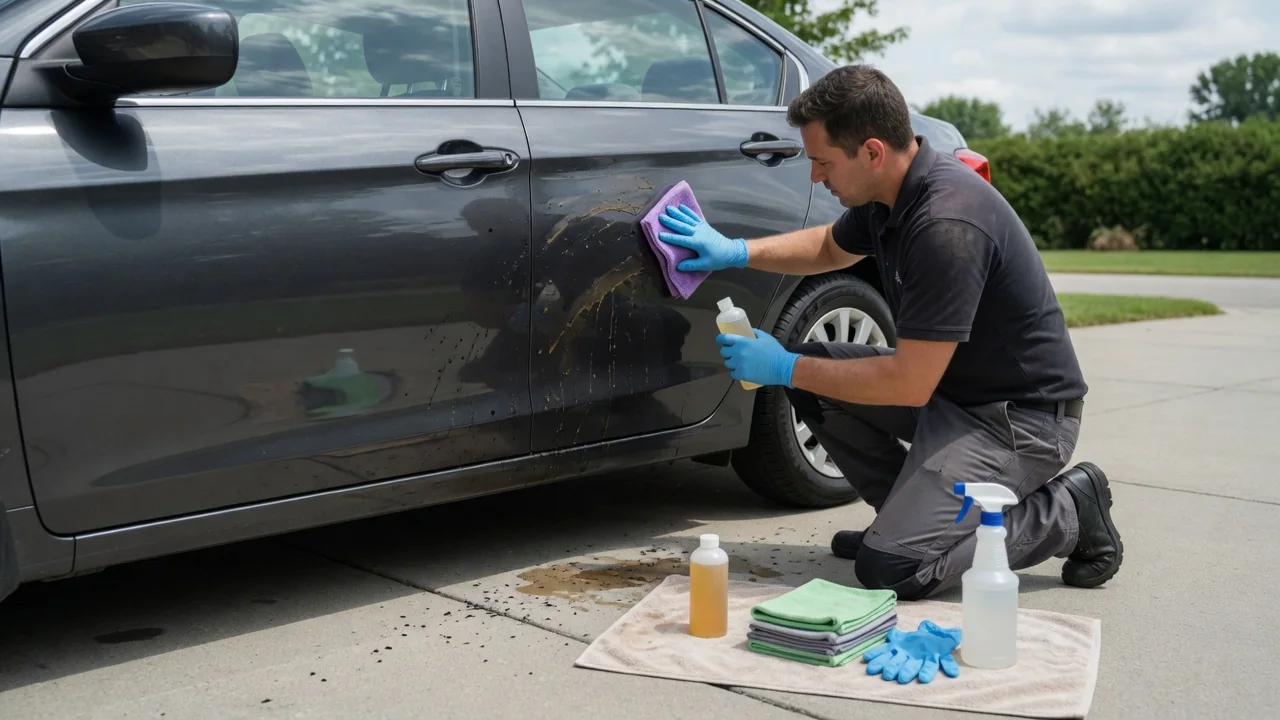
Tar spots tend to appear behind the wheels and along the lower doors after driving on fresh or hot asphalt. They cling because tar is sticky, oily and does not mix with water, so a normal wash rarely moves them. A tar remover uses solvents chosen to dissolve that material while leaving cured automotive paint intact. Knowing how that chemistry works explains how to use it, where it can cause problems and why washing afterward matters.
Solvent action: how tar remover dissolves road tar
Road tar and the asphalt binder that splashes onto lower panels are made largely of bitumen, a dense mixture of heavy hydrocarbons. These molecules are mostly nonpolar, so water and many ordinary wash solutions cannot dissolve them; the shampoo slides over the spot while the tar stays put. Tar removers rely on the long-established chemistry rule that like dissolves like: nonpolar solvents interact readily with nonpolar hydrocarbons. Car tar remover chemistry is therefore commonly based on petroleum distillates such as aliphatic hydrocarbon solvents or mineral spirits, or on citrus-derived solvents such as d-limonene. Formulations differ between products, and the label or safety data sheet is the place to check what a specific bottle actually contains.
When the solvent touches a tar spot, its molecules work their way into the deposit, swell it and lower its viscosity. As the tar softens, its grip on the paint weakens, and the spot turns from a hard bead into a loose smear that can be lifted with a soft towel. This is why labels usually call for a short dwell time rather than immediate wiping. Many products also contain surfactants or emulsifiers so the dissolved tar and solvent can be dispersed and rinsed with water, while others leave a more oily film. Evaporation rate matters too: a solvent that flashes off quickly may leave tar only partly softened, whereas a slower one gives more working time but more residue to remove. Gels and clinging sprays exist mainly to hold the solvent against vertical panels long enough to act.
Paint compatibility: clearcoat, wax and trim
Most modern factory finishes use a pigmented basecoat protected by a clearcoat. Once fully cured, that clearcoat is a crosslinked polymer film that generally tolerates brief contact with the mild solvents used in products made for automotive paint. That tolerance is the reason these products are formulated as they are. It does not extend to every solvent: aggressive chemicals such as acetone or lacquer thinner can soften or dull finishes and are not a substitute for a purpose-made tar remover.
Compatibility is less certain on other surfaces. Wax and many paint sealants are themselves soluble in these solvents, so the treated area should be assumed to have lost its protection. Fresh repaints that have not fully cured, older or single-stage paint, unpainted textured plastic trim, rubber seals, vinyl wraps, matte finishes and paint protection film can react differently, with possible staining, swelling, edge lifting or an uneven sheen. Whether a particular car has any of these depends on its finish and repair history, not simply on its make or model. Following the label, testing on an inconspicuous spot, working on a cool panel out of direct sun and not letting the product dry on the surface reduce the risk.
Wash afterward: removing solvent residue
Removing the visible tar does not leave the panel clean. A film of leftover solvent, dissolved tar and any oils in the formula remains on the surface. This residue can smear, look hazy or rainbow-like in sunlight, attract dust, and keep sitting against nearby trim and seals. It can also interfere with how well a new layer of wax or sealant bonds to the paint.
Washing the treated area with a car shampoo afterward lets the detergent emulsify that oily layer so it can be rinsed away. Use a clean wash mitt so that any loosened tar particles are not dragged across other panels, rinse thoroughly and dry with a clean microfiber towel. Because the tar remover has likely stripped wax or sealant from the spot, reapplying protection restores the barrier the paint had before. A protected surface also tends to make later tar removal easier, since fresh deposits have a slicker layer to cling to.
Practical implications and limits
Fresh tar usually releases faster than deposits that have sat for weeks, hardened and been baked by heat. Old spots may need several applications with a dwell period between each, and patience works better than pressure. Scrubbing, scraping with a fingernail or using an abrasive pad can cause marring, because softened tar often carries trapped grit that acts like sandpaper when rubbed.
Not every dark speck on a lower panel is tar. Tree sap, bug residue, rubber marks and iron fallout have different chemistry, so a tar remover may barely affect them; bonded contamination that stays rough after washing may call for a clay bar or a dedicated product. A tar remover also cannot reverse staining or etching that has already formed in the clearcoat, particularly on light colors where discoloration is easier to see. Those marks are a paint correction issue rather than a cleaning one.
Many tar removers contain flammable solvents that release vapors, so use them with good ventilation, wear chemical-resistant gloves, keep them away from ignition sources and avoid spraying them onto hot exhaust parts or brake components. The vehicle's owner's manual may include care guidance for its specific finishes, and the product label remains the authority on dwell time, compatible surfaces and storage.