How Does Rubber Hardness Affect a Car Bushing?
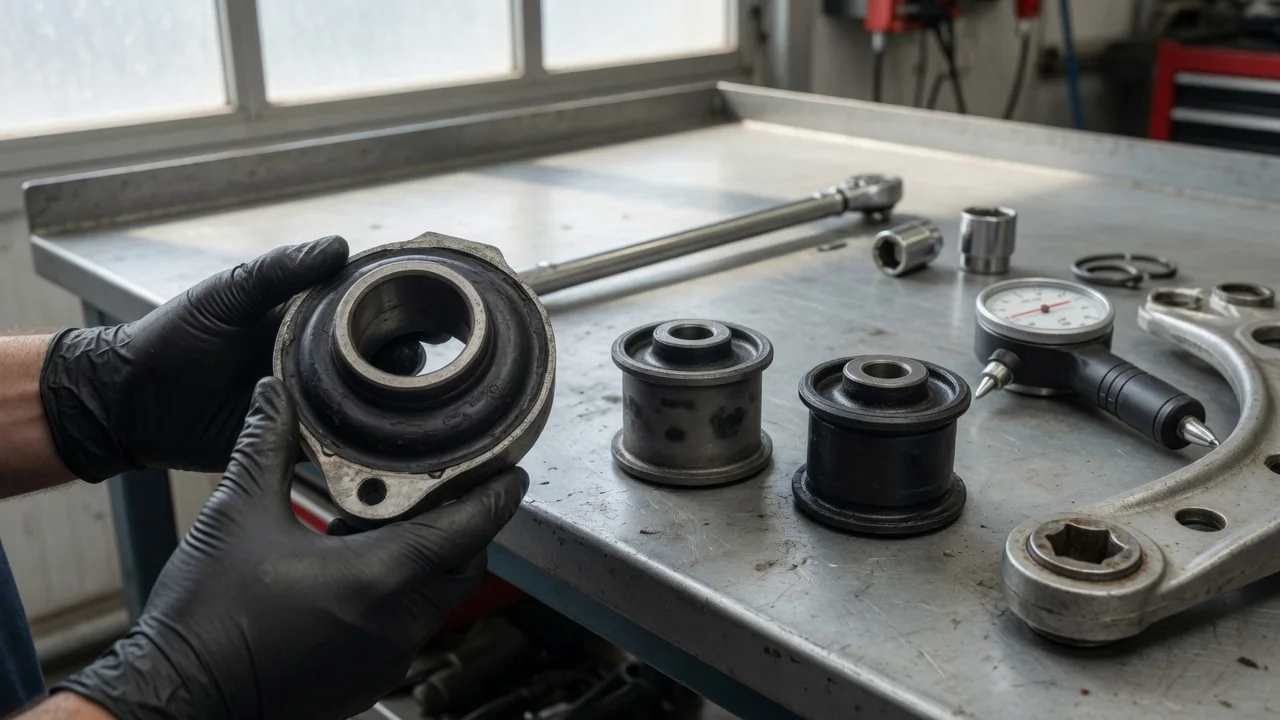
A suspension bushing is a rubber cushion that locates a control arm, link, or subframe while still letting it move and absorbing some vibration. Rubber hardness, usually expressed as a durometer reading, is one of the main properties that decides how that cushion behaves. Changing bushing rubber hardness shifts the balance between precise control and comfort, changes how much noise reaches the cabin, and affects how the part ages. Here is how each of those effects works.
Compliance
Compliance is the amount a bushing deflects under load. Rubber hardness is commonly measured with a durometer on the Shore A scale, where higher numbers indicate a material that resists indentation more strongly. In general, a harder rubber compound is stiffer, so a bushing made from it deflects less for the same force. A softer compound lets the inner sleeve move further relative to the outer shell before the load is fully carried. The relationship is not linear, and hardness is only one input: the bushing's shape, rubber thickness, bonding, and any voids or slots molded into it also determine its stiffness.
Engineers use these properties deliberately. Many bushings are designed to be compliant in one direction and stiff in another. A control arm bushing may need to allow rotation as the suspension travels up and down while resisting fore-aft or lateral movement that would change wheel alignment under braking or cornering. Voids, inserts, and rubber thickness tune these directional rates, and the compound hardness sets the baseline for all of them. Raising the hardness generally stiffens every direction at once, which can tighten steering and alignment control but also removes compliance the original design may have relied on.
Compliance also affects how suspension geometry behaves under load. A softer bushing allows small changes in toe or camber as forces build, which some designs use to smooth the ride or influence handling balance. A harder bushing keeps the geometry closer to its static position. Neither approach is automatically better; the appropriate amount depends on how the whole suspension was developed, and that varies from vehicle to vehicle.
Noise
Bushings are an important part of a vehicle's noise, vibration, and harshness (NVH) control. They help isolate the body from road inputs, tire vibration, and drivetrain movement. A softer, more compliant rubber generally gives a lower natural frequency for the mass it supports, which tends to improve isolation of higher-frequency vibration. As hardness rises, stiffness rises with it, and more vibration energy passes through to the subframe and body, where it can be heard as road noise or felt as buzz through the steering wheel, floor, or seats.
Hardness and damping are related but not identical. Damping depends on the rubber formulation, including the polymer type and fillers, so two compounds with similar durometer readings can absorb vibration differently. Some bushings also contain fluid chambers to add damping at particular frequencies, which is a design feature rather than a hardness effect. Harder materials can also introduce different noises. Polyurethane bushings, for example, are often designed to rotate on their sleeves rather than twist, and they may squeak if the sliding surfaces lack the specified lubrication. Rubber bushings bonded to their sleeves avoid that sliding contact, but if they crack or separate they can produce clunks as metal parts begin to touch.
Durability
Rubber hardness influences durability partly through the amount of strain the material experiences. A softer bushing deflects more for a given load, so the rubber is stretched and compressed through a larger range on every bump, which can contribute to fatigue over many cycles. A harder bushing deflects less, but the loads it does not absorb are passed into the mounting brackets, fasteners, and adjacent components. Durability therefore depends on the whole load path, not only on the bushing itself.
The compound's resistance to its environment often matters as much as its hardness. Heat, ozone, ultraviolet exposure, and contamination from oil or other fluids can degrade rubber, leading to cracking, swelling, softening, or hardening over time. Many rubber compounds tend to stiffen as they age, so an old bushing may no longer behave as it did when new even if it looks intact. Service life is shaped by the polymer, additives, and manufacturing quality, so a higher durometer number by itself does not indicate a longer-lasting part.
Installation also affects how long a bushing lasts. Bonded rubber bushings are typically designed to twist within a limited range around a set position. If the fasteners are tightened with the suspension hanging rather than at the position the service manual specifies, the rubber may sit pre-twisted and experience extra strain in normal driving, which can shorten its life regardless of hardness.
Practical implications and limits
For a car owner, the most useful takeaway is that bushing rubber hardness is a trade-off rather than a quality ranking. Moving to a harder bushing can make steering response feel more immediate and reduce unwanted movement of suspension parts, but it usually brings more road noise, more vibration, and a firmer ride. Moving to a softer one tends to do the opposite. Which direction suits a car depends on how it is driven and what the original design expected from that particular joint.
There are limits to what hardness information can tell you. Manufacturers do not always publish durometer values, and when they do, a single number does not describe the complete part. Geometry, voids, sleeve design, and the specific compound all change real-world behavior, so two bushings described with similar hardness can perform differently. Results also vary by location: a stiffer bushing at one point in the suspension may be barely noticeable, while the same change elsewhere may be obvious inside the cabin.
When replacing bushings, the vehicle's service manual and the original part's specifications are the most reliable reference for fitment, orientation, and tightening procedure. If a different hardness is being considered, changing one location at a time makes its effects easier to judge, keeping in mind that changes in noise, alignment, and wear of related components may only become clear over normal driving. Worn bushings of any hardness deserve attention, because excess play can affect alignment, tire wear, and handling.