How Does Regenerative Braking Turn Motion Into Electricity?
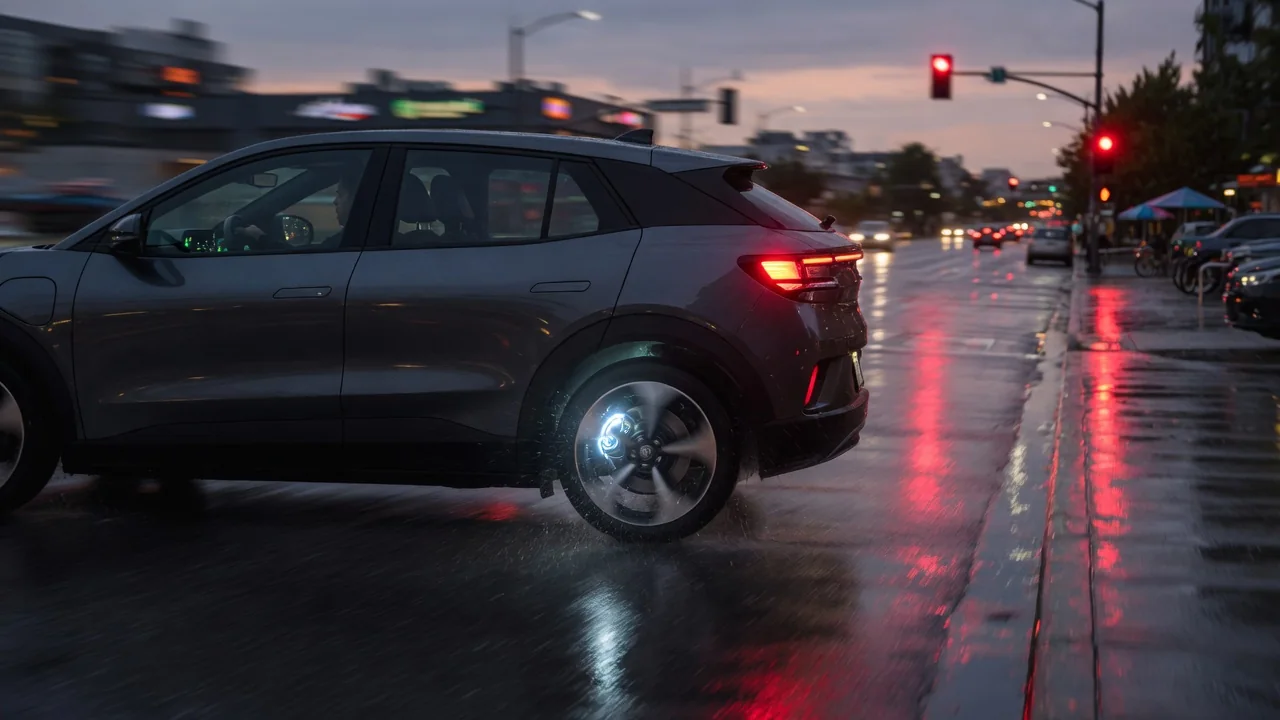
When a hybrid or electric vehicle slows down, it does not have to turn all of its motion into wasted heat at the brake pads. Regenerative braking lets the car slow itself by producing electricity and storing it for later use. Regenerative braking turns motion into electricity through three components working in sequence: the motor generator, the inverter, and the high-voltage battery. Following that regen braking energy path also explains why recovery has limits and why friction brakes remain essential.
Motor generator: where motion becomes electrical current
The electric motor that drives the wheels is a reversible machine. It works on electromagnetic induction: when a magnetic field moves relative to a coil of wire, a voltage is induced in that coil. During acceleration, the inverter feeds current into the stationary windings, called the stator. This creates a rotating magnetic field that pulls the rotor around and turns the wheels through the drivetrain. When the driver lifts off the accelerator or presses the brake pedal, the process can run in the opposite direction. The wheels keep spinning the rotor, and the rotor's magnetic field sweeps past the stator windings, inducing an alternating current. In a permanent magnet machine, magnets in the rotor provide that field. In an induction machine, the controller establishes it electrically.
The braking effect comes from the same physics. When current flows in the stator windings, it creates a magnetic field that opposes the rotor's motion. That opposing torque travels back through the gears to the wheels and slows the vehicle. The motor generator does not simply collect spare energy while the car slows on its own. Drawing electrical energy out of it is what produces the deceleration, so the more current the system allows to flow, the stronger the retarding force. Many battery electric vehicles use their traction motor or motors for both driving and regeneration. Some hybrid designs use more than one motor generator and assign them different roles. The underlying principle is the same in either case.
Inverter: converting and controlling the recovered power
The motor generator produces alternating current whose frequency and voltage change with rotor speed, but the battery can only store direct current. The inverter sits between them. It is a set of power semiconductor switches, commonly IGBTs or silicon carbide MOSFETs, that can connect each motor phase to the positive or negative side of the high-voltage DC circuit. While driving, the inverter switches rapidly to create three-phase AC from battery power. During regenerative braking it works as an active rectifier. It times those same switches so that energy flows from the motor generator back to the DC side at a voltage the battery can accept. Some designs add a separate DC-DC converter between the battery and the inverter so the motor side can run at a higher voltage. In that layout, the converter also steps the regenerated power down to battery voltage.
The inverter is also where the amount of regeneration is controlled. The motor control electronics adjust switching patterns to regulate current in the windings. Because current determines opposing torque, this sets how hard the car regenerates at any moment. The vehicle's controllers choose the target using inputs such as pedal position, the selected regeneration setting, vehicle speed, battery limits, and signals from the stability and anti-lock braking systems. The conversion is efficient but not lossless. Switching and conduction losses become heat, which is why inverters are cooled, often with liquid coolant.
Battery: storing the energy for the next acceleration
Once converted to DC, the recovered energy flows into the high-voltage circuit. Loads connected there can use part of it immediately, such as the DC-DC converter that supports the 12-volt system or electric climate components. The rest charges the traction battery. In lithium-ion cells, charging moves lithium ions from the cathode side to the anode, storing the energy chemically until the car needs it again. A battery management system monitors cell voltages, temperatures, and state of charge. It continuously reports how much charging power the pack can safely accept.
That acceptance limit governs regeneration. If the battery is nearly full, there is little room for more energy. If the cells are cold, charging current is usually restricted to protect them from damage such as lithium plating, and very high temperatures can also trigger limits. When the battery management system lowers the allowable charging power, the vehicle reduces regenerative torque and the brake system covers the remainder with friction. Each stage loses some energy: the generator, the inverter, and the battery while charging, and again on the way back out during the next acceleration. As a result, only a portion of the original motion ever returns to the wheels.
Practical implications and limits
For drivers, the most noticeable effect is how the car responds when the accelerator is released. Many electrified vehicles slow down more strongly than a conventional car when the driver lifts off the pedal. Some offer selectable regeneration levels or a one-pedal driving mode that can bring the car to a stop or near stop. The brake pedal itself is often blended: the system uses regeneration first and adds friction braking as needed, ideally without the driver feeling the handoff. These functions behave and adjust differently by manufacturer and model, so the owner's manual is the reliable reference for a specific vehicle.
Several everyday conditions reduce or interrupt regeneration. At very low speeds little kinetic energy remains to recover, and many systems let the friction brakes complete the final stop. A fully charged battery can limit recovery, for example right after charging or at the top of a long descent. In cold weather the effect may be weaker until the battery warms up. During hard emergency stops or on slippery roads, the braking system may scale back regeneration so that anti-lock and stability functions can control each wheel precisely. Regeneration also acts only through driven wheels, so a non-driven axle always relies on friction brakes. Some vehicles show reduced regeneration on the instrument panel when these limits apply.
Because friction brakes are used less often, pads may wear more slowly. However, discs that see little use can collect corrosion, particularly in wet or salted conditions, so following the maintenance schedule and having the brakes inspected remains important. Regeneration delivers the most benefit in driving with frequent slowing, such as city traffic and downhill stretches. It contributes comparatively little during steady highway cruising, where there are fewer opportunities to recover energy.