How Does Regeneration Differ From Engine Braking?
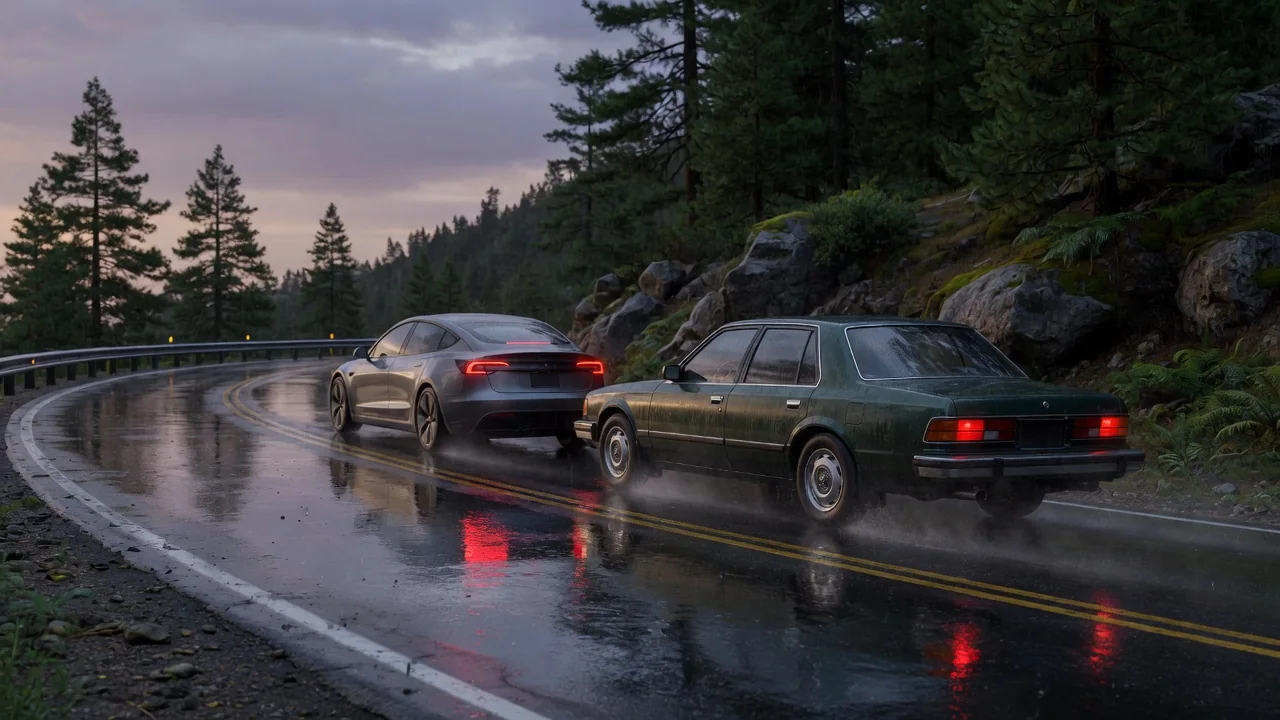
Lifting off the accelerator slows almost any car, but what happens to the energy depends on what is doing the slowing. In a conventional engine, closed-throttle deceleration turns motion into heat. In an electrified vehicle, regenerative braking turns part of that motion back into stored electricity. Both reduce the work done by the friction brakes, yet they differ in where the energy goes, how deceleration feels, and which vehicles can use them. This regen versus engine braking explanation walks through each difference.
Energy path
Engine braking happens when the wheels drive the engine through the transmission instead of the other way around. With the throttle closed in a gasoline engine, the pistons draw air past a nearly shut throttle plate, creating pumping losses, while internal friction in bearings, piston rings and the valvetrain adds more resistance. Many modern fuel-injected engines also cut fuel delivery during closed-throttle deceleration, so the engine uses little or no fuel while the wheels are turning it. The kinetic energy absorbed this way ends up as heat in the engine, its oil and coolant, and the exhaust. None of it is stored for later use. Diesel engines usually have little or no intake throttling, so their natural engine braking tends to be weaker, which is why heavy trucks often add exhaust brakes or compression-release brakes for more retarding force.
Regenerative braking reverses the role of an electric motor. When the driver lifts off or presses the brake pedal, the control system commands the motor to act as a generator. The wheels turn the motor, the motor produces electrical current, and power electronics convert that current into a form the high-voltage battery can accept. The resistance required to generate that electricity is what slows the vehicle. Not all of the energy comes back: some is lost as heat in the motor, inverter, wiring and battery, and more is lost when the stored energy is later used to drive the wheels again. Even so, a meaningful share of the energy that engine braking would simply discard can be reused, and that is the core difference between the two.
Deceleration feel
Engine braking strength depends mostly on engine speed and the selected gear. A lower gear spins the engine faster for a given road speed, which increases resistance, so downshifting produces noticeably stronger slowing. In a higher gear the effect is gentle. With a manual transmission the driver controls this directly; with an automatic, the transmission logic decides when to downshift, and many automatics offer a manual or low-range mode for more holding power. Because engine braking is tied to mechanical conditions, it changes in steps as gears change and fades as engine speed drops toward idle. It disappears entirely when the clutch is disengaged or the transmission is in neutral.
Regeneration is controlled by software, so its feel is whatever the manufacturer calibrates within the limits of the hardware. Lift-off regen can be mild, imitating a conventional car, or strong enough that the vehicle slows considerably without the brake pedal, an approach often called one-pedal driving. Many vehicles let the driver choose between several regen levels or adjust it with steering-wheel paddles. On the brake pedal, most electrified vehicles blend regeneration with friction braking, using the motor first and adding hydraulic braking as needed. Regen strength can also change with conditions: it may be reduced when the battery is full or cold, and it typically tapers at very low speed, where the friction brakes complete the stop unless the system is designed to hold the vehicle. Drivers may notice these variations as slightly different slowing from one trip to the next.
Vehicle type
A conventional gasoline or diesel vehicle relies on engine braking and friction brakes. It has no traction motor and no high-voltage battery, so it cannot perform regenerative braking in the electrified sense. Some conventional vehicles manage the alternator to charge the 12-volt battery more during deceleration, but this recovers only a small amount of energy for electrical accessories rather than for propulsion.
Hybrids combine both mechanisms. Mild hybrids use a small motor-generator, often belt-driven or integrated near the transmission, to recover some energy during deceleration and assist the engine, but their recovery capacity is limited by motor and battery size. Full hybrids and plug-in hybrids have larger motors and batteries, so regeneration handles more of the everyday slowing. Engine braking can still occur in these vehicles, depending on the design and drive mode. Some hybrids include a mode, often labeled B, that increases deceleration on descents; depending on the system, it may rely on regeneration, on spinning the engine to dissipate energy, or on a combination, particularly when the battery cannot accept more charge.
Battery electric vehicles have no combustion engine, so true engine braking does not exist in them. When people speak of engine braking in an EV, they usually mean lift-off regeneration. Because regen is the only alternative to the friction brakes, its calibration largely defines how an EV feels when the driver lifts off the accelerator.
Practical implications and limits
On long downhill grades, both mechanisms help keep the friction brakes cool, but they reach their limits differently. Engine braking can continue as long as the engine is turning, which is why selecting a lower gear is standard advice for steep descents in conventional vehicles. Regeneration depends on the battery having room to absorb energy. A vehicle that starts a long descent with a nearly full battery may offer less regen than usual, and the friction brakes or another mechanism must take on more of the work. The owner's manual is the right reference for the recommended descent mode, because the best approach depends on the specific powertrain.
Both forms of braking act only on the driven wheels, and strong deceleration on slippery surfaces can reduce grip at those wheels. Stability and traction systems in many vehicles can reduce regeneration when they detect slip, but drivers should still be cautious with aggressive downshifts or high regen settings on ice, snow or loose gravel. Efficiency is another limit: regeneration recovers only part of the energy, so smooth driving that avoids unnecessary slowing generally saves more than repeatedly accelerating and recovering energy. Regen reduces waste; it is not a free source of range.
Both mechanisms reduce wear on pads and rotors, and electrified vehicles can go long periods with light friction-brake use. Reduced use is not the same as no maintenance. Brake components that are rarely applied firmly can develop surface corrosion or sticking parts, so following the manufacturer's inspection schedule still matters, and brake fluid follows its own service interval regardless of how much slowing is handled by regen or the engine.