How Does Automatic Headlight Leveling Work?
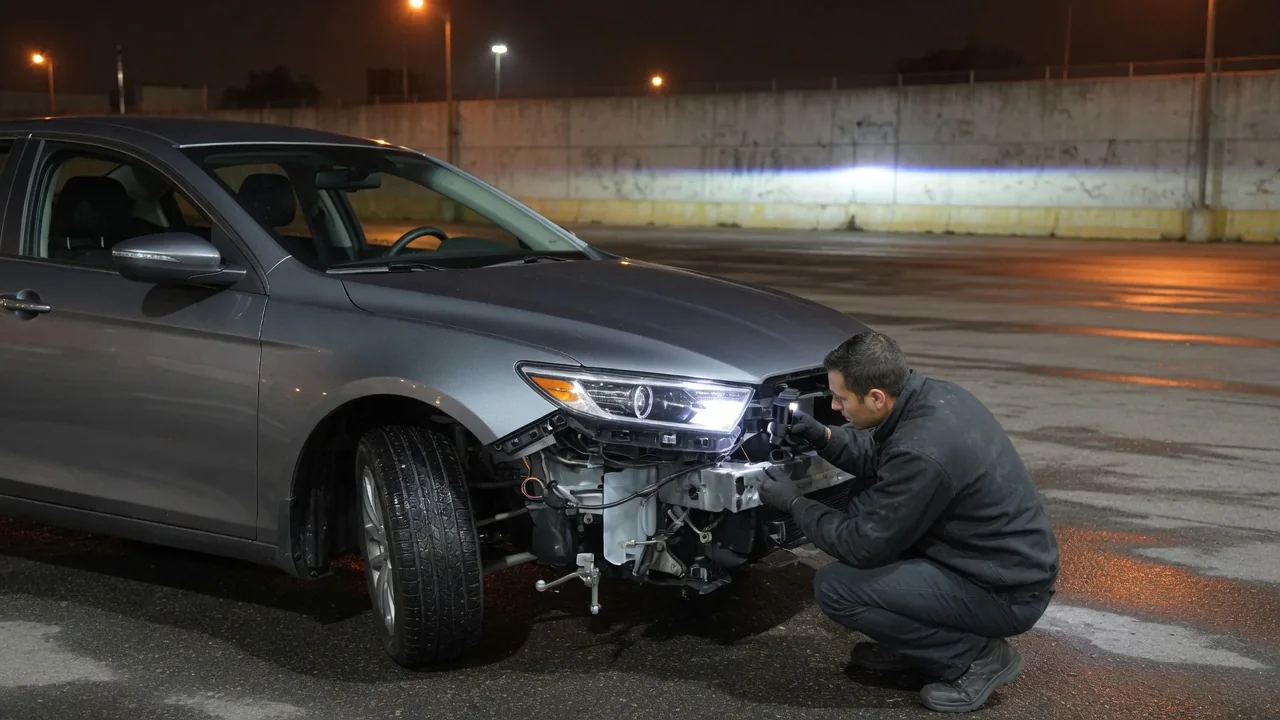
Automatic headlight leveling keeps the low beam pointed at a consistent angle to the road as the vehicle's body pitches up or down. Passengers in the back seat, cargo in the trunk, or a trailer on the hitch can tilt the nose upward and push light into oncoming drivers' eyes. The auto headlight leveling mechanism counters that by measuring body attitude, calculating a correction, and tilting the headlamp optics to match.
Ride-height sensing
Understanding how automatic headlight leveling works starts with knowing how the body sits relative to the axles. Most designs use one or more ride-height sensors bolted to the body or subframe, each connected by a short linkage rod to a suspension arm or axle. When the suspension compresses or extends, the linkage rotates a shaft inside the sensor, and the sensor converts that rotation into an electrical signal. Older and simpler units often rely on a potentiometer, while many newer ones use a non-contact Hall-effect or magnetoresistive element that has no wiper to wear out.
Sensor placement varies by vehicle. Some systems monitor only the rear axle, because loading the trunk or rear seats is the most common cause of nose-up pitch. Others place sensors at both the front and rear, which lets the control module calculate the body's pitch angle more directly. Some newer designs supplement or replace linkage sensors with an acceleration-based inclination sensor inside the module, inferring body angle from gravity and vehicle motion. Only the vehicle's own service information can confirm which approach a given car uses.
Raw height readings are noisy, so the control module filters them. It typically combines sensor data with vehicle speed and other network signals to distinguish a lasting change, such as a heavy load, from a brief one, such as a pothole. Systems described as static or quasi-static mainly correct for load and respond slowly. Dynamic systems also react to the pitch caused by acceleration and braking, which requires faster processing and faster actuators. In both cases, the module compares the measured attitude with a reference value stored during calibration.
Actuator
Once the module decides how far the beam should move, it commands a leveling actuator mounted on or inside each headlamp housing. The actuator is usually a compact electric motor, commonly a stepper motor or a small DC motor with position feedback, driving a gear train and an output shaft. That shaft pushes or pulls on the reflector or projector module, which pivots on ball-and-socket mounts so the beam tilts vertically without shifting sideways.
Communication between the module and the actuators depends on the vehicle's electrical architecture. In some vehicles the control module drives the motors directly through dedicated wires. In others, each actuator contains its own electronics and receives position commands over a vehicle data bus such as LIN or CAN. Some headlamp assemblies integrate the leveling function into a lamp control unit that also manages the light source itself.
Many systems run a reference cycle when the ignition or lights are switched on, moving the actuators to an end stop and back so the module knows their exact position. Owners sometimes notice this as a brief downward-and-upward sweep of the beam on a wall. The actuator works only within a limited range around the headlamp's base aim, which is still set by mechanical adjusting screws. Automatic leveling corrects deviations from that aim; it does not establish the aim in the first place.
Faults
Ride-height sensors live under the vehicle, exposed to water, salt, gravel, and impacts, so they are a frequent source of trouble. Linkage rods can bend, seize, or snap, and the small plastic ball joints at their ends can wear or pop off. The sensor itself may fail internally, and its connector and wiring can corrode or be damaged during suspension or exhaust work. Because the module trusts what the sensor reports, a disconnected or stuck linkage can leave the beam fixed at the wrong angle even though the electronics are working.
Inside the headlamp, actuator motors can burn out, and their gears or output shafts can strip or break. The plastic pivot points that let the reflector or projector tilt can crack with age and heat, leaving the optics loose or sagging. Moisture entering a damaged housing can attack connectors and motor electronics. Faults on the control module side, including failed outputs, communication errors, and software problems, are possible as well.
Symptoms usually include a beam that aims too high or too low, headlights that point at different heights, no movement during the start-up reference cycle, or a warning light or message on the instrument cluster. Many systems store diagnostic trouble codes that identify which sensor or actuator circuit is out of range. Some faults are not hardware failures at all but calibration problems: replacing a sensor, headlamp, or control module, or changing suspension height, can invalidate the stored reference value until the system is recalibrated.
Practical implications and limits
For drivers, the main benefit is consistency. A properly working system reduces glare toward other road users when the vehicle carries a varying load, and it helps keep the illuminated distance ahead from shrinking or growing unexpectedly. It does not swing the beam left or right, follow curves, or dim for oncoming traffic; those are separate adaptive lighting functions that may or may not be fitted alongside leveling.
Suspension modifications deserve particular care. Lowering springs, lift kits, and different wheel and tire sizes all change the relationship between sensor position and actual body attitude. Even when the hardware is undamaged, the system may then work from an incorrect baseline. Some modification kits include altered sensor linkages, but the safer route is to follow the vehicle's service information for recalibration and to have the headlamp aim checked afterward.
Recalibration typically requires a scan tool that can access the lighting or leveling module, a level surface, and the vehicle at a specified load condition, so it is often a workshop task rather than a driveway job. When diagnosing, it helps to inspect the visible sensor linkages first, since a broken rod is easy to spot and usually far simpler to replace than a headlamp assembly. On a vehicle that originally required automatic leveling, converting to manual adjustment may conflict with local inspection rules, so check the applicable requirements before making changes.