How Does an Oil Filter Capture Debris? Media, Bypass Valve, and Replacement
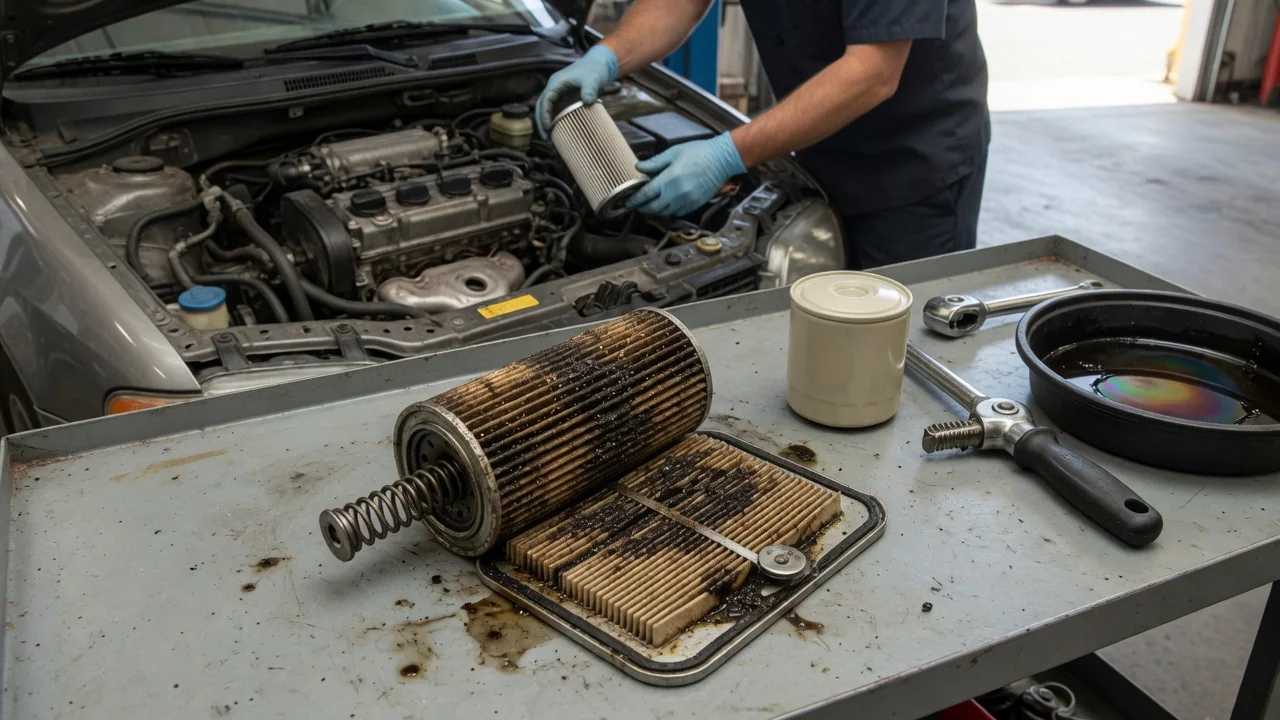
Every engine sheds tiny amounts of metal, carbon, and dirt into its oil, and those particles can scratch bearings, cam lobes, and cylinder walls if they keep circulating. The oil filter's job is to pull that debris out of the oil before it reaches close-fitting parts. How an oil filter captures debris comes down to three things: the filter media that traps particles, the bypass valve that protects oil flow, and timely replacement.
Filter Media and How It Traps Particles
In most passenger-car engines, the oil filter is a full-flow design: the oil pump pushes the circulating oil through it before the oil reaches the main oil passages. Oil typically enters through a ring of small holes around the outer edge of the filter base, fills the space around the media, and then flows inward through the media into a perforated center tube. From there, cleaned oil exits through the threaded center opening and continues to the bearings, valvetrain, and other lubricated parts. Because the oil must pass through the media to get out, particles that cannot follow it are left behind on the surface or inside the media itself.
The media is usually made from cellulose fibers, synthetic fibers such as glass or polyester, or a blend of the two, often bonded with resin for strength. It is folded into pleats to pack a large surface area into a small canister, which lowers flow resistance and spreads debris over more material. Capture happens in two general ways. Larger particles are stopped at the surface because they cannot fit through the gaps between fibers, a process often called straining or sieving. Smaller particles enter the fiber matrix and become lodged as they contact and stick to fibers along a winding path, which is known as depth filtration. Synthetic fibers are generally finer and more uniform than cellulose, which is why synthetic and blended media are commonly associated with better capture of small particles, though actual performance depends on the specific product.
Filtration efficiency is not a single number that applies to every particle size. A filter catches a high share of large particles and a progressively smaller share of finer ones, and manufacturers that publish ratings usually tie efficiency to a particular particle size and test standard. As debris builds up, the trapped layer can help catch finer particles, but it also increases resistance to flow. That trade-off between capture and flow is why filters have a finite service life.
The Bypass Valve and Why It Exists
A bypass valve, sometimes called a relief valve, is a spring-loaded valve that lets oil go around the media instead of through it. It stays closed during normal operation. When the pressure difference between the dirty side and the clean side of the media rises past the valve's set point, the spring is overcome and the valve opens, sending some or all of the oil directly to the outlet. Two common situations can create that pressure difference: a cold start, when thick oil struggles to pass through the media, and a filter so loaded with debris that oil can no longer flow through it easily.
The logic is simple: unfiltered oil is far less harmful than no oil. If the media were allowed to block flow completely, bearings and other parts could be starved of lubrication. The price of that protection is that, while the valve is open, debris is not being removed and particles already in the oil keep circulating. Depending on engine design, the bypass valve may be built into the filter or located in the engine's filter mount or housing, and its opening pressure is chosen for the specific application. This is one reason a filter that threads on correctly is not automatically the right filter; the bypass setting and other internal features should match what the engine was designed to use.
Replacement and Why It Matters
A filter cannot unload what it has captured. Over time the media fills, flow restriction rises, and the bypass valve becomes more likely to open, so the filter is replaced rather than cleaned. Spin-on filters are discarded as a complete unit, while cartridge-style systems keep a reusable housing and replace only the media element along with its seals. Many owners replace the filter at every oil change, and the vehicle's owner's manual or service information is the authoritative source for the interval, which may be shorter under severe-service conditions such as frequent short trips, towing, dusty roads, or extended idling.
Installation details affect whether the new filter works as intended. The old gasket or O-rings should come off with the old filter or element; a leftover gasket stacked under a new one can cause a sudden, serious leak. A thin film of clean oil on the new gasket helps it seal and makes later removal easier. Tightening should follow the instructions printed on the filter or in the service information, since overtightening can distort the gasket and undertightening can allow leaks. Many spin-on filters also include an anti-drainback valve that helps keep oil in the filter when the engine is off, so oil pressure can build quickly at startup. Running the engine briefly, checking for leaks, and rechecking the oil level confirms the installation.
Practical Implications and Limits
Understanding engine oil filter function also means knowing what a filter cannot do. It handles solid particles within its capture range, but it does not remove contaminants that are dissolved or dispersed at a very fine scale, such as fuel dilution, moisture, combustion acids, or much of the fine soot held in suspension by the oil's detergent and dispersant additives. Those contaminants, along with gradual additive depletion, are why the oil itself still has to be changed. A more efficient filter can help reduce abrasive wear, but it cannot restore oil that has degraded chemically.
These mechanisms also explain some real-world limits. Cold oil may partly bypass the media, and the first moments after a start are when lubrication is least established, so frequent cold starts and short trips place more demand on both the oil and the filter. Debris found in a used filter can be useful evidence, and some technicians cut filters open to inspect the media, but interpreting what they find requires context rather than assumptions. The right filter for a given engine is the one that matches its specified thread, sealing, dimensions, bypass setting, and flow needs, which is why the owner's manual and correct parts lookup matter more than general claims about any single filter type.