How Does an HID Headlight Work? Arc, Ballast and Warmup Explained
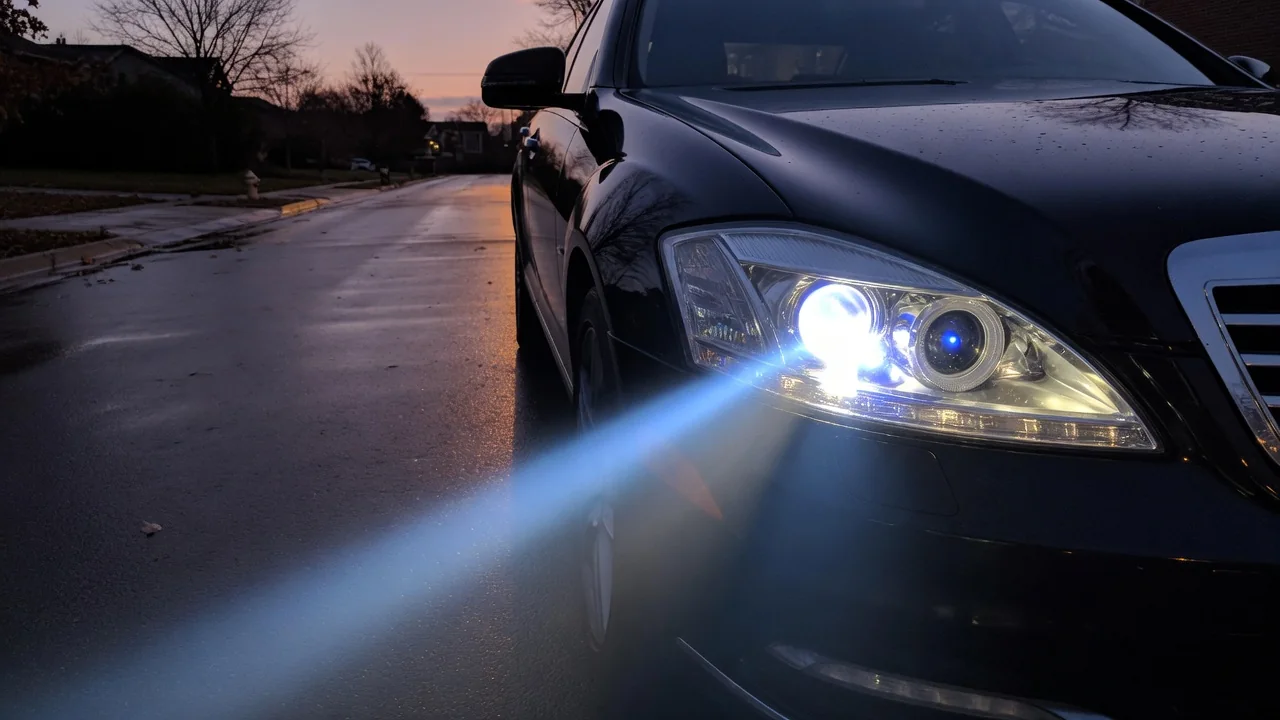
A high-intensity discharge (HID) headlight, often called a xenon headlight, makes light very differently from a conventional halogen bulb. Instead of heating a filament until it glows, it sends an electric arc through a sealed capsule of gas and metal salts. How an HID headlight works comes down to three linked pieces: the arc discharge itself, the ballast that starts and controls it, and the warmup period before the lamp reaches full brightness.
Arc Discharge: Making Light Without a Filament
At the heart of an HID bulb is a small arc tube, usually made of quartz glass, with two tungsten electrodes facing each other across a short gap. No filament bridges that gap. The tube is filled with xenon gas under pressure along with a small dose of metal halide salts. When a high enough voltage is applied across the electrodes, the gas between them ionizes. Electrons are stripped from atoms, and the gas becomes electrically conductive. Current then flows through this ionized path as a continuous arc, much like a contained, stable spark.
The light comes from excited atoms in that arc. Electrons collide with the xenon atoms and, once they have vaporized, with the metal atoms too. Those atoms jump to higher energy states and release the energy as light when they fall back. Each element emits at characteristic wavelengths, so the chemistry inside the capsule largely determines the color of the beam. This is why HID light usually looks whiter or slightly bluer than the yellowish output of halogen lamps. It is also why different bulb formulations can produce noticeably different color tones.
Because the light comes from a gas discharge rather than a glowing wire, an HID bulb turns more of its electrical input into visible light and less into heat than a halogen bulb of similar output. Without a filament, it also lacks the part that most often breaks or burns out in halogen bulbs. The electrodes still wear gradually over time. That wear is one reason HID bulbs tend to age slowly rather than simply failing all at once.
The Ballast: Igniting and Controlling the Arc
An arc discharge cannot run directly from a car's low-voltage electrical system. The ballast is the electronic control unit at the center of HID car headlight operation, and it does two separate jobs: starting the arc and keeping it stable. An ignitor circuit handles the start. Depending on the system design, the ignitor may be built into the ballast, mounted separately, or integrated into the bulb base. It produces a brief pulse of many thousands of volts. That pulse breaks down the gas in the cold arc tube and establishes the first conductive path.
Once the arc is struck, the electrical situation changes. An ionized gas has what engineers call negative resistance: as current increases, resistance drops. Left unchecked, current would keep climbing. The ballast prevents this by actively regulating the power delivered to the bulb. It reduces the voltage to a much lower running level and holds the arc at a controlled operating point. Without that regulation, the bulb would quickly overheat, or the arc would become unstable and go out.
Most automotive ballasts also convert the vehicle's direct current into alternating current for the bulb. Reversing the current many times per second spreads the load evenly between the two electrodes, so one does not erode faster than the other. Modern ballasts also monitor the lamp. As a protective measure, they can shut down or refuse to restart if they detect a fault, such as an open circuit or an arc that will not hold.
Warmup: Why HID Lights Reach Full Output Gradually
When an HID headlight is switched on from cold, it does not immediately reach full brightness or its final color. In the first moments, the light comes mostly from the xenon gas, which ionizes readily and gives usable light almost at once. The metal halide salts, however, start as solid deposits on the inside of the cold arc tube. Heat from the arc must melt and vaporize them before they can join the discharge and add their share of the light. As the capsule heats up over a period of seconds, output builds and the color settles toward its steady white.
The ballast actively manages this phase. During warmup, it typically gives the bulb more power than it will draw in steady operation. The extra power heats the capsule faster and shortens the time to useful output. As the bulb approaches its normal temperature, the ballast tapers the power back to the regulated running level. The exact warmup profile depends on the bulb type and the ballast design, so the time to full brightness and the visible color shift can differ between systems. A bulb that is still hot from recent use may also behave differently on restart than one starting fully cold.
Practical Implications and Limits
The warmup behavior explains a common design choice. An HID lamp does not deliver full output instantly and does not respond well to rapid on-off cycling. For that reason, some headlight systems keep the HID lamp lit and use a movable shutter or reflector to switch between low and high beam. Others pair HID low beams with a separate light source for high beam and flash-to-pass. Which approach a given vehicle uses depends on its specific headlight design. The owner's manual or service information is the reliable reference.
The high ignition voltage is a genuine safety concern. Before servicing an HID headlight, switch off the lights and the ignition. Disconnect the lamp as the vehicle's service procedures direct, and do not touch connectors or the bulb while the system could be energized. Bulbs also run hot, so handle them only once they have cooled, and hold them by the base rather than the glass. Some HID bulb types contain small amounts of mercury, so dispose of them according to local rules for that kind of waste.
Electrode wear and chemical changes inside the capsule develop gradually, so an aging HID bulb often shows symptoms before it stops working. These include dimmer output, a shift in color, flickering, or the light going out after warming up. The same signs can also point to a ballast, ignitor, or wiring problem, so follow the vehicle's service information when diagnosing. Replacing bulbs in pairs keeps color and brightness matched on both sides. Finally, HID headlight optics are designed around the small, bright arc. Fitting HID bulbs into housings built for halogen filaments can therefore produce poor beam control and glare for other drivers.