How Does an EV Reverse Direction? Motor, Gearbox and Controls Explained
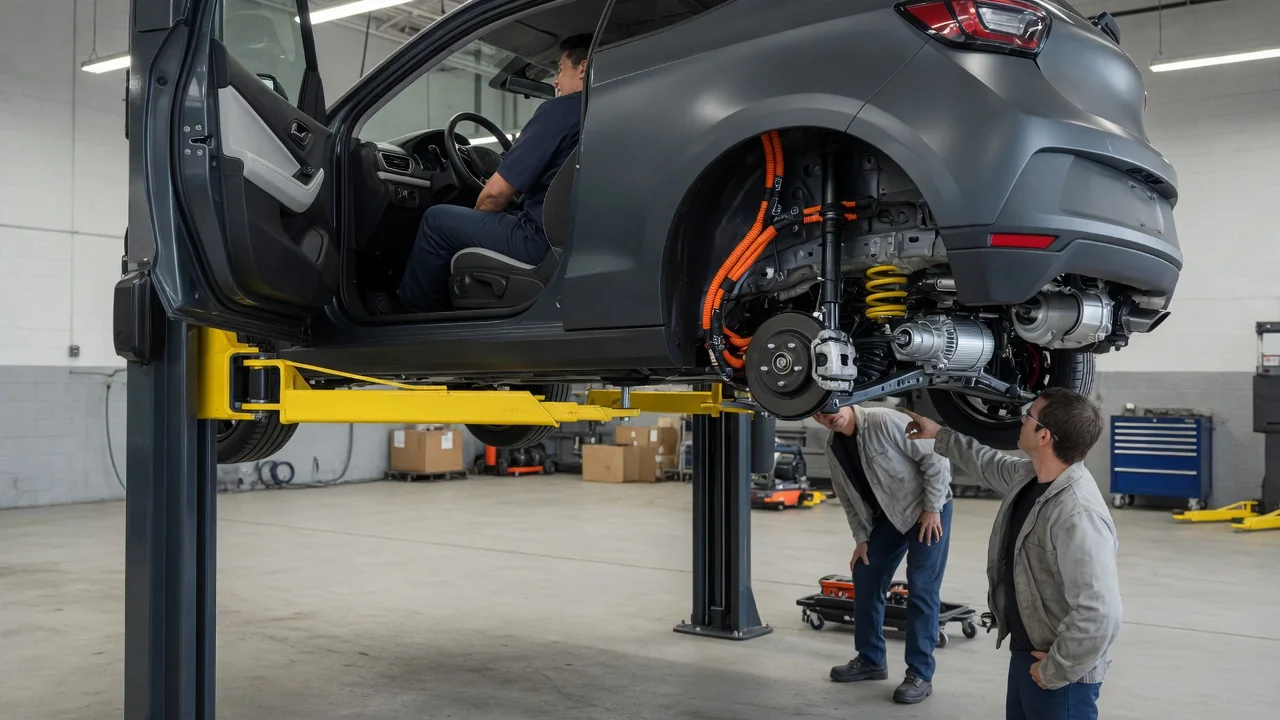
Most electric vehicles have no reverse gear at all. Instead of routing power through an extra set of gears, an EV typically backs up by spinning its traction motor the other way, a change made entirely in the power electronics. Understanding how an EV reverses direction means looking at three pieces: how the inverter controls the motor, what the gearbox does and does not do, and how the driver's selection reaches the hardware.
Electrical control: turning the motor the other way
The traction motor in a typical EV, whether a permanent-magnet synchronous design or an induction motor, is an AC machine fed by an inverter. The inverter converts the battery's DC power into three-phase AC by rapidly switching power transistors. Energizing the stator windings in a set order creates a rotating magnetic field, and the rotor follows that field. The direction of rotation depends on the order in which the three phases peak. One sequence turns the motor one way; swapping the order of any two phases turns it the opposite way. That is the core answer to electric car reverse motor direction: the controller changes the phase sequence, and no mechanical changeover is needed.
Modern motor controllers do not literally swap wires. They generally use a technique called field-oriented control, in which software calculates the torque being requested and generates the voltage pattern needed to produce it, based on the rotor's position measured by a resolver or encoder or estimated from electrical signals. Reversing simply means commanding torque in the opposite sense. Because the controller knows where the rotor is at every moment, it can apply that torque smoothly from a standstill. The same principle underlies regenerative braking: torque applied against the direction of rotation makes the motor act as a generator, so the car can still recover some energy when slowing while backing up.
Simpler electric vehicles built around brushed DC motors, such as some low-speed utility designs, reverse in an older way: the controller or a contactor reverses the polarity of the supply to the armature or field winding. The outcome is the same, but road-going EVs overwhelmingly rely on inverter-driven AC motors.
Gearbox: why there is usually no reverse gear
Most EVs use a single-speed reduction gear between the motor and the differential. Its job is to trade the motor's high rotational speed for more torque at the wheels at a fixed ratio. An internal combustion engine can only turn in one direction, so a conventional transmission needs an idler gear or a planetary set with clutches to reverse its output. An electric motor can produce torque in either direction from zero rpm, so the reduction gears simply turn backward when the motor does. The same gear teeth carry the load in both directions, just on opposite faces of the teeth.
A small number of EVs use two-speed transmissions to improve efficiency or performance at different speeds, but reversing is still generally handled electrically rather than by a dedicated reverse ratio. The one mechanical function commonly tied to the gear selector is park, which engages a locking pawl in the reduction unit or applies an electric parking brake. In many full hybrids with a power-split layout, reverse is likewise produced by the electric motor, because the planetary arrangement has no separate reverse gear.
Driver input: from the selector to the inverter
In most EVs the gear selector, whether a lever, dial, buttons or a stalk, is shift-by-wire. It sends an electronic request rather than moving any linkage. A vehicle control unit evaluates that request against conditions such as whether the brake pedal is pressed, whether the car is stationary or below a low speed threshold, and whether the high-voltage system is ready. If the request is accepted, the control unit tells the motor controller to treat accelerator input as a demand for reverse torque, and the instrument display confirms that R is engaged.
The accelerator pedal works the same way in reverse, but the software can map it differently. Manufacturers often cap reverse speed and limit available torque to make backing up predictable. Selecting reverse also triggers the reversing lights and, where fitted, the rear camera and parking sensors. In markets that require acoustic vehicle alerting systems, the car emits an external sound at low speeds, and some vehicles use a distinct tone when reversing.
If the driver selects R while the car is still rolling forward faster than the permitted threshold, the system typically ignores the request or shifts to neutral instead of slamming the motor into reverse. The exact rules vary by vehicle and are described in the owner's manual.
Practical implications and limits
Without a reverse gear, there is nothing to grind or crunch when changing direction, and an abrupt shift cannot damage gear teeth the way a misused manual gearbox can. On the other hand, any cap on reverse speed or torque is a deliberate software decision, not a fault. Owners who back a trailer up a slope or reverse out of deep snow should check the manual for any stated limits, because reverse performance is not always identical to forward performance.
Because direction is chosen electronically, a problem with the low-voltage 12-volt battery, a wheel speed or brake sensor, or a control module can prevent the car from engaging any drive position at all. Such symptoms usually call for diagnostic scan tools rather than mechanical transmission work. Faults in the inverter or motor generally affect both directions at once. The reduction gearbox is still a mechanical part with lubricant, so any service interval the manufacturer specifies for it still applies.
The permanent connection between motor and wheels also matters when the car is moved without its own power. Turning the drive wheels can spin the motor and generate voltage, which is why many manufacturers recommend flatbed transport or wheel dollies rather than towing with the drive wheels on the ground. Follow the vehicle-specific towing and transport mode instructions before moving a disabled EV.