How Does an EV Measure Charging Energy?
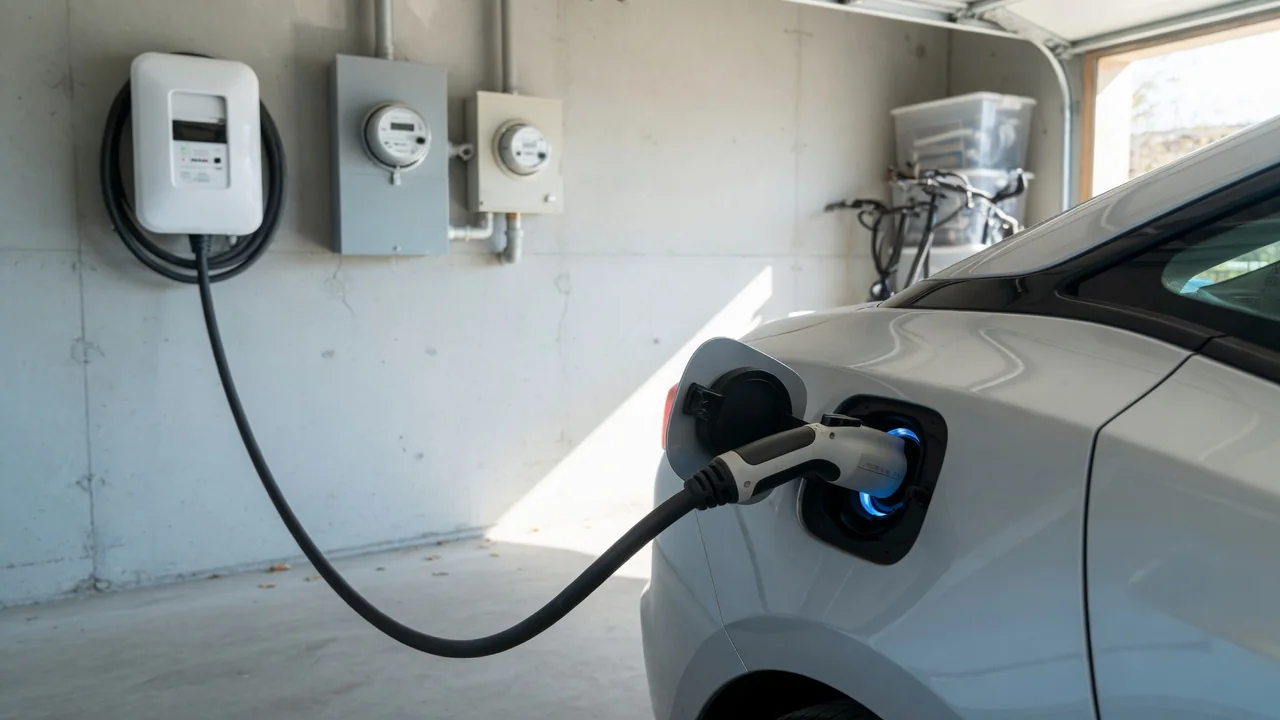
An electric vehicle has no single gauge for charging energy, the way a fuel pump counts gallons. Electronics in the car and in the charging equipment measure voltage and current over and over. They multiply the two to get power, then add that power up over time. Where each measurement happens, and what it includes, explains why the dashboard, the charger screen and the final bill often show different numbers.
Power over time
At any moment, electrical power in watts equals voltage multiplied by current. Energy is that power accumulated over time, usually expressed in kilowatt-hours. One kilowatt-hour is the energy delivered by one kilowatt of power sustained for one hour. Charging power rarely stays constant through a session. It changes with battery state of charge, temperature and what the charger can supply. Because of this, measuring equipment does not multiply one power value by the elapsed time. It samples voltage and current repeatedly and sums many small slices of energy. In effect, it performs a running numerical integration.
Inside the vehicle, this job falls mainly to the battery management system. It measures pack current with a dedicated sensor, commonly a precision shunt resistor or a Hall-effect sensor, and it measures pack voltage directly. Tracking current flowing in over time gives the charge added, a technique often called coulomb counting. Combining that with voltage gives the energy added. The same sensors keep working while driving, so the system follows energy in both directions.
The measurement point matters as much as the method. During AC charging, power from the grid passes through the vehicle's onboard charger, which converts it to DC for the battery. That conversion is not perfectly efficient. Other systems may also draw power, including cooling pumps, battery heating and the low-voltage electrical system. During DC fast charging, the conversion happens inside the station. Its meter measures what the station delivers, while the car measures what reaches the pack. Cable losses and vehicle loads sit between those two points, so the readings are not expected to be identical.
Display
The figures a driver sees are processed versions of the raw measurements. These can include the battery percentage, charging power, estimated time to finish, range added and sometimes energy added in kilowatt-hours. The percentage, known as state of charge, is an estimate rather than a direct reading. Coulomb counting slowly drifts because small sensor errors build up. The battery management system therefore corrects its estimate using voltage-based models, temperature data and reference points, which are often reached near full or near empty. As a result, the percentage can move unevenly or adjust slightly after a rest period.
An energy-added figure can mean different things depending on the vehicle's software. It might represent energy measured going into the battery or energy drawn at the charging inlet. It might also be calculated from the change in state of charge multiplied by the estimated usable capacity. Manufacturers do not always state which method applies. Rounding and slow screen updates add further small differences. A range-added estimate is another step removed. It is usually based on recent driving consumption, so the same energy can show as more or less range from one week to the next.
The charging station often has its own screen or app session showing energy delivered. That number comes from the station's internal meter, not from the car. Seeing two different kilowatt-hour values for one session is normal. Each device reports from its own side of the connection.
Billing context
When a public charging session is billed by energy, the figure normally comes from the station's EV charging energy meter, not from the vehicle. In many places, meters used to sell electricity to the public are covered by weights-and-measures or metrology rules. These rules can address accuracy, sealing or how readings are shown to the customer. Requirements differ by jurisdiction and change over time, so the local framework determines what a given station must meet. The vehicle's display has no role in that process.
Not every network prices purely by kilowatt-hour. Some charge by the minute, per session or through membership plans. Idle fees may apply once charging ends and the car stays plugged in. Under those models, the energy reading may appear on the receipt without fully determining the cost. At home, the utility meter records the whole household's use, so EV charging is mixed in with everything else. Some home charging stations include built-in metering. Some utilities offer EV-specific rates or separate metering. Time-of-use pricing can make the hour of charging as important as the amount of energy.
Because billing meters sit on the supply side, the energy a driver pays for includes losses that happen before the energy reaches the cells. Onboard conversion losses during AC charging, thermal management and other vehicle loads are paid for even though they do not end up as stored battery energy.
Practical implications and limits
A gap between the car's figure and the station's or utility's figure is expected and does not by itself indicate a fault. The gap tends to look larger in long, low-power sessions. Fixed overhead from control electronics and pumps runs for more hours relative to the energy stored. It can also grow in cold weather, when the car may spend energy warming the battery before or during charging. Preconditioning before arrival can shift some of that energy use into driving instead.
Pick the number that matches the question. For cost, rely on the station receipt, the charging network's app or the utility bill. For driving efficiency, the vehicle's own consumption figures are more relevant. For tracking battery condition, treat any capacity or health figure as an estimate. A single charging session is not a reliable diagnostic. When comparing sessions, use the same source each time, because mixing car-side and supply-side readings creates differences that come from method rather than reality.
In-car readouts are designed for guidance, not for certified measurement. A software update can change how a manufacturer calculates or rounds the values it shows. The owner's manual is the best reference for what a particular vehicle's charging screens represent. If a public charger's billed energy looks clearly inconsistent with the session, the network operator is the party that can review the meter data.