How Does an EV Inverter Adjust Motor Speed?
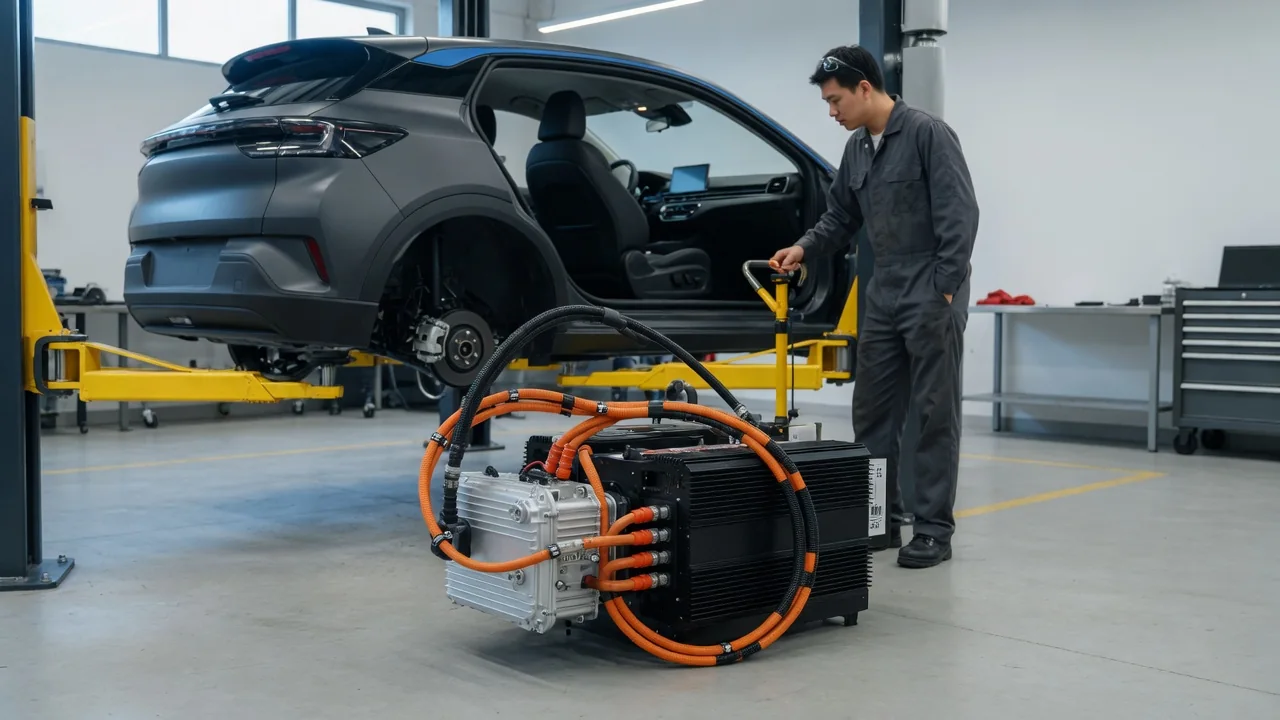
An electric vehicle has no throttle body or multi-speed gearbox to manage engine speed, so motor speed control falls largely to the inverter. This power-electronics unit converts the battery's direct current into alternating current and shapes that current continuously. Inverter motor speed control comes down to three linked factors: the frequency of the AC output, the voltage applied to the motor windings, and the torque request that starts with the driver's right foot.
AC frequency
Most EV traction motors are three-phase AC machines, either permanent-magnet synchronous motors or induction motors. The battery, however, supplies DC. The inverter bridges that gap with a set of high-power semiconductor switches, typically IGBTs or silicon carbide MOSFETs. These switches can connect each of the three motor phases to the positive or negative side of the battery thousands of times per second. Switching in a carefully timed pattern creates three alternating currents offset from one another. Together they produce a magnetic field that rotates inside the motor's stator.
The electrical frequency the inverter produces sets the speed of that rotating field. In a synchronous motor, the rotor locks onto the rotating field. Its speed is proportional to the frequency divided by the number of magnetic pole pairs in the machine. If the inverter raises the frequency, the rotor turns faster, and if it lowers the frequency, the rotor slows. An induction motor works on the same principle, but its rotor always turns slightly slower than the field. That difference is called slip, and it is what induces current in the rotor and produces torque. The inverter manages both frequency and slip to get the speed and torque it needs.
The inverter can vary frequency smoothly from zero upward. As a result, an EV can pull away from a standstill without a clutch and cover its whole speed range without shifting. Many EVs pair the motor with a single fixed reduction gear, so motor speed and wheel speed stay in a constant ratio. The field must stay aligned with the rotor at every moment. To do this, the inverter reads a rotor position sensor such as a resolver, or estimates rotor position from electrical measurements, and adjusts its switching pattern accordingly.
Voltage
Frequency alone is not enough. A spinning motor also acts as a generator. It produces a voltage called back electromotive force, or back-EMF, which rises roughly in proportion to speed and opposes the voltage the inverter applies. As speed climbs, the inverter has to raise the effective voltage it delivers so it can keep pushing current into the windings and producing torque. It does this through pulse-width modulation, which varies how long each switch stays on within every switching cycle. The inverter uses this to control the average voltage the windings see and to shape it into an approximate sine wave. Effective voltage is low at low speed and increases as speed rises.
The battery's DC bus voltage sets the ceiling on that output. Base speed is the point where the motor's back-EMF approaches the most voltage the inverter can supply. Beyond it, the inverter can no longer raise voltage to keep pace. Below base speed, the drive can generally deliver its maximum torque, and current is the main limit. Above it, the controller has to change its strategy.
In permanent-magnet motors, that strategy is called field weakening. The inverter injects a component of current that partially opposes the magnets' flux. This lowers back-EMF, so the motor can spin faster than the available voltage would otherwise allow. The trade-off is that available torque falls as speed increases. The motor then operates in a roughly constant-power region instead of a constant-torque one. Induction motors reach a similar result by reducing their magnetizing current. This is why EV acceleration typically feels strongest at lower speeds and tapers off at highway speeds.
Driver request
In most EVs, the accelerator pedal is not a direct speed command; it is better understood as a torque request. A pedal position sensor reports how far the pedal is pressed. A vehicle control unit interprets that signal along with other inputs, including vehicle speed, selected drive mode, battery state of charge, battery and motor temperatures, and any traction or stability control intervention. The result is a torque target sent to the inverter's controller.
The inverter then turns that torque target into motor currents. A common method is field-oriented control. It mathematically splits motor current into one component that produces torque and another that sets the magnetic flux. The inverter then adjusts its switching pattern so both components match their targets, and frequency and voltage follow from that process. The car's actual speed depends on the torque at the wheels compared with the forces resisting motion, such as aerodynamic drag, rolling resistance and road grade. Cruise control adds an outer loop that compares actual speed with the set speed and raises or lowers the torque request.
The same mechanism also works in reverse. When the driver lifts off the accelerator or presses the brake pedal, the controller can command negative torque. The inverter shapes current so the motor acts as a generator, which slows the vehicle and sends energy back to the battery. This is regenerative braking. Driving in reverse does not require a reverse gear, because the inverter changes the order in which it energizes the three phases and the magnetic field rotates the other way.
Practical implications and limits
The inverter sits between the battery and the motor, so the condition of both shapes how the car responds. A cold battery, or one with a low state of charge, may not be able to deliver or accept as much power. In that case the control system may limit acceleration or regenerative braking. The inverter and motor also generate heat. Repeated hard acceleration, towing or sustained high-speed driving can push temperatures up, and the vehicle may reduce available power to protect the hardware. When and how strongly these limits apply depends on each manufacturer's calibration, so EVs with similar hardware can feel noticeably different.
Some sounds owners notice are a byproduct of this control. A faint whine that changes pitch with speed can come from electromagnetic forces in the motor, the reduction gear or the inverter's switching. Some vehicles also add artificial sound at low speeds so pedestrians can hear them. Have the car checked rather than ignoring it if the noise changes character and also shows warning messages or enters a reduced-power mode.
Beyond the drive modes and regeneration settings the manufacturer provides, owners cannot meaningfully adjust how the inverter behaves. The inverter operates at high voltage, and its capacitors can hold stored energy after the vehicle is switched off. Inspection or repair should therefore be left to trained technicians who follow the vehicle's service manual and high-voltage safety procedures. For model-specific details, such as how regeneration levels or power limits are set, the owner's manual is the authoritative reference.