How Does an EV Estimate Battery Temperature? Sensors, Models, and Display
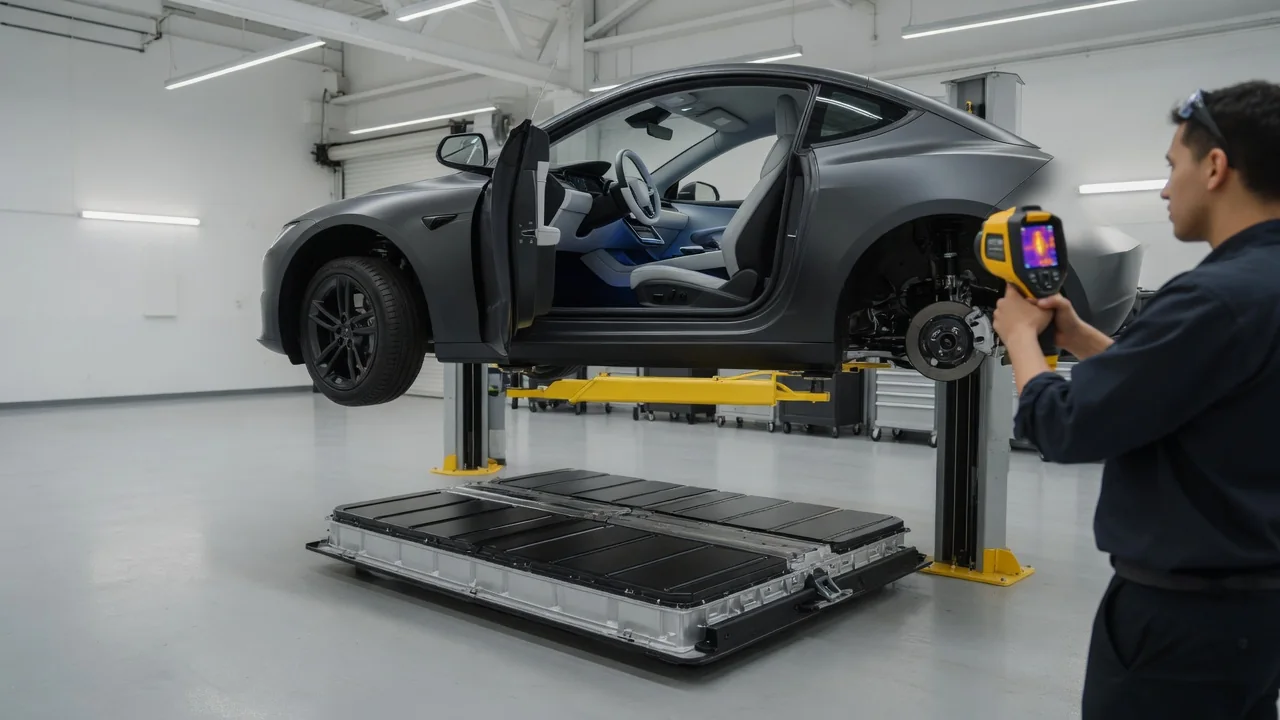
An electric vehicle cannot measure the temperature of every cell in its battery pack, so it builds an estimate instead. A limited number of EV battery temperature sensors report to the battery management system (BMS). The BMS combines those readings with current, voltage, and coolant data to judge how warm or cold the pack actually is. That estimate then shapes charging speed, available power, and how the thermal system runs. This article explains the general process, from where the sensors sit to what appears on the dashboard.
Sensor positions
Most lithium-ion packs sense temperature with small thermistors, which are resistors whose resistance changes predictably with temperature. They are usually mounted at the module level rather than on every cell. Common locations are cell surfaces, the areas near cell terminals or busbars, and the module circuit boards that also monitor cell voltages. Busbars and terminal connections are useful spots for two reasons: current flowing through them generates heat, and cell tabs conduct heat from inside the cell relatively well. A pack with hundreds or thousands of cells may therefore have only a few dozen measurement points, or fewer, depending on the design.
Liquid-cooled packs typically add sensors to the coolant loop, often at the inlet and outlet of the battery cooling plate or circuit. The difference between those two readings shows how much heat the coolant is removing or adding. Some systems also monitor the pack enclosure, the battery heater, or power electronics attached to the pack. Sensor placement is a compromise among cost, wiring complexity, reliability, and how well a given spot represents the cells around it. Designers generally try to place sensors where hot or cold spots are expected, such as cells in the middle of a module or at the end of a coolant path. The exact layout varies by vehicle and is rarely published in detail.
A sensor reads a cell surface or a nearby component, so under heavy load its reading lags behind the cell core. Measurement alone therefore does not fully explain how an EV estimates battery temperature. The BMS fills the gaps with calculation.
Control decisions
The BMS typically turns raw readings into several working values, such as minimum, maximum, and average cell temperature. To account for locations it cannot measure, it may run a thermal model. That model estimates heat generated from current and the cells' internal resistance, heat moved by the coolant, and heat lost to the surroundings. Some systems use state estimation techniques, such as Kalman-type filters, that continuously correct the model against sensor readings. Internal resistance itself changes with temperature, so the cells' electrical behavior can serve as an additional cross-check. The sophistication of this modeling varies widely between manufacturers.
These estimates set power limits. Lithium-ion cells accept charge poorly when cold, and charging them too hard at low temperature risks lithium plating. The BMS therefore reduces the allowed charging current, including current from regenerative braking, until the pack warms. At high temperatures, it limits both charge and discharge power to slow degradation and keep cells within safe bounds. DC fast charging is especially sensitive to temperature. The current the car requests from the station is calculated partly from the estimated pack temperature, and the coldest or hottest region usually sets the limit rather than the average.
The same estimates also command the thermal system. Depending on the design, the controller may run a coolant pump, switch valves to route coolant through a chiller connected to the air conditioning, or warm the pack with a resistive heater or heat pump. Some vehicles also deliberately generate heat in the drive unit. When a driver navigates to a fast charger or schedules a departure time, many vehicles use the temperature estimate to decide whether and when to precondition the pack. If a sensor reports an implausible value or disagrees sharply with its neighbors, the BMS will typically flag a fault and fall back to conservative limits.
Display
Many EVs do not show a numeric battery temperature on the standard instrument cluster. The estimate usually appears indirectly instead. Common cues include a snowflake or similar symbol indicating a cold battery, and a dashed or shortened section of the power meter showing that regeneration or acceleration is limited. A charging screen may also report that the battery is warming or that temperature is limiting charging speed. Some vehicles show preconditioning status in the companion app or on the navigation screen. Whether a given model offers any of these cues, and how they look, depends on the manufacturer and the software version.
Some cars make a number available through a service menu, an energy screen, or an OBD-II scanning app that reads manufacturer data. That number is usually a processed value. It may be an average, a minimum, a maximum, or a single sensor's reading, and it is often filtered to smooth out jumps. Third-party apps may label these values inconsistently. Two tools can therefore show different figures for the same car at the same moment without either one being faulty.
Practical implications and limits
For owners, the key point is that charging and driving performance follow the estimated pack temperature, not the outside air temperature. A car parked in a warm garage may charge normally on a cold day. A car that sat outside overnight may need a long time to warm its pack, even after a short drive, because a large battery has substantial thermal mass. Where the vehicle supports it, preconditioning before a fast-charging stop gives the thermal system time to bring the pack into the range the BMS favors. Expect slower charging and reduced regeneration when the pack is cold. In hot weather, expect possible power reduction during sustained hard driving or repeated fast charging.
The estimate has limits of its own. With sparse sensors, the BMS has to infer conditions in the cells it does not measure, and its models are calibrated for a healthy pack in its original condition. Aging cells, a failing sensor, low coolant, or a weak pump can make the estimate less representative. The usual result is more conservative power limits rather than a visible temperature warning. A persistent temperature-related message, unusually slow charging in mild weather, or a stored battery temperature fault code is worth having checked by a qualified technician with manufacturer-level diagnostic tools. For how a specific vehicle behaves, the owner's manual guidance on cold-weather charging and preconditioning remains the best reference.