How Does an Engine Control Idle Speed?
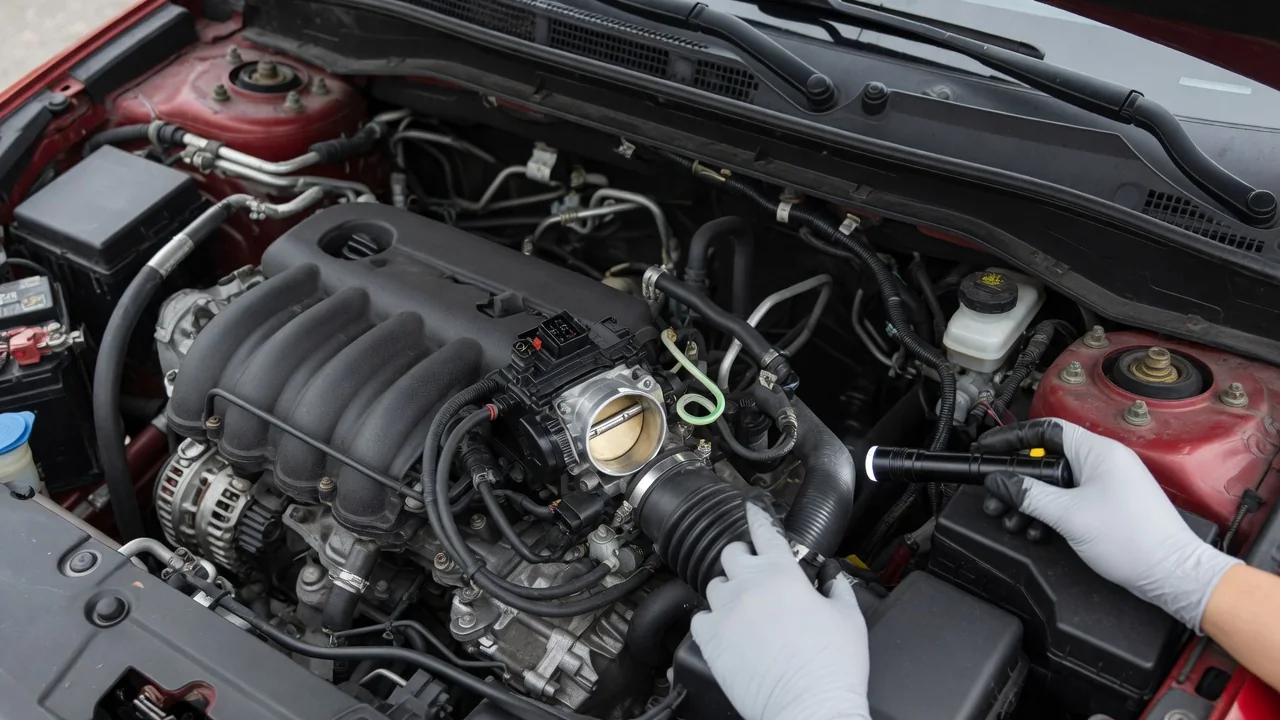
At idle, the driver isn't asking the engine for power, but the engine still has to keep turning smoothly, stay warm, run its accessories, and avoid stalling. Engine idle speed control balances those demands. On modern fuel-injected engines, the engine control module does this by adjusting three things together: how much air enters the engine, when the spark fires, and how the engine responds to loads from accessories such as air conditioning and the alternator.
Airflow: The Primary Way to Set Idle Speed
Idle speed depends mostly on how much air the cylinders receive. With the throttle plate nearly closed, only a small amount of air passes into the intake manifold, and the fuel system meters fuel to match it. More air means more fuel, more torque, and a higher idle. Less air does the opposite. The control unit compares actual engine speed, measured by the crankshaft position sensor, with a target idle speed and adjusts airflow to close the gap. That target is not fixed. It is typically raised when the engine is cold, which helps it warm up and run steadily, and lowered as coolant temperature rises.
How the airflow is adjusted depends on the design. Many older fuel-injected engines use an idle air control valve, a small motor-driven or solenoid valve that opens a passage around the closed throttle plate. Engines with electronic throttle control, often called drive-by-wire, usually have no separate bypass. The control module opens the throttle plate itself by a small, precise amount. Carbureted engines used mechanical parts, such as an idle speed adjusting screw and a fast-idle cam for cold starts, with little or no automatic correction.
Airflow has one important limitation: it does not change engine torque instantly. After the throttle or bypass valve moves, the intake manifold must fill or empty before the amount of air in each cylinder changes. That delay is long enough that airflow alone can let idle speed dip or overshoot when conditions change suddenly. This is why idle control does not rely on air alone.
Ignition Timing: The Fast Correction
Spark timing gives the control module a much quicker way to change torque. Each spark can be fired a little earlier or later, and the effect appears on the very next cylinder firing. Advancing the spark toward the point of best torque increases the work each cylinder produces. Retarding it reduces that work. Because the change takes effect almost immediately, ignition timing is well suited to smoothing small, rapid swings in idle speed that airflow adjustments would be too slow to catch.
To make this possible, many engine control strategies deliberately run idle timing somewhat later than the most efficient setting. This keeps a reserve of torque available. If engine speed starts to fall, the module can advance the spark and recover speed right away, then gradually add air and bring timing back toward its usual idle value. If speed rises, it can retard the timing. The tradeoff is a small loss of efficiency at idle in exchange for stability. Fuel delivery plays a supporting role. The module keeps the air-fuel mixture near its target using oxygen sensor feedback, but it holds the mixture steady for emissions and smoothness rather than using it as the main speed control.
Accessory Loads and How the Engine Anticipates Them
At idle the engine produces only a small amount of power, so a sudden extra load can pull speed down noticeably. Common loads include: • the air conditioning compressor engaging; • the alternator charging harder when the headlights, rear defroster, or cooling fans switch on; • a hydraulic power steering pump working near full steering lock; • an automatic transmission being shifted from park or neutral into gear; Each of these demands more torque from the crankshaft while the accelerator pedal stays where it is.
Rather than waiting for idle speed to sag, the control module often anticipates these loads. Depending on the vehicle, it may receive an air conditioning request signal before the compressor clutch engages, a signal from a power steering pressure switch, information about alternator load, or a signal showing which gear the transmission is in. With that warning, it can add airflow and adjust timing in advance, sometimes raising the target idle slightly while the load is present. Some systems briefly delay the compressor clutch until the extra air is in place. When a load arrives without a signal, the module still corrects the speed drop by comparing actual engine speed with its target, but only after the drop begins.
Practical Implications and Limits
These mechanisms explain several common idle complaints. A vacuum leak lets in air the control module did not account for, which can raise the idle or make it surge up and down. Carbon buildup around the throttle plate or in an idle air passage narrows the small opening the system depends on. The result can be a low, rough idle or stalling, especially when an accessory load comes on. An idle that is higher right after a cold start and settles as the engine warms is normal, not a fault.
Many engines also learn and store idle airflow corrections over time to compensate for gradual changes such as deposits. After a battery disconnection, a throttle body cleaning, or a part replacement, the stored correction may no longer match, and idle can be unstable until the module relearns it. Some vehicles relearn on their own during normal driving, while others require a specific procedure or a scan tool. On electronically controlled engines, base idle generally is not meant to be adjusted with a screw, and doing so may confuse the control system.
This article describes general principles. Target idle speeds, warm-up behavior, the signals a given module monitors, relearn requirements, and the hardware used all vary by engine and vehicle. Vehicles with automatic stop-start or hybrid powertrains may shut the engine off instead of idling under some conditions. For exact values, diagnostic steps, and procedures, the service manual for the specific vehicle is the authoritative reference.