How Does an Electric Car Reduction Gear Work?
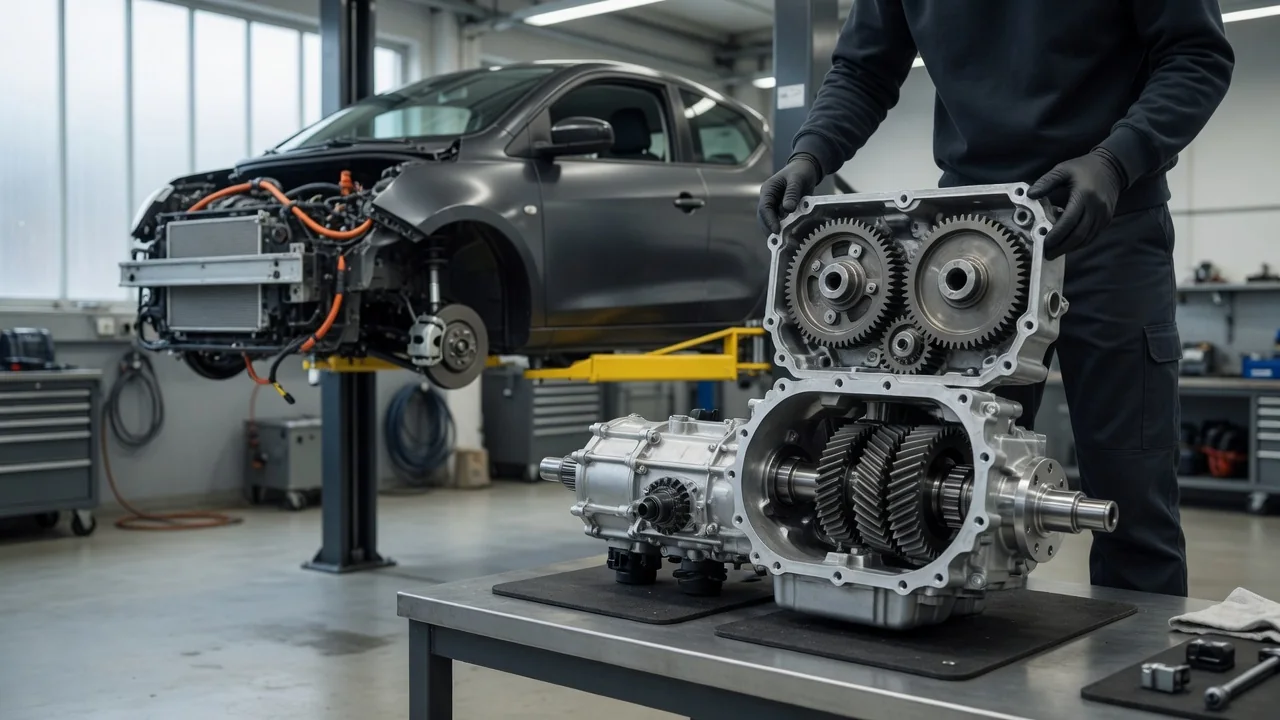
An electric motor spins far faster than a car's wheels ever need to turn, so something has to sit between the two. Understanding how does an electric car reduction gear work comes down to one idea: a fixed set of gears trades motor speed for wheel torque, without the shifting a combustion drivetrain requires.
Motor speed range
A traction motor produces strong torque from a standstill and keeps delivering useful power across a very wide span of rotational speed. A gasoline engine, by contrast, makes its best output in a narrow band and stalls if it turns too slowly. That difference is the reason an electric car can manage with one fixed gear. The motor does not need several ratios to stay in a productive range, because nearly its whole operating range is productive, from creeping in a parking lot to highway cruising.
Most traction motors hold roughly constant torque at low speed, then shift into a region where torque tapers as speed climbs while power stays near its peak. The reduction gear is chosen so that both regions line up with real driving. Maximum motor speed differs considerably between designs, depending on rotor construction, bearing limits, and inverter capability, so the exact figures belong to each vehicle's own documentation. What a driver can observe is simply that the car never pauses to change gear as speed builds.
Reduction ratio
The reduction ratio describes how many times the motor shaft turns for each turn of the wheels. A small pinion on the motor shaft drives a larger gear, and the size difference slows the rotation while multiplying torque by nearly the same factor, minus small friction losses. Many units do this in two stages using an intermediate shaft, which keeps each gear a manageable size. The final gear usually drives a differential, which splits torque between the left and right axle shafts.
Choosing the ratio is a compromise. A numerically higher ratio gives stronger launch and hill-climbing force at the wheels, but the motor reaches its speed limit at a lower road speed. A numerically lower ratio favors relaxed high-speed running at the cost of initial shove. Engineers balance this against tire diameter, vehicle weight, and motor character. Some layouts use helical gears on parallel shafts, others use a planetary set arranged around the motor axis, and the ratio itself varies by model and even by axle.
Driving feel
Because the gears are always meshed in the same ratio, acceleration arrives as one continuous push. There is no clutch engagement to wait for and no interruption in thrust while a transmission selects another gear. Pressing the accelerator changes motor torque almost immediately, and that torque reaches the tires through a short, rigid path. This directness is why even modest electric cars feel eager away from a stop, and why power delivery seems unusually linear compared with a multi-speed automatic.
The same fixed connection works in reverse when the driver lifts off. The wheels drive the motor through the gearset, the motor acts as a generator, and the car slows through regenerative braking. How strongly it decelerates depends on software settings and battery conditions rather than on the gears themselves. Backing up needs no separate reverse gear either, since the motor simply spins the opposite way. Drivers may notice acceleration tapering at high speed, where the motor is operating in its falling-torque region.
Everyday Use and Observations
In daily driving the reduction gear asks for almost nothing from the driver. The selector offers forward, reverse, neutral, and park, yet none of these choose between different ratios. Park is typically provided by a locking mechanism or the electric parking brake, depending on the design. With no engine noise to mask it, some owners hear a faint, rising whine under acceleration or regeneration. That sound often comes from gear teeth meshing and motor electronics, and its character varies between vehicles.
The gearset runs in its own lubricant, which cools and protects the teeth and bearings. Some units share fluid with motor cooling, while others keep the gearbox oil separate. Whether that fluid is ever scheduled for replacement depends entirely on the manufacturer, so the maintenance schedule for the specific vehicle is the right reference. Useful things to watch for are fluid spots beneath the drive unit, a new clunk when moving between acceleration and deceleration, or a whine that has clearly grown louder over time.
Limits and Next Steps
A single ratio cannot be ideal everywhere. The gearing that gives brisk launch also forces the motor to spin very fast on the highway, where efficiency can fall and top speed is ultimately capped by motor speed. A few performance-oriented vehicles add a second gear to widen that envelope, and some dual-motor cars use different ratios front and rear to get a similar benefit. For most cars, though, the simplicity, low weight, and reduced losses of one fixed reduction outweigh those compromises.
When something seems wrong, noise or vibration alone rarely identifies the cause, because wheel bearings, tires, axle joints, and motor bearings can all produce similar symptoms. Any stored fault code is evidence to interpret alongside those symptoms, not proof that a particular component has failed, and manufacturer-specific codes need confirmation against that vehicle's service information. Drive units sit close to high-voltage components, so inspection beyond a visual check for leaks is best left to a technician trained and equipped for electric vehicles.