How Does an AWD Clutch Pack Work?
The short answer
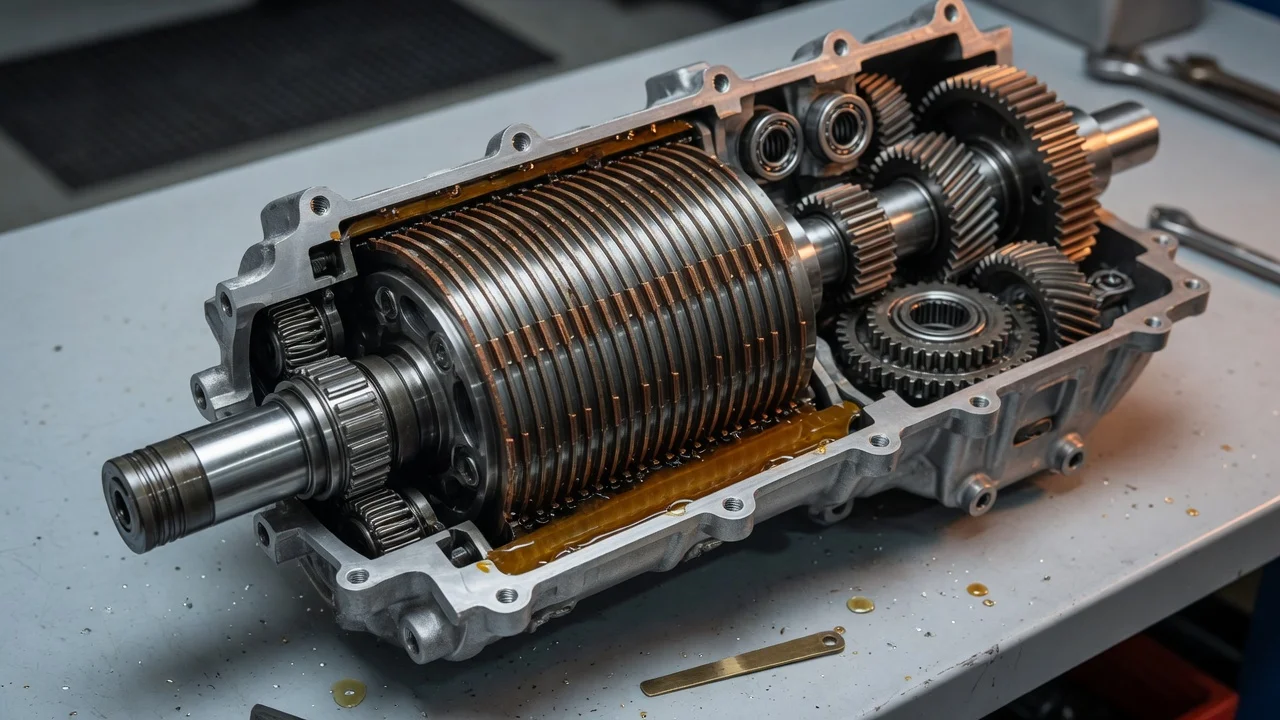
An AWD clutch pack is a stack of alternating friction plates and steel plates inside a sealed coupling. When a control system squeezes the pack together, the plates lock against each other and transfer torque to the axle or wheel that needs it. When the pressure is released, the plates can slip relative to one another. That slipping is not a defect by itself. It is the mechanism that lets an all-wheel-drive system vary how much power goes to each axle.
The effect depends on the design. Some systems use a clutch pack ahead of the rear differential, often called a center coupling or hang-on AWD. Others place clutch packs inside a rear differential to control torque between the left and right wheels. In both designs, the basic idea is the same: hydraulic, electromagnetic, or mechanical force compresses the plates, and friction carries torque.
How the plates create torque transfer
A typical pack contains friction plates and smooth steel separator plates arranged in an alternating stack. One set is splined to the input side of the coupling, and the other set is splined to the output side. When the pack is loose, the input and output sets can rotate at different speeds with low resistance. When an actuator compresses the stack, friction between the plates resists that speed difference and carries torque from one side to the other.
The amount of torque transferred depends mainly on clamping force, the number of plate surfaces, the plate material, and the friction characteristics of the fluid between the plates. More clamping force and more contact surfaces generally mean more torque capacity. However, the coupling still permits controlled slip whenever the wheels need slightly different speeds, such as in a tight turn.
How the control system decides when to engage
The control strategy varies by vehicle. Many modern systems monitor wheel-speed sensors, steering angle, throttle position, and other signals. When the control module detects a speed difference between the front and rear axles or between left and right wheels, it commands an actuator to build pressure on the clutch pack. The actuator may be an electric motor driving a pump or cam, a solenoid controlling hydraulic pressure, or an electromagnetic coil.
Once the pressure rises, the pack tightens and torque flows to the slower-turning or better-supported axle or wheel. As speeds return to normal, the control system reduces pressure and the pack loosens. This allows the system to operate as effectively front- or rear-biased most of the time while still providing extra traction when road conditions change.
What the clutch pack means in normal driving
In normal driving with good traction, the clutch pack may remain mostly open or only lightly engaged. This helps reduce driveline drag and tire scrub. When traction drops, the system can engage the pack quickly enough to send torque to the axle or wheel with more grip. The driver usually notices smoother acceleration on wet, snowy, or loose surfaces rather than a mechanical shift.
There are operating limits. A clutch pack is designed for brief, variable slip, not for continuous heavy slipping under high load. Sustained wheelspin, aggressive launches, towing beyond the vehicle's rating, or running mismatched tires can generate excessive heat. Overheating can damage the fluid, glaze the plates, or cause the system to temporarily reduce engagement as a protection measure.
Symptoms that may point to a worn or damaged pack
Wear often appears first as reduced all-wheel-drive effectiveness. The vehicle may behave more like a two-wheel-drive model, with extra wheelspin on low-traction surfaces even though the AWD system appears active. In some cases, drivability changes only in stored fault codes or through a warning message.
Other possible signs include shudder, judder, or a grab-and-release feeling during low-speed turns, especially after fluid degradation or plate glazing. Noise, vibration, or metallic debris in the coupling fluid can indicate mechanical damage. These symptoms do not automatically confirm a failed clutch pack, because tires, sensors, actuators, wiring, or the control module can produce overlapping behavior. Diagnosis should start with the complete drivetrain and electronic fault codes rather than replacing the pack on symptom alone.
Maintenance and service
Some clutch-pack couplings have a serviceable fluid and filter, while others are treated as sealed units with replacement fluids specified only for certain service operations. The correct interval and fluid specification vary by manufacturer, model year, and system design. The manufacturer's service information is the reliable source for fluid type, fill procedure, and whether a filter is replaceable.
Tire condition also matters. Many AWD systems tolerate only a small difference in rolling circumference between tires. Mismatched tire sizes, unequal wear, or repeated temporary-spare use can force the clutch pack to work continuously and overheat. Before blaming the coupling, check that all four tires match the vehicle's specification and are in similar condition.
What should you do next?
If the vehicle is behaving normally and the goal is simply to understand the system, no immediate action is required. Keep tires matched and follow the manufacturer's service schedule. If there is a warning light, driveline shudder, reduced traction, or fluid leakage, the next step is a qualified diagnostic inspection. Because AWD behavior can be affected by fault codes, actuator operation, tire differences, and coupling wear, a proper diagnosis should identify the actual cause before any clutch pack is replaced.
Replacement and internal repair are generally not roadside tasks. Servicing the pack may require lifting the vehicle, removing drivetrain components, using specific tools, and completing a control-system adaptation procedure. This work should be performed by a qualified service facility using the applicable manufacturer instructions for the specific vehicle and system.