How Does Altitude Change a Car's Cooling Demands?
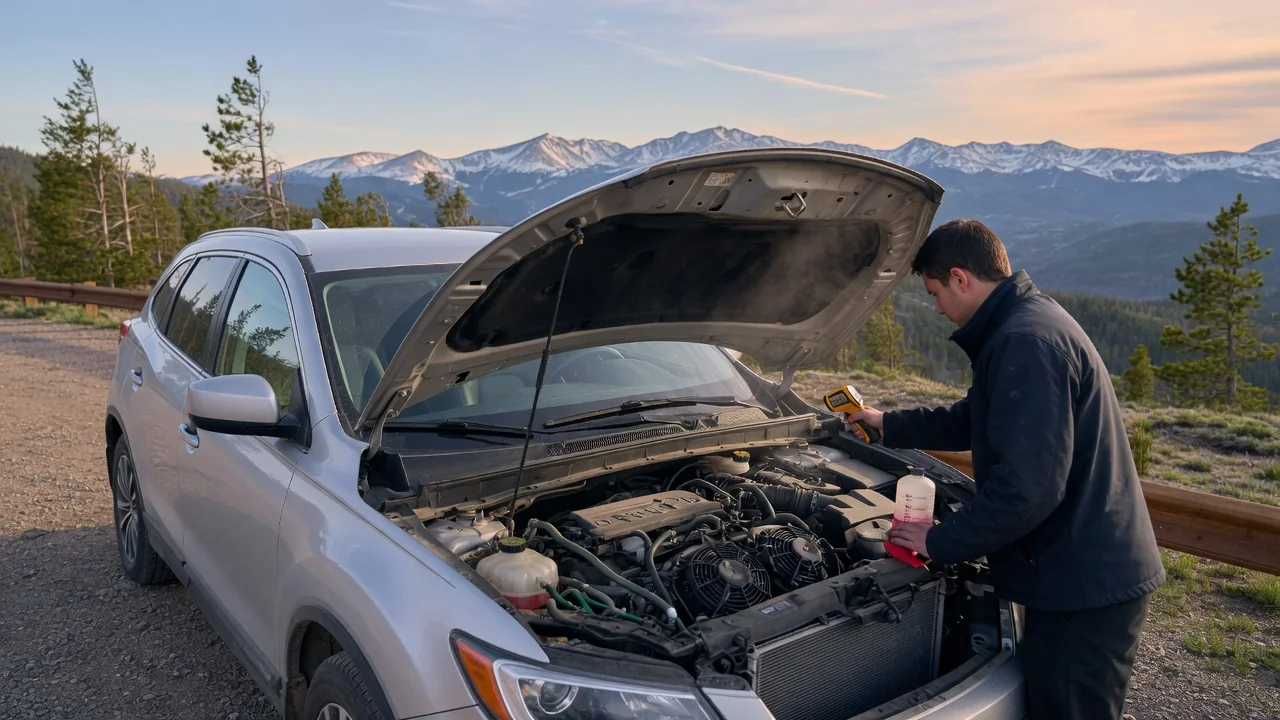
High altitude car cooling involves several effects that pull in different directions. Thinner air carries less heat away from the radiator. Lower atmospheric pressure reduces the coolant's boiling margin. Mountain roads often add long, steady climbs that keep the engine working hard. At the same time, a naturally aspirated engine makes less power up high, which changes how much heat it produces. Seeing how these factors interact explains how altitude changes a car's cooling demands and what drivers should watch.
Air Density and Heat Transfer
Air becomes less dense as elevation increases because less atmospheric pressure is pressing it together. For a cooling system, density matters more than volume. A radiator sheds heat by passing air across its fins, and the amount of heat that air can absorb depends on the mass of air moving through, not just how fast it flows. A cooling fan or a given road speed pushes roughly the same volume of air at any elevation, but at altitude that volume contains less air, so it carries away less heat. The same applies to the air conditioning condenser, which usually sits in front of the radiator and adds its own heat to the airflow.
Lower pressure also affects the coolant. Water boils at a lower temperature as atmospheric pressure drops, and engine coolant follows the same principle. A pressurized cooling system raises the boiling point by holding pressure above the surrounding atmosphere, and the radiator or reservoir cap typically regulates that pressure relative to outside air. Because outside pressure is lower at altitude, the total pressure inside the system is lower too, which trims the margin between normal operating temperature and boiling. A healthy system with the correct coolant mix and a sound cap usually keeps enough margin, but a weak cap or diluted coolant has less room to spare.
Density works in the other direction for engine heat output. A naturally aspirated engine draws in less oxygen per cycle in thin air, so its maximum power drops and it burns less fuel at full throttle. Turbocharged engines can compensate by spinning the turbocharger harder, which preserves more power but also raises intake air temperature and the load on the intercooler and radiator. How these effects balance depends on engine design, so altitude does not affect every vehicle in the same way.
Climbing Load on Mountain Roads
The bigger cooling challenge at altitude usually comes from the roads that lead there. Climbing a long grade requires sustained power to lift the vehicle's weight, and producing that power generates heat continuously rather than in short bursts. In flat highway driving the engine often operates well below its capability; on a steep, extended climb it may stay near the upper end of its output for many minutes. Because a naturally aspirated engine has less power available up high, the driver may need more throttle, a lower gear, or both to hold the same speed, which keeps heat production high while the radiator works with thinner air.
Speed adds another factor. Climbing traffic often moves slowly, and lower road speed means less air forced through the grille, so the cooling fan carries more of the burden. Extra weight compounds everything: passengers, cargo, roof loads, and especially a trailer increase the work required on every grade. Automatic transmissions are affected as well, since they generate heat under heavy load, and in many vehicles the transmission fluid is cooled through the radiator or a separate cooler in the same airflow path.
Hot weather is the third piece. Heat transfer depends on the temperature difference between the coolant and the outside air, and a hot day shrinks that difference. A long climb on a hot afternoon with the air conditioning running, a loaded vehicle, and thin mountain air stacks several demands at once. Any single condition is usually manageable for a properly maintained system; it is the combination that most often pushes temperatures upward.
Monitoring Engine Temperature
The dashboard temperature gauge is the primary tool for most drivers, but it has limits. Many modern vehicles buffer the gauge so the needle stays in the middle across a range of normal temperatures, then moves noticeably only when the engine runs hotter than intended. That design avoids alarming drivers over ordinary fluctuations, but it also means any upward movement deserves attention. A warning light or message indicating high coolant temperature is a clear signal to reduce load right away.
Drivers who want more detail can use the vehicle's information display, if it shows coolant or transmission temperature, or a plug-in OBD-II reader that displays live data. Watching actual readings on a long climb shows how the system behaves under load and how quickly it recovers on flatter sections. Normal ranges vary by vehicle, so the owner's manual or a service reference for the specific model is the right benchmark rather than a general number.
Other signs can appear before or alongside a rising gauge: the smell of hot coolant, steam from under the hood, or air conditioning that suddenly blows warmer, since some vehicles disengage the compressor when coolant runs hot. Before a mountain trip, checking coolant level with the engine cold, looking for leaks or soft hoses, and confirming the cooling fan operates helps ensure the system starts in good condition.
Practical Implications and Limits
In practice, altitude rarely causes overheating by itself. A vehicle in good condition driving at a steady pace through cool mountain air usually stays within its normal range. Trouble tends to appear when altitude combines with heat, a long grade, heavy load, and an existing weakness such as a partially clogged radiator, aging coolant, a failing fan, or a cap that no longer holds pressure. Altitude narrows margins; it exposes problems more often than it creates them.
If the temperature starts rising on a grade, practical responses include easing off the throttle, turning off the air conditioning, and setting the heater to maximum heat with the blower on high, which uses the heater core as a small additional radiator. If the reading keeps climbing, pulling over safely and following the owner's manual guidance on idling or shutting down is better than pushing on. Never open the radiator cap or pressurized reservoir while the system is hot, because coolant can boil violently once pressure is released, and its boiling point is already lower at altitude.
General advice has limits. Cooling system design, fan control strategy, transmission cooling, and towing ratings differ widely between vehicles, and some manufacturers publish specific guidance for towing or driving at high elevations. Those instructions take priority over general rules. A vehicle that repeatedly runs hot in the mountains despite sensible driving likely has an underlying issue worth diagnosing rather than a problem that altitude alone explains.