How Does ABS Modulate Brake Pressure?
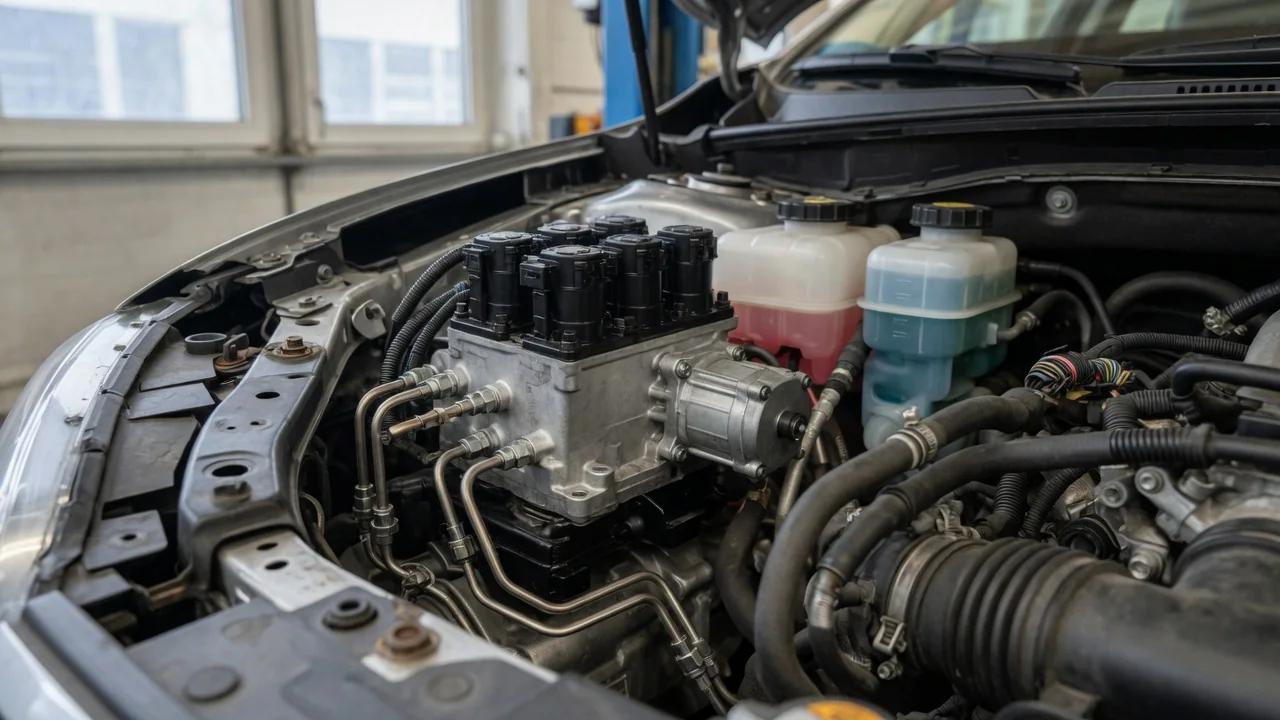
Anti-lock braking systems do not add braking force. They manage it. When a wheel starts to lock during hard braking, ABS briefly reduces, holds, and reapplies hydraulic pressure at that wheel so the tire keeps rolling near its point of best grip. Understanding how ABS modulates brake pressure comes down to three linked pieces: the wheel-speed signals that detect trouble, the valves that change pressure, and the pedal feedback the driver feels while the system works.
Wheel-speed signals
Every ABS decision starts with knowing how fast each wheel is turning. Most vehicles use a sensor at each wheel, positioned next to a toothed or magnetically encoded ring that turns with the hub, axle, or driveshaft. Some older or simpler layouts used a single shared sensor for the rear axle. Older passive sensors generate an alternating voltage whose frequency rises with wheel speed. Newer active sensors are usually based on Hall-effect or magnetoresistive elements. The control module powers them, and they output a digital square-wave signal that remains usable down to very low speeds. In both cases, the control module converts pulse frequency into rotational speed.
Wheel speed alone is not enough, so the module compares it with an estimated vehicle speed derived from all the wheels together. The difference between that reference speed and an individual wheel's speed indicates slip. The module also watches how quickly each wheel is slowing. If a wheel decelerates far faster than the vehicle itself could, it is about to lock. Tires generate their strongest braking force at a modest amount of slip, not at zero slip or full lockup. The control logic therefore aims to keep each wheel inside that productive band instead of preventing slip entirely. Each manufacturer calibrates its own thresholds and strategies, and these differ between systems.
Because the logic depends on clean, consistent signals, anything that distorts them affects pressure control. A cracked or corroded tone ring, debris on a magnetic sensor, a damaged harness, or an incorrect air gap can produce erratic readings. When the module detects an implausible signal, it typically stores a fault and disables ABS rather than act on bad data.
Valves
Pressure changes happen in the hydraulic control unit, often called the modulator. It sits between the master cylinder and the brake calipers or wheel cylinders. Each controlled circuit, or channel, generally uses a pair of solenoid valves. The inlet valve is normally open, so in ordinary braking fluid flows straight from the master cylinder to the wheel and the system stays passive. The outlet valve is normally closed. When it opens, fluid at the wheel can flow out toward a low-pressure accumulator. These default states matter: if the electronics are not commanding anything, the brakes behave like a conventional hydraulic system.
During an ABS event, the module cycles each channel through three basic states. To hold pressure, it closes the inlet valve so additional pedal effort does not reach that wheel, while the outlet stays closed. To release pressure, it keeps the inlet closed and opens the outlet, letting fluid escape so the wheel can spin back up. To reapply, it closes the outlet and opens the inlet again, often in short steps so pressure rises gradually rather than all at once. Repeating these states rapidly is what ABS brake pressure modulation means. The system is not simply switching the brakes on and off. It is shaping pressure in small increments around the point of best grip.
Fluid released from the wheels has to go somewhere. An electric motor drives a return pump that moves it from the accumulator back toward the master cylinder side of the circuit. This keeps the pedal from sinking progressively as fluid is dumped. Layouts vary. Some systems control each wheel individually, while others control the rear wheels together and set their pressure by whichever rear wheel has less grip. Many modern units also share the same valves and pump with stability control and traction control, which can build pressure without driver input.
Pedal feedback
Drivers usually recognize ABS by what comes through the brake pedal. As valves open and close and the return pump pushes fluid back toward the master cylinder, pressure pulses travel up the brake lines and into the pedal. The result is a rapid pulsing, vibration, or kicking sensation, sometimes with the pedal rising slightly against the foot. A buzzing, grinding, or clicking sound from the modulator area is also common. These sensations are normal signs that the system is actively regulating pressure, not evidence of a mechanical failure.
The correct response is to keep firm, steady pressure on the pedal and steer where the vehicle needs to go. Drivers of cars without ABS were taught to pump the pedal, but doing so with ABS interferes with the system. Each release removes the high pressure the module is trying to manage. Some vehicles also briefly run the pump and valves as a self-check shortly after starting or driving off, which can produce a short noise or faint pedal sensation at low speed. How strong the feedback feels depends on the system design. Some newer brake-by-wire or decoupled systems deliberately reduce what reaches the pedal.
Practical implications and limits
ABS is designed mainly to preserve steering control and stability under hard braking, not to guarantee the shortest possible stop. On dry or wet pavement it often helps the vehicle stop efficiently while still letting the driver steer around an obstacle. Loose gravel, deep snow, and similar surfaces behave differently. A locked tire there can build a wedge of material in front of it, so an ABS-controlled stop may take longer than a skid would. Tire condition and road surface still set the ultimate limit. Modulation can only make the best use of whatever grip is available.
When the ABS warning lamp stays on, the module has usually detected a fault and disabled anti-lock function. Ordinary hydraulic braking normally remains. Wheels can then lock in an emergency stop, so the cause should be diagnosed rather than ignored. If the main brake warning lamp is also lit, the problem may go beyond ABS and needs prompt attention. Stored fault codes generally point toward a specific sensor, circuit, valve, or pump problem, though exact codes and procedures depend on the vehicle.
Several routine factors also influence how well the system modulates pressure. Mismatched tire sizes or heavily uneven tread depth can confuse wheel-speed comparisons. Old or contaminated brake fluid can affect valve and pump operation over time. Air trapped in the modulator after brake work may require a specific bleeding sequence, and some vehicles need a scan tool to cycle the valves during that process. For anything beyond basic inspection, the procedure in the vehicle's service manual is the authoritative reference.