How Does a Transmission Cooler Use the Radiator?
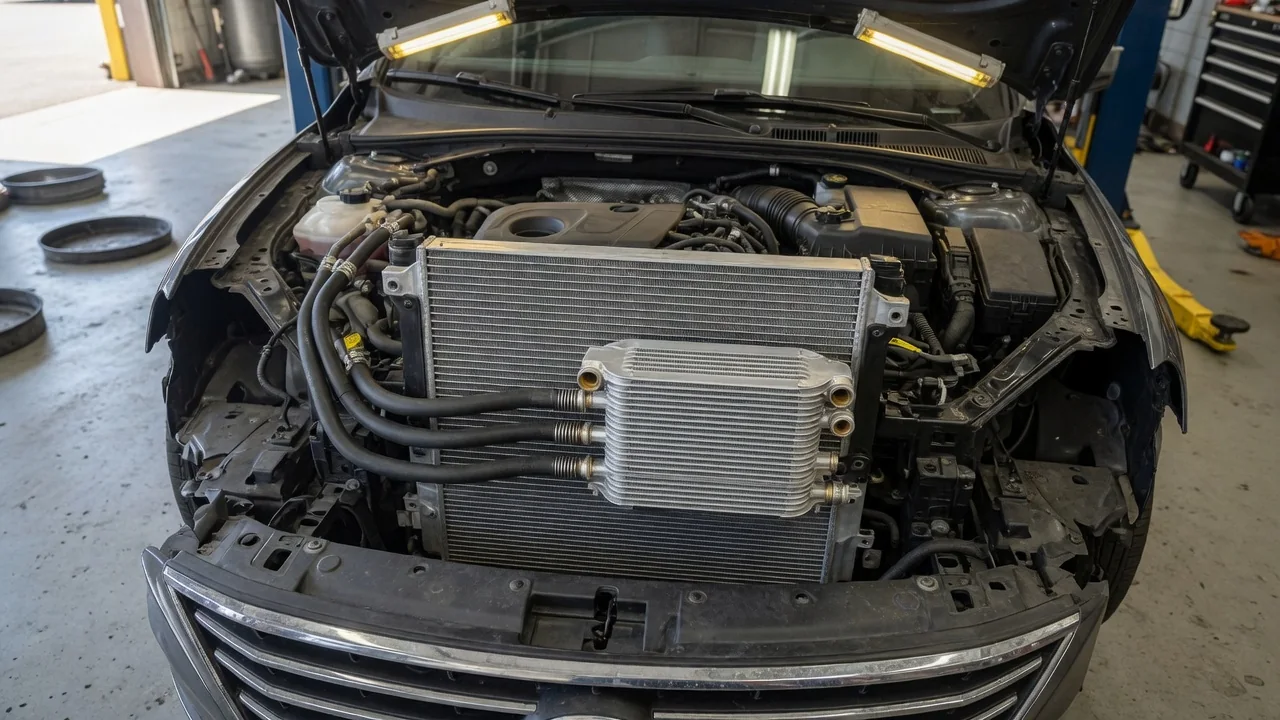
Many vehicles with automatic transmissions cool their transmission fluid with a heat exchanger built into the engine radiator. From the outside it looks like part of the radiator. Inside, it is a sealed passage that lets hot fluid give up heat to the engine coolant without the two fluids mixing. This guide explains how a transmission cooler uses the radiator, how the design keeps the fluids apart, what service involves, and where the arrangement reaches its limits.
Heat exchange: how transmission fluid sheds heat into the coolant
An automatic transmission produces heat as it works. Most of it comes from fluid shear and slip in the torque converter and from friction as clutches engage. To control that heat, the transmission sends fluid out through a cooler line to fittings on one of the radiator tanks. Inside that tank sits the cooler itself. It is typically a tube or a stack of flattened passages, often with internal fins to add surface area, and engine coolant surrounds it completely. The fluid travels through the cooler and returns to the transmission through a second line.
Heat moves from the hotter transmission fluid through the metal walls of the cooler into the coolant flowing around it. The coolant carries that heat through the radiator core, where air passing over the fins removes it. The system therefore works in two stages. A liquid-to-liquid exchanger sits inside the tank, and the radiator core is the liquid-to-air stage that finally releases the heat. The cooler is usually located in the outlet-side tank. Coolant there has already passed through the core and is at its coolest point within the radiator, which gives the largest available temperature difference.
Heat always flows from the warmer fluid to the cooler one, and the engine thermostat holds coolant temperature in a regulated range. An in-radiator cooler therefore tends to pull transmission fluid toward coolant temperature rather than far below it. In cold weather the same mechanism can work in reverse once the engine warms up, helping cold transmission fluid approach normal operating temperature. How strongly either effect shows up depends on the specific design and on operating conditions.
Fluid separation: keeping transmission fluid and coolant apart
The transmission fluid and the coolant share the same radiator tank, but they belong to two separate circuits. Only the walls of the cooler and the seals or joints where its fittings pass through the tank divide them. In normal operation, transmission fluid never enters the coolant passages, and coolant never enters the transmission. Depending on the design, the fittings may be threaded or quick-connect, and they are sealed with gaskets, O-rings, or brazed joints.
This separation matters because the two fluids are not compatible. Coolant is a mixture of water and glycol. In a transmission it can damage clutch friction materials and the bonding that holds them, promote corrosion, and change how the fluid lubricates and controls shifts. Even a small amount of coolant contamination is generally treated as serious for a transmission. Transmission fluid in the cooling system is usually less immediately harmful, but it can coat internal surfaces, reduce heat transfer, and leave the coolant in need of flushing.
An internal leak in the cooler has several common warning signs. The transmission fluid may look pink, milky, or frothy. An oily film or sludge may appear in the coolant reservoir, or either fluid level may drop without explanation. Which way the fluid moves depends on which circuit is at higher pressure at a given moment, and that varies with operating conditions, so contamination can appear in either system. Other failures can produce similar signs. A failed engine oil cooler or head gasket, for example, can also put oil into coolant. Confirm the source before replacing parts.
Service: inspection, flushing, and radiator replacement
Routine care is mostly inspection. Check the cooler lines and their fittings at the radiator for seepage, corrosion, kinks, or chafing against nearby parts. Keep the radiator fins free of debris so air can pass through. Service the coolant and the transmission fluid on the schedules the manufacturer specifies. Check the transmission fluid level using the vehicle's own procedure, because many transmissions must be checked at a particular temperature or with the engine running.
On most vehicles with this layout, the cooler is built into the radiator and is not serviced as a separate part. An internal leak is therefore usually repaired by replacing the radiator and then flushing both the cooling system and the transmission. A transmission that has run on contaminated fluid may need inspection or repair beyond a fluid change. The replacement radiator must have the correct cooler and fittings for the vehicle. During installation, transfer any adapters and use new seals where specified. Recheck the transmission fluid level afterward, since some fluid is lost when the lines are disconnected.
Transmission repair adds another consideration. When a transmission fails internally, debris can settle in the cooler and its lines and later be carried into a rebuilt or replacement unit. Many repair procedures call for flushing the cooler and lines and confirming adequate flow, while some manufacturers require replacing the cooler or radiator instead. A restricted cooler reduces cooling. It can also reduce the fluid returning to the transmission, which on many designs supplies part of its lubrication.
Practical implications and limits
Because the transmission cooler depends on the radiator, transmission temperature is tied to the condition of the whole cooling system. Towing, long climbs, and slow traffic in hot weather all increase heat from the engine and the transmission at the same time, and that heat must leave through the same radiator. A radiator clogged inside or out, a weak cooling fan, or low coolant can therefore look like a transmission temperature problem even when the transmission itself is sound.
The arrangement also has a built-in floor: an in-radiator cooler cannot bring transmission fluid much below coolant temperature. For this reason, auxiliary air-to-fluid coolers are often added for towing or severe service. They are usually plumbed in series with the radiator cooler, often on the return side. The coolant first moderates the fluid temperature, and the air-cooled unit then removes additional heat. Some installations also use a thermostatic bypass to prevent overcooling in cold weather. Follow the vehicle maker's guidance for any addition, because extra cooling capacity does not help in every climate.
Not every vehicle uses this layout. Some transmissions use a coolant-to-fluid heat exchanger mounted away from the radiator, a stand-alone air-cooled unit, or thermostatic valves that control when fluid reaches the cooler. Many manual transmissions have no cooler at all. The general principle stays the same: heat follows the temperature difference, and a sealed wall keeps the fluids apart. Line routing, fitting types, and service procedures differ, so confirm the actual layout in the vehicle's service information before diagnosing or modifying it.